My dad is a police officer and he mentioned the other day how he is part of a policemen's association, which to my understanding basically functioned as a union. I was wondering how, historically, these have survived while most unions have been dismantled over time for private sector workers.
edit: to be specific, in the United States, why have public sector unions not faced the same sort of elimination that private sector one's have? Have they grown, stayed the same? What is the history like comparing the two?
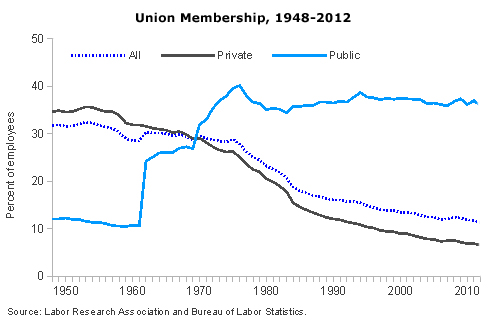
Public sector workers and private sector workers have unionized at different rates. As you can see from this chart, private sector unions have been in decline since the fifties while public sector unions rose dramatically in the sixties and seventies, and have leveled off since the eighties. Why private sector unions have declined is multifaceted, and a much bigger question than I can answer. Part of it is the growth of white collar jobs, which in the private sector are traditionally ununionized. Part of it is the growth of the low wage service sector, which is traditionally has had low rates of participation. Part of it is the decline of manufacturing in U.S., traditionally among the most heavily unionized sectors, as a lot of it moved overseas. Some of the manufacturing moved to so-called "Right-to-work states" (the increase in states with "right-to-work laws", which seriously hamper collective bargaining, was a major factor in its own right). So it's not just that unions have been dismantled in places where they already exist, so it's also that where people work shifted and the unions didn't necessarily follow. And a good deal of that shift was by employers specifically to avoid unions and other forms of higher wage labor, but some of it was things like the growth of the service sector. But at a basically level, the City of New York, or wherever, can't exactly shift it's police force to Mexico, or even to a state with different union laws. But further, it doesn't often look good for the government to play hardball too much with most public employees, especially not police and firemen. Even the recent law change in Wisconsin didn't affect policemen, firemen, or state troopers while it affected all other public sector workers.
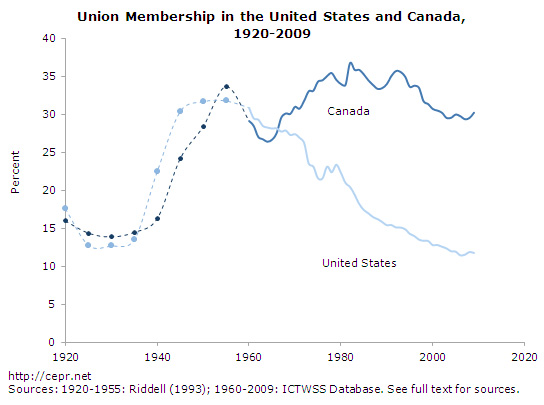
I should add that this was not a necessary part of the shifts in the global economy, but one that's rather particular to the U.S. In Canada and much of Europe, unionization rates remain close to their level in the seventies. Look at this map of the U.S. and Canada. That's a pretty superficial overview, but if you want more information, /r/AskSocialScience might also be able to give you a good answer [it might be contentious as people from different disciplines give different answers].
You should try to be a little bit more specific when asking. For example, it really matters which country you're from. I'm not an expert on the history of unions, but I can guarantee you that the scope of unions will change depending on whether you are from Sweden or the USA.
Now, perhaps this comment is a little bit too meta for a non-moderator to make, but I think it's important to clarify so that you can actually get good answers.
Wish I knew more about this but you may get a better answer over at r/socialism. Lots of union/labor history knowledge over there.