I've seen vikings blow up in popular culture for the last two decades, with viking rock, viking metal, viking board games, viking video games, and whatnot. But oddly enough I have had a hard time actually pin pointing what vikings actually are. What sources are there that vikings actually existed? Are they like an ethnicity, or is viking just some word people called them? What did they call themselves? What did they do and what are their accomplishments? What's so great about a bunch of guys that go on boats and steal stuff? Who led the vikings?
hi! as /u/Historyguy81 says, "vikings" were Norse raiders. But the word "viking" is also commonly used to refer to the Norse (aka Northmen) people in general, who lived during the "Viking Age" (10th-11th century).
If you have 4.5 hours to spare, /u/isndasnu posted links to a really interesting 3-part lecture series The Viking Mind by archaeologist Professor Neil Price. In part 1, he provides a quick rundown on the various sources of information about the Norse. Then he goes on to tie together the archaeological record with various written sources, including their own oral history (which was, unfortunately, not written down until approx 300 years after the events in question).
edit: fixed link
What sources are there that vikings actually existed?
Most sources concerning the vikings are either archeological - for example the Oseberg and Gokstad ships found in Norway, or the Valsgärde burial site - or literary. Among the literary sources are the sagas, epic tales written in Old Norse, the language of the vikings (and is to the modern Scandinavian languages what Latin is to Spanish, French and Italian). In modern Swedish, the word saga means fairy tale, which, to a degree, speaks for their historical accuracy, especially given that many of the classic sagas were written down in the 13th century.
Much of what we know about the vikings therefore comes from contemporary Christian and even Islamic sources; at the time Scandinavia had no literary tradition like the Christian and Islamic worlds did. The Annála Uladh, the Annals of Ulster, contain a vast amount of information on the vikings' activity in Ireland, just like the Anglo-Saxon Chronicle does in England. A problem with these sources is that since they were written by Christians, they portray the vikings in a very negative light. They weren't written as unbiased pieces of information.
In AD 793, the first viking raid took place at the monastery of Lindisfarne, an island off the northeastern English coast. This is what the Anglo-Saxon Chronicle says about it:
In this year fierce, foreboding omens came over the land of the Northumbrians, and the wretched people shook; there were excessive whirlwinds, lightning, and fiery dragons were seen flying in the sky. These signs were followed by great famine, and a little after those, that same year on 6th ides of January, the ravaging of wretched heathen people destroyed God's church at Lindisfarne.
Another source is the writings of one Ahmad ibn Fadlan, a 10th century Arab emissary to the king of the Volga Bulgars. On his journeys, he encountered a people he called the Rus, identified by scholars as Varyags or Varangians, mainly Swedish vikings who had travelled east across the Baltic sea, to present day Russia and Greece. He provides us with a first-hand account of a viking ship burial, where the vikings buried their chieftain aboard his ship along with his weapons and grave offerings. They then sacrificed animals to the gods, in addition to a slave girl, and subsequently torched the ship.
So yes, we definitely know that the vikings existed.
Are they like an ethnicity, or is viking just some word people called them? What did they call themselves?
The simplest answer is that they were Scandinavians of the late 700s to the mid-1000s, during what is known as the Viking Age, but that hardly does them justice. It is true that they originated in Scandinavia, in present day Denmark, Sweden and Norway, but by the end of the Viking Age, their voyages had taken them far beyond the North Sea and Baltic Sea. That said, the term viking does not describe an ethnicity. The word is related to the Old Norse víking, roughly meaning an expedition, and as /u/raspberry_pie said, it was commonly used as part of a verb, fara í víking, "to go on an expedition". A person who went víking was, in Old Norse, a víkingr (a term which originally referred to someone who lived in a vík, a bay or a cove).
What did they do and what are their accomplishments?
During the first decades of the Viking Age, the vikings were primarily raiders. The aforementioned raid on Lindisfarne was only the first of many raids in the British Isles; the villages and monasteries along the coasts and rivers of Britain, Ireland and Francia (present day France and Germany) were prime targets for raiders seeking wealth. When they weren't raiding, many vikings were farmers back home in Scandinavia. This all changed in AD 865, when the Great Heathen Army, allegedly led by the sons of Ragnar Loðbrok (meaning Hairy-Breeches), a legendary figure who, as of late, has become known to the public as the protagonist of the fantasy TV show Vikings, invaded England.
Unlike the raiders that had plagued Britain for 70 years, the Great Heathen Army, composed of Danes hungry for land, intended to conquer England for themselves. During this time, England was divided into four kingdoms; Northumbria, Mercia, East Anglia and Wessex. Over the following decade, they went on to conquer the English kingdoms. Only the emergence of King Alfred of Wessex, later Alfred the Great, in the 870s, put an end to the Great Heathen Army.
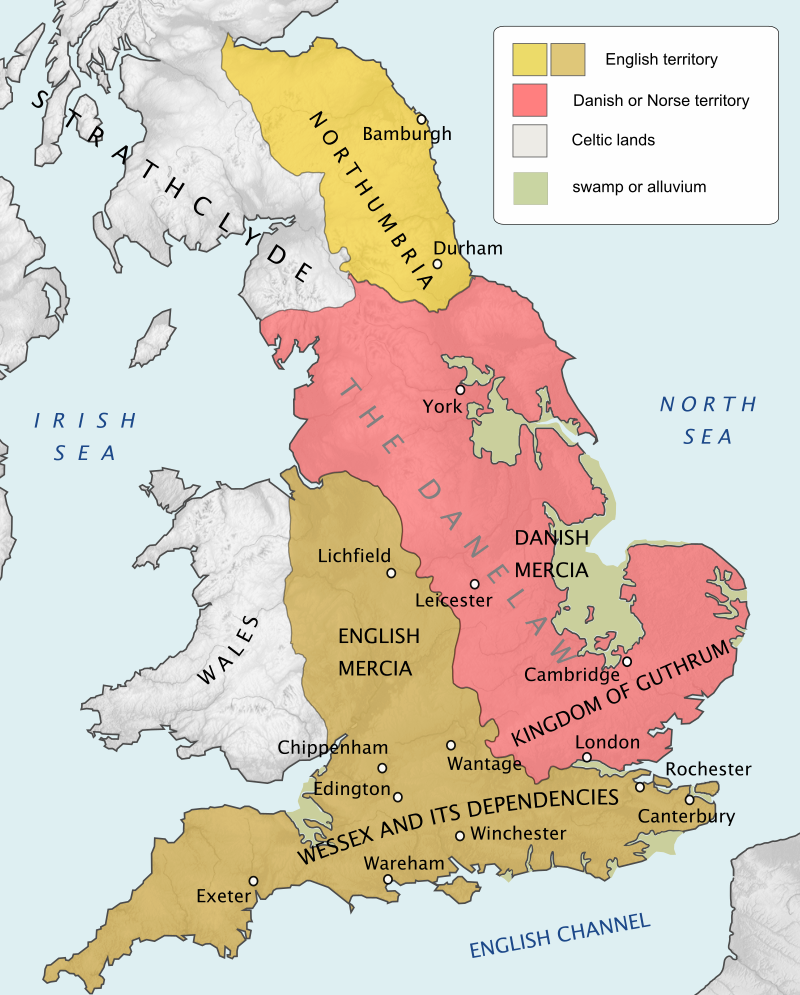
After a series of military victories, ending with the Battle of Edington in 878, Alfred signed a treaty with the vikings, now led by a man named Guthrum, declared that the Danes would withdraw from Wessex immediately and that Guthrum would be baptised. Some years later, a second treaty between Alfred and Guthrum further served to establish the Danelaw, the parts of present day England which would be ruled by the Danes. A map of the Danelaw can be found here. Alfred's children and grandchildren would later on, in the early-to-mid 900s, retake the lands under the Danelaw.
In 1015, King Cnut (or Canute) the Great of Denmark (and later Norway) invaded England, and by 1016 he had become king. His two sons would go on to inherit England, but both died within a decade of their father, leaving no heirs, and the crown instead returned to Edward the Confessor, a descendant of Alfred the Great.
In addition to England, both Danish and Norse vikings went on to settle parts of Ireland; Dublin was founded by viking settlers. There was also a considerable amount of Norse settlers in the northern parts of the British Isles, as shown in the 2001 TV documentary series Blood of the Vikings, where they found that Norwegian genetic heritage was highly common in the Shetlands and Orkneys, as well as Cumbria in northwestern England.
Norse vikings also settled Iceland in the late 9th century, and a century later, a Norse viking named Erik the Red colonised Greenland, and from there they went on to discover North America (with some expeditions led by Erik the Red's son, Leif Eriksson), but ultimately no successful attempts at settling North America were made.
Another notable viking settler is Rollo (Possibly Hrolfr in Old Norse). His background is disputed, but it is thought that he was either a Norseman or Dane who was exiled from his home after making an enemy of the king. What is known is that he frequently raided present day France during the late 800s and early 900s, besieging Paris multiple times. After an unsuccessful siege of Chartres in 911, he pledged allegiance to the King of France. In return for swearing to protect France against other vikings, the king made him ruler of Normandy.
Finally, we come to the Swedish vikings. Unlike their Norse and Danish kin, they were not quite as predisposed to raiding and conquering; instead they became merchants, trading with the people on the other side of the Baltic Sea (this is not to say that there were no Swedish raiders; we even know that there were Swedes who went west, to England, mainly based on runestones). According to Russian sources, the people of Novgorod invited a Swedish tribe known as the Rus (the East Slavic Primary Chronicle claims that the Rus were a separate people from the Swedes, but I can find no other sources supporting this claim) to come and rule them. Rurik, the leader of these vikings, founded the Rurik dynasty which, after conquering Kiev, became the rulers of Kievan Rus' and later the Grand Duchy of Moscow and ultimately founded the Tsardom of Russia.
In the east, the vikings were known as varangians or varyags. They even went as far east as the Byzantine Empire, where they would form the Varangian Guard, bodyguards to the Byzantine emperor. One member (and commander) of the Varangian Guard was Harald Hardrada, who had been exiled by Cnut the Great, having fought against Cnut alongside his half-brother, who had been the King of Norway before Cnut had taken the throne. When he returned to Norway, some years after the deaths of Cnut and his sons, he had amassed a considerable amount of wealth and managed to take the throne for himself.
Harald Hardrada spent some twenty years as King of Norway, laying claim to both the Danish and the English crowns in the process. Despite successful campaigns, he was unsuccessful in conquering Denmark. In 1066 he set out for England, landing near York. He defeated the English at the Battle of Fulford, but died five days later at the Battle of Stamford Bridge, and with him the Viking Age ended. Still, the legacy of the vikings would live on; barely three weeks after Hardrada's death at Stamford Bridge, Duke William of Normandy, a direct descendant of Rollo, defeated the English at the Battle of Hastings, to some degree fulfilling the dream of a viking-ruled England.