When I look at the SECC plates (pages for Rogan and Malden plates), I'm reminded of Mesoamerican artwork (on stone, jade, amate, or other mediums). Even the Emmons mask looks like the Olmec jade mask to me.
However, I'm not formally trained in the history of either region, so I don't know if this has been discussed before. Has anyone written anything on this, either arguing for or against a connection between the two (or just discussing it)? Or even an art-focused piece just comparing the aesthetics of the two?
To me, this seems like the most tenable link between the Mississippians and the Mesoamericans, so I'm wondering if it has been explored before.
EDIT: I forgot, also shell engravings like shell gorgets remind me of Mesoamerican art.
The only, and I mean only, established link between the Mississippian and Mesoamerican culture areas is a single obsidian blade, the material of which have been proven to come from one of the largest Mesoamerican sources of that stone. Beyond that, there are no reputably acknowledged connections. The presence of Mesoamerican obsidian in the Southeast does not even assure that there was a direct connection between the regions; it could easily (and more probably) passed through several intermediary traders.
That said, some past scholars have seen similarities like you are seeing. I'm not aware of any research that links the copper effigies in the Southeast to Mesoamerica, but I do know that the long-nosed masks found North of the Rio Grande have had posited to have links to the pochteca of Mesoamerica. The problem is that all we have is supposition and no actual evidence of this link. The masks, though widespread, aren't even necessarily found in contexts associated with trade.
We do have firmer links between Mesoamerica and cultures in the Southwest, where we have icongraphy much more representative of Mesoamerican styles and, more critically, items like macaw feathers and rubber balls which could only have come from down South. We also have other supporting evidence such as the spread of maize which supports the Southwest and Mesoamerica being a connected via West Mexico. If there was any connection between the Mississippian and Mesoamerican groups, the most likely route would have been through the Southwest. The material evidence just isn't there for any definite link though.
If you've got a decent university library near you, you could see if they have a copy (or ILL a copy) of Gulf Coast Archaeology: The Southeastern United States and Mexico. It doesn't present any firm evidence of a connection -- a big chunk of the chapters are really just focused on local archaeology -- but it is the only work I know of that tries to take a scholarly approach to the question of a connection.
I'd give up on the Emmons-Olmec connection though. Even if we forgive the distance, there's almost 2000 years between the end of the Olmecs and the mask.
I believe iconography from the Mississippian Ideological Interaction Sphere looks like Mesoamerican art simply because Mesoamerican is more familiar than most precontact art of the Eastern Woodlands. That said, I've been taught that when maize and tobacco came north from Mesoamerica, a cycle of ceremonies and stories traveled with them—not through direct contact but cultural diffusion. Most maize-growing tribes in the US have cultural overlaps, and Mississippian cultures are defined by maize-based agriculture.
You might find the 2011 book Visualizing the Sacred: Cosmic Visions, Regionalism, and the Art of the Mississippian World interesting. It's essays by archaeologists trying to interpret MIIS iconography. I take it all with a grain of salt, but Visualizing the Sacred is a vast improvement over the 2009 Ancient Objects and Sacred Realms: Interpretations of Mississippian Iconography by many of the same writers/editors.
Now archaeologists are comparing the iconography of rock art and cave art in the Eastern United States to the portable arts of ceramics, copper, shell engraving, etc. The Gottschall Rockshelter located in the southwest Wisconsin Driftless Area is considered by many to be something of a Rosetta Stone, connecting the precolumbian Mississippian iconography to historical Hochunk oral history connected to the god Red Horn.
Back in the late 1930s and 1940s, when the extent Southeastern Ceremonial Complex was just starting to be grasped archaeologically, the hypothesis that it represented an influx of Mesoamerican influences that reshaped the political, religious, and artistic landscape of the region. This hypothesis, often called the Southern (Death) Cult, was almost immediately challenged by one that proposed that interpreted this complex as a largely indigenous development, the Southeastern Ceremonial Complex (SECC). SECC has won out over the Southern Cult interpretation for the reasons /u/400-Rabbits and /u/Ahalenia have mentioned.
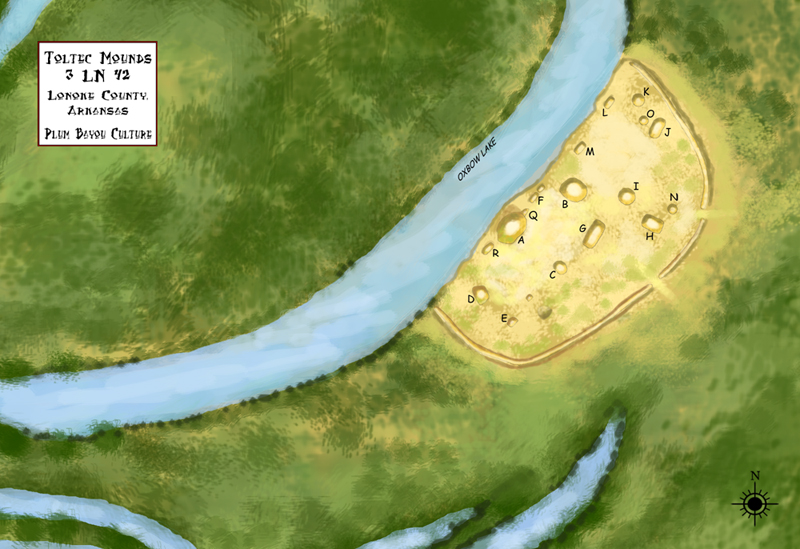
Looking into the archaeological record, we can see that the elements of SECC's aesthetics have local antecedents. The Emmons Mask is preceded by the Seip Mask, while the copper plates trace their lineage through items like this copper falcon (note the similar eye motif). The flat-topped earthen pyramids built by the Mississippians likewise have ties to structures like the confusingly named Toltec Mounds in Arkansas, which seems to be the immediate predecessor to Mississippian architectural trends, and the Bird Mound at Poverty Point in Louisiana, which predates the Olmec's Great Pyramid of La Venta by a couple centuries.
When looking into the historical and ethnographic record, the descendants of the SECC's components tend to have different social roles and interpretations than their Mesoamerican analogues. For example, while human sacrifice did play a part in some Mississippian cultures, it did so in a different context than Mesoamerican sacrifices. Sacrifices were not made to sustain or honor the gods, but mainly to provide deceased leaders with an appropriate retinue in the next life (at least if the Natchez sacrifice system is any indication). Potentially related beliefs concerning the dead requiring traveling companions in the afterlife also informed the old Osage practice of seeking out enemies to kill so that recently departed and particularly restless loved ones might have their journey in the afterlife eased. The ancestors of the Osage and other Dhegihan-speaking peoples, it should be noted, are the most likely candidates for the founders of Cahokia, where much of the SECC originated.
The fact that the early epicenter of the SECC is at Cahokia, far into the interior of the continent, is also a point against the Southern Cult and its alleged Mesoamerican connections. Had this influence come up from the Gulf, we would expect to see it earliest on the coast and radiate northwards. But in fact, it radiates outward from Cahokia, mainly to the south and east. As /u/ahalenia mentioned, this corresponds with the spread of maize-based agriculture, which also became a staple crop in the Cahokia-region before other areas of that would eventually become associated with the SECC. Maize had actually shown up in the region a couple hundred years earlier, but was only a novelty. Whether it took a direct route up the eastern coast of Mexico as tobacco appears to have done, or whether it detoured through the Southwest (where it could be found long before it reaches the Eastern Woodlands) is uncertain. Also unresolved is whether Cahokia's maize developed from those earlier introductions or was the result of a second introduction.
If you'd like to know more, you might want to check out Southeastern Ceremonial Complex: Chronology, Content, Contest.