I had always been told that Von Kluck was to blame for the German defeat on the outskirts of Paris as it was a brash, selfish push by Von Kluck to gain glory for himself to be the one to enter Paris and/or defeat the French Army there, but I recently read an article which states that he and a good deal of officers after the war believe that it was Bulow who was at fault for not taking the initiative and being too conservative. This somewhat makes sense as the modified Schlieffen plan would require great aggression, and that if Bulow had acted aggresive as Von Kluck he would likely not have been encircled. I don't want to play historical what-if, but whom do you consider more responsible for the defeat and why?
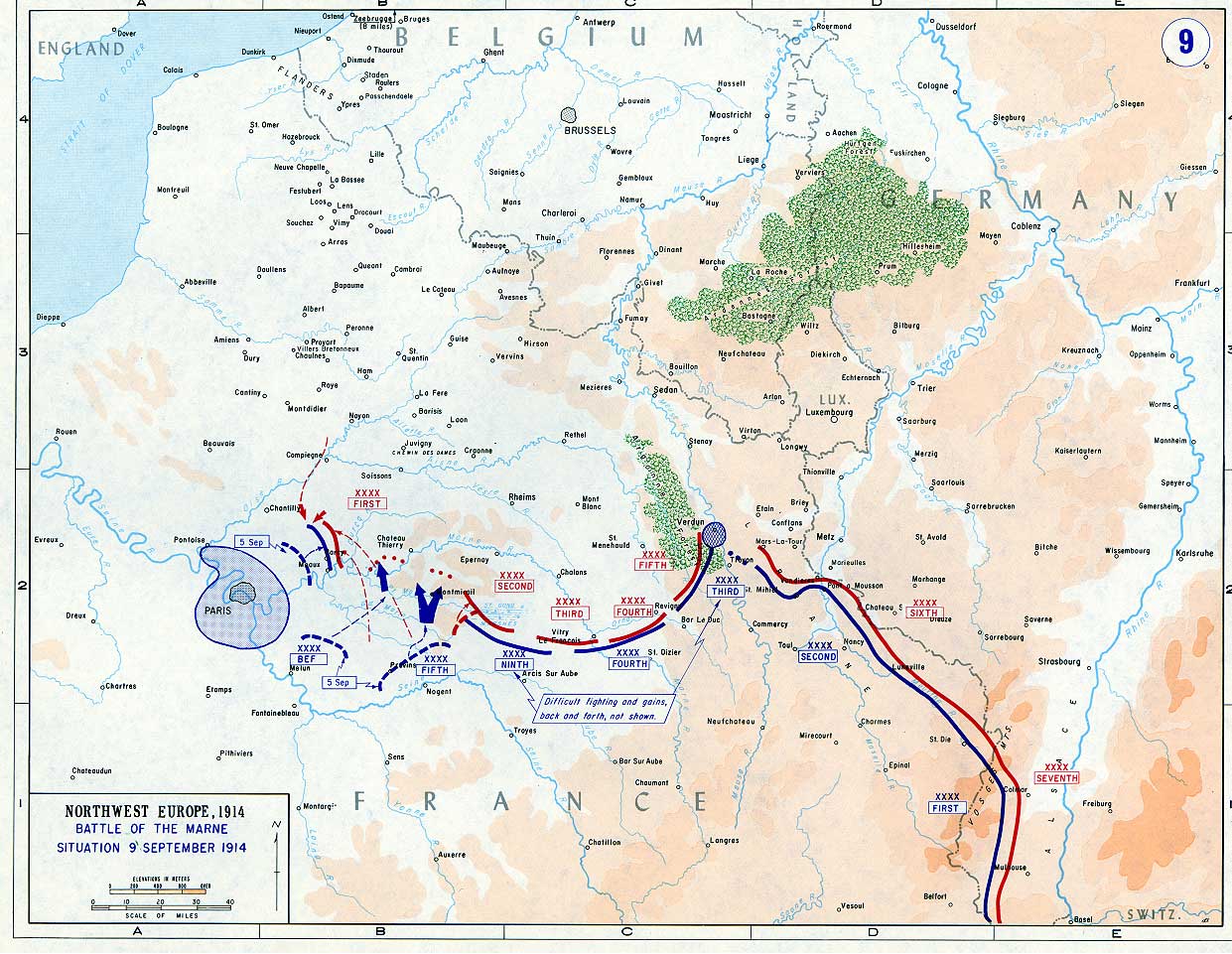
Holger Herwig, in his book The Marne, 1914 would disagree with the idea that Kluck was responsible for the defeat on the Marne, and I agree with him. First, and most simply, look at a map (like this one. Youll notice that Kluck, whose way out on the left, had to completely reorient his forces to meet the attack of Gallieni, who was rushing troops out of Paris. So, while Kluck reorientated to keep his army from being flanked, Bulow continued pushing south, hoping to destroy French 5th Army. Thus, we have the legendary gap, where Kluck zigged and Bulow zagged. Yet, had Kluck continued to keep in contact with Bulow, he would have served the French a great victory anyway, either by withdrawing in the face of Gallieni's attack, or stretching his army so thin that Gallieni and the BEF would have had no problem piercing it anyway.
So I think saying that Kluck's attack was merely glory-seeking is a bit harsh. It was unlikely that Paris would have fallen anyway, given it was never conquered in 1871, and I think Kluck would have had no illusions that he was going to march through Paris while Bulow continued to slog it out.
But I would also not put ultimate blame on Bulow, who forced the retreat to the Asine. Dont get me wrong, he was very timid and extremely cautious, and was terrified of the BEF which had proven itself the most sluggish element of the Entente forces. But Bulow was not in command, and the ultimate decision to abandon the Schlieffen plan was not his to make. I, and Herwig, would place the blame fully on the shoulders of Helmuth von Moltke the Younger, the Chief of Staff of the German Army, and the overall commander of German forces in the field.
Moltke was everything his uncle was not, unsure, timid, and very cautious. He also believed that in the new style of war, commanders were to lead from well behind the front line, plotting out the course of the war from a map and a comfortable leather chair. He was to utilize telegraph and radio communications to keep apprised of every armies situation, and keep every force moving together towards one unified goal. Thus, on the eve of the Marne, Moltke set up a new command HQ in occupied Luxembourg, where he thought he would best control the final battle for France.
But Moltke was indecisive, and unwilling to issue orders to his subordinate commanders (some of whom were German royalty). Moltke was to act in a role later defined as an "Army Group Commander", that is, his job was to keep the multiple armies all on the same track. He was supposed to be the guy with a clear head, who, armed with up-to-date information, would say "You go here, you stay put, you push now, you pull back". But this never happened. As early as mid-August, Moltke had repeated allowed his army commanders to fight battles as they pleased. Against his better judgement (and repeated "requests" to stay put), he allowed the Armies in the south to push forward, eventually letting them smash themselves against the fortified line between Verdun and Nancy, and the Swiss border. That cost precious lives, stretched those armies out, committed valuable reserves to a hopeless cause, and it pushed the French onto a well developed rail line which allowed them to drain the southern front of troops. It also set the precedent that Moltke would allow his subordinates to do as they thought proper, not as the commander wanted.
On the Marne, Moltke was placed into a similar situation. While Kluck was technically subordinate to Bulow, it was never in a formal manner. That meant that Kluck was really only answerable to Moltke and so was Bulow. Moltke had a problem, he had two commanders who were going different directions, and arguing about which way both should go. Moltke had to make a decision, but by this point his communications network had been ravaged by one of the greatest acts of sabotage Ive ever read about.
Here-in lies said act, if you are uninterested, skip the quoted section. Anyway, as the German Army advanced through Belgium they erected telegraph lines to maintain communication with the rear, including Moltke. Telegraph lines were strung from a pole, much resembling a telephone pole, and stretched for miles across occupied Belgium. The occupied Belgians, angry at being occupied, would go out at night, climb the poles, and clip the telegraph wires. That was obviously annoying, and so the Germans changed how they ran their lines. Rather than string them up in the open, the Germans just placed the lines on the ground, and ran them through fields, farms, woods, everywhere they needed to pass through. This new process succeeded in preventing the old form of sabotage, but the lines up to another. While the humans largely stopped cutting the lines, patriotic and loyal Belgian field mice went to work on the wires, proudly giving their lives to defend their homeland. All joking aside, much like today, animals loved to chew on telegraph wires, and mice were responsible for damaging huge sections of the wires.
Between the clippers and the mice, 1st and 2nd Armies were largely put out of communication with Moltke. The only way he could communicate was by radio, but radios were still new and rare, and only one army had a set in the North: 2nd Army. And the only message that reliably got through from Bulow was the repeated request to retreat, rather than accurate status reports of the condition of both 1st and 2nd Armies. Moltke knew that he needed an accurate picture of events, and that somebody needed to go out and settle this major crisis. But Moltke couldnt go, he had a war to fight!
So he sent a subordinate, Lt. Colonel Hentsch, which he invested with his full authority. Hentsch was to ascertain the situation of both Armies and settle matters. Rather than make a personal decision, Moltke left the campaign in the hands of a Lt. Colonel. Hentsch isnt a bad guy, or a villian in our story, because he was placed in an impossible situation. Upon arriving at 2nd Armies HQ, he found Bulow on the verge of a breakdown, fretting about the gap and the tremendous pressure all along his front. He was also sure that Kluck was losing, and was only hours away from complete collapse. Without meeting with Kluck, Hentsch authorized Bulow to begin withdrawing back to the Aisne river. By completely withdrawing in that manner, Hentsch forced Kluck to withdraw as well, rather than meet destruction from three sides. This ended the great Battle of the Marne, and the German's advance into France.
And I would place the blame completely on the shoulders of Moltke. He wanted to command the armies from afar, as some kind of angry god who points on the map and destroys armies. He made a dozen mistakes, including the ones outlined above, which sapped his authority, and promoted confusion and indecisiveness amongst his subordinates. And, instead of appointing intermediary commanders, group commanders between the Army and the Chief of Staff, Moltke tried to manage eight armies spreading from the Channel to Switzerland, and in the Prussian heartland in the east. I fully believe, had Moltke been more like his uncle, things would have gone better for the Germans. Even if he had just set up some kind of command hierarchy, which clearly defined who was in command of whom, the confusion of September could have been avoided. Had Moltke been more like Joffre, who was chauffeured by a high-speed racecar driver to and from Army HQs, he could have solved Bulow and Kluck's argument personally. But Moltke was not those men, he was just Moltke. And I feel that that man was completely mismatched for the task set in front of him.