The border in the middle of Germany was a highly militarized no-man's-land, including minefields and snipers in the East German towers that were required to shoot to kill (there were numerous trials for officers and shooters alike after the reunification), so the trek through the border was very dangerous, and you'd have to walk a while. There also were fewer crossing points that you could sneak through.
The Berlin Wall cut right through the city of Berlin along the Soviet sector's border. Windows were mortared shut, as were subway tunnels. Yet, many West and East Berlin folk had to work on the other side (and both sides needed to get their spies into each other's hair as well). That made the Berlin Wall more porous to start with. And being in the middle of a city, having moves out and snipers and attack dogs would lead to disaster sooner rather than later.
And since the border was in the city, an East German didn't have to walk far to be safe.
A German TV station made a historical movie called 'Der Tunnel', dramatizing a, well, tunnel used for fleeing the GDR.
Edit: Autocorrect picked the wrong word.
You are just assuming that it was easier to escape south or north. It was not.
It was the Cold War, both sides were paranoid about an attack from the other side. As a consequence the borders all along the iron curtain were heavily guarded. Especially the Soviet Union and the satellite states were very concerned about a Western invasion. They put a lot of effort into guarding any border with the west. If it had been easy for people from the East bloc to cross that border, it also would have been easy for a Western spy to cross that border.
Whereever you tried to cross, you risked death or prison.
Some tried to escape via the Baltic Sea, swimming from East Germany to Denmark. Many drowned or were caught by the East German Coast Guard. The Danish on the southern most islands were almost used to finding drowned people on their beaches.
Another route was swimming across the Danube from Romania into Yugoslavia - equally as dangerous as trying to swim across the Baltic Sea.
Many tried to cross from Bulgaria into Greece over the mountains, but this border was also heavily guarded and just as dangerous. There were mines and the guards were ordered to shoot first and ask questions later.
http://herbst89.info/index.php/inhalte-bulgarien/280-tot-oder-lebendig
A few escaped with small boats on the Black Sea from Bulgaria to Turkey.
The most drastic "going somewhere south" is probably the story of Kerstin Beck, an East German woman who at 16 looked at a map and decided that the border between Afghanistan and Pakistan had the most holes. She then worked towards becoming an exchange student in Afghanistan, studying Dari and Pashto. At the end of her exchange year she then fled across the mountains with the help of a few local warloards.
She wrote a book about this called "Verschleierte Flucht" (Veiled Flight - from the GDR to freedom via Afghanistan).
where I suppose it would be much easier to escape?
Which was not a case, as pointed out by /u/phmayo. And it wasn't the border itself (and not just East Germany, but other states bordering the Western Bloc), the cca 20 km strip along the border was filled with foot patrols, road checks, train checks and snitches, people were routinely checked and simple presence near the border without a good reason could make you an object of suspicion and possible persecution. If you had a backpack with some clothes and a few prized possessions and the check with secret police from the place of your residence (remember, totalitarian regime) confirmed some other sign of possible emigration attempt, you were charged with "attempt for illegal leave of the country" and even without any signs, you could get transported back inland and lose the job, get fired from school, get under closer scrutiny.
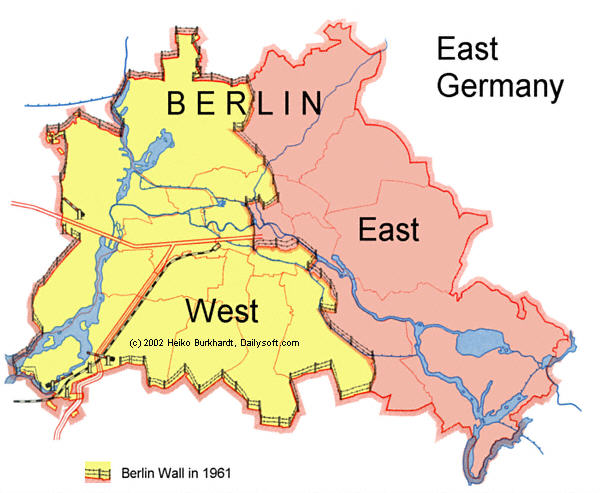
There is a difference between the iron curtain and the Berlin wall, the Berlin wall only encircled west-Berlin an was not connected to the iron curtain. West-Berlin was like a little island of western territory within the eastern part of Germany. While the Berlin-wall was heavily defended, the length of the iron curtain was defended less strictly. Here is a map showing the iron curtain and the berlin wall, the iron curtain is the long black line and the berlin wall is the small dot where Berlin is.
EDIT: I found a illustration of the Berlin wall, as you see it encircles west-Berlin.
To add to /u/phmayo 's answer, here's a document from the US Army history website showing how the rest of the border was.
The DDR had towers, trenches, mines, detection devices, guard dogs, barbed wire, patrols, aerial patrols by Chech and Soviet Air Forces
All that in a layered system.
Denmark had a lightower boat north of the east german coast, and they regularly recived svimmers and boats with east german refugees. I saw a documentary about it, and one of the keepers told the documentary crew, that basically every time there was a havy fog or bad weather someone would make an attempt to reach the boat.
here is an article about three east germans rowing to denmark in a rubber boat in 1977. but it is in danish, but you can translate it with googletranslate. https://www.sa.dk/content/dk/undervisning_og_temaer/webudstillinger/nyt_i_arkivet/pa_flugt_fra_ddr_under_den_kolde_krig
While I can't answer about what happened for the majority of the time the wall was up, it did become easier to flee North/South in the months before the wall came down.
In May of 1989 Hungary (one of the more liberal Warsaw Pact Members) took down a 150 mile stretch of barbed-wire fencing along the border with Austria. As the first real break in the "Iron Curtain", this caused many young East Germans to flee first to Hungary, and then over to Austria, and finally to West Germany.
This flight was strengthened in June of 1989 when Gorbachev, during a visit to France, effectively ended the Brezhnev Doctrine, and said Poland and Hungary could control their own political futures. Without direct Soviet control of the Satellite states, and with Solidarity (the first Polish non-communist government) being elected in August of 1989, many East German (and other Communist state citizens) took advantage of the loosened repression to flee to the west.
Then of course the Berlin Wall finally did fall in November, and tens of thousands more East Germans flooded through to the West within just a few hours of the fall.
Source: Rise to Globalism: American Foreign Policy since 1938.
hi! you'll find some additional info in this thread
Something I've never really understood about the berlin wall...
Can I add to this question? Why not just rent a boat and take it to West Germany?
Were crossings from West to East at all common? Did the west try to prevent defections nearly to the point that the East did?