I recently found in wikipedia some "coats of arms"/emblems that seemed to be precolumbian. I didn't know they were a thing.
This one is (according to wikipedia) the coat of arms of the city of Tula de Allende, a city that was once inhabited by the Toltec civilization.
These are (once again according to wikipedia) the emblems of the Triple Alliance.
There are more in the "preceded by" section of the chart.
A lot of them seem to represent diferent crops.
First of all: were they actually things or were they just made-up?
Are they used by royal houses and/or clans in an european and japanese style?
Both of these are mexican, did these things exist in North or South America too?
What else can you tell me about them?
I wouldn't go so far as calling these "coats of arms." Instead, they are more accurately called toponyms. Since the Aztecs' documents were essentially pictographic, however, it's easy to see the confusion. What would be read as symbols or words seems to be just an image to us. These particular emblems can be seen in the codex Osuna, written about 30 years after the Spanish arrived.
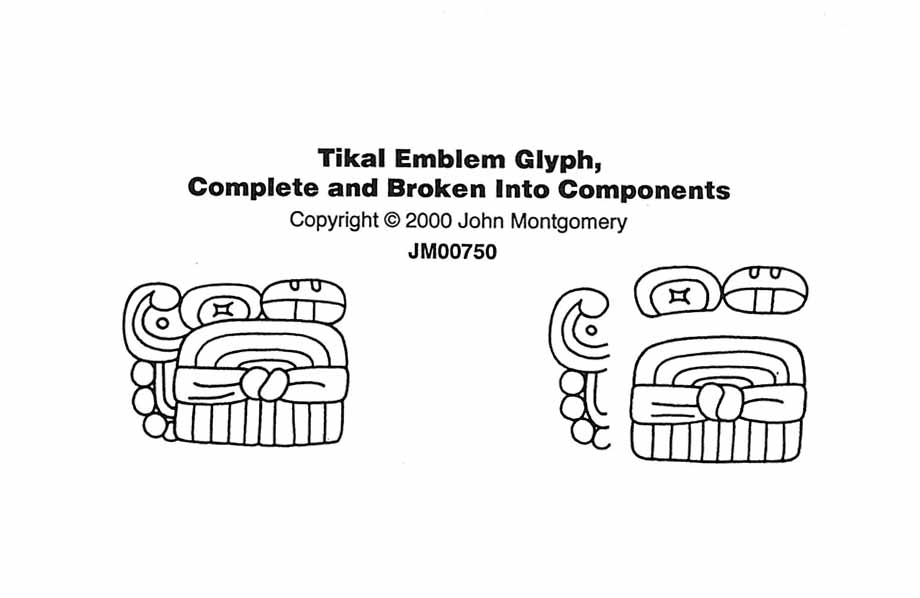
The tradition for such toponyms in Mesoamerica is strong. Some of the earliest writing in the region contains toponyms (fig 5.27), as can be seen in Zapotec sites in Oaxaca. Though very little has been translated, toponyms seem to feature prominently in writing at Teotihuacan. The Mayan writing system, which we can mostly read, makes heavy use of toponyms, or, as they are often called in epigraphic studies, "emblem glyphs." These were used to indicate where a person was from. Often, they represented a single city, as with Tikal's. This set of glyphs would be placed after a ruler's name.The large hair-knot in the middle is the emblem, and the rest reads "k'uhul ajaw," meaning "divine lord [of Tikal]." Sometimes, they were more of a dynastic title than an actual toponym. Calakmul's rulers stlyed themselves as the "Snake Lords" and used the snake head glyph as their emblem.