I was reading about Fabian strategy and it mentioned something about interior lines and I did a quick google search which yielded a wiki article with no pictures, and the image search produced several diagrams that either I don't get, or don't explain what the symbols within the diagram mean. Is there a simplistic way I can understand what each movement or formation is made for? What sort of advantage is it supposed to bring to those who execute this military maneuver?
So, it's come to war. As you can see on this map, when Oklahoma and Kansas go to war against Texas, New Mexico, Colorado, and Nebraska, the OK/KA alliance seems hosed. One advantage they do have is interior lines. This means that relative to their opponents, they don't have as far to move things. For the TX/NM/CO/NE alliance to get some Nebraskan corn down to some Texan cows, they have to go all the way around the OK/KA alliance's territory. Now, when KA drops out of the OK/KA alliance, OK seems even more hosed than they were before. However, OK by itself has even shorter interior lines, which is a good thing.
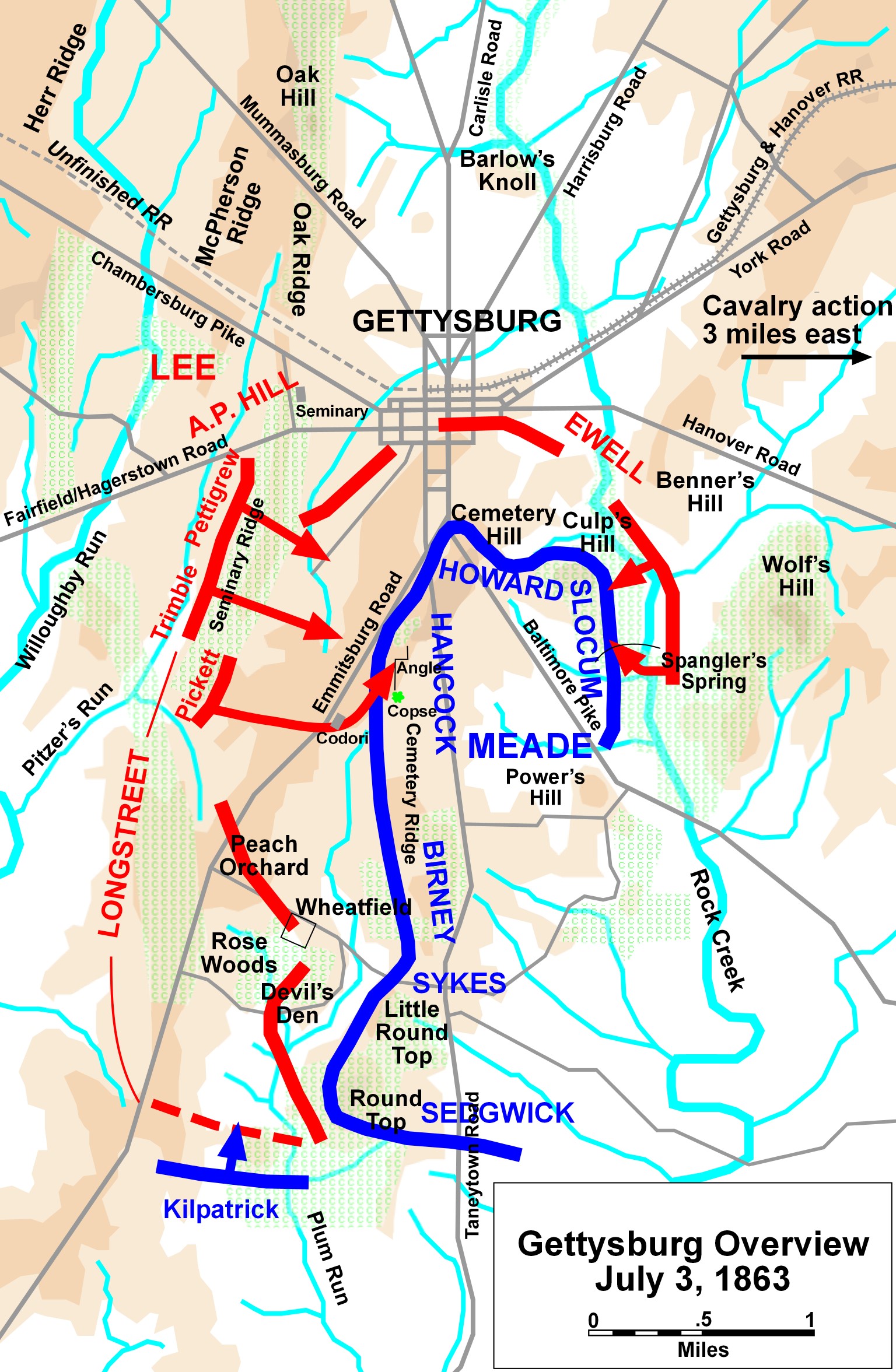
Basically, interior lines means that you have a (relatively) smaller area to defend and can move your assets around to meet threats (relatively) more easily. Germany in 1945 featured an advantage of interior lines--the Allies couldn't move items easily between the British Isles and Russia, for example. Usually having interior lines means you're being attacked on multiple fronts. This could also be applied to a battlefield. The Union had interior lines at Gettysburg, and they used them to shift troops to the most threatened sector during that three day battle.
Does that make sense? As always, followup questions from OP and others are encouraged.
Note: There is no war between the OK/KA alliance and the TX/NM/CO/NE alliance--at least until football season begins.
My answer would have to be based on the interpretation of Interior Lines made by Clausewitz.
I can't explain each formation, as that is not my expertise, but the concept of Interior Lines is quite simple.
Consider two groups, A and B. Group A is gathered in a circle, and group B is surrounding A.
For group A, moving from any point of the group to another point is quite short, as they can move through their own center through an 'Interior Line'.
On the other hand, group B would have a significantly harder time moving to the opposite point of their group, as it would require going all the way around in a circle.
This simple geometric fact has consequences in formation design in ancient pitched battles, as well as the deployment of entire fronts in the later centuries.
Source: Clausewitz, On War