This is a very, very broad area to talk about. So you'll have to forgive me if I'm being a little vague. I'll do my best to answer, though, primarily using one of my books on American history (specifically pre-Civil War), a journal article, and two dissertations I've read on the subject.
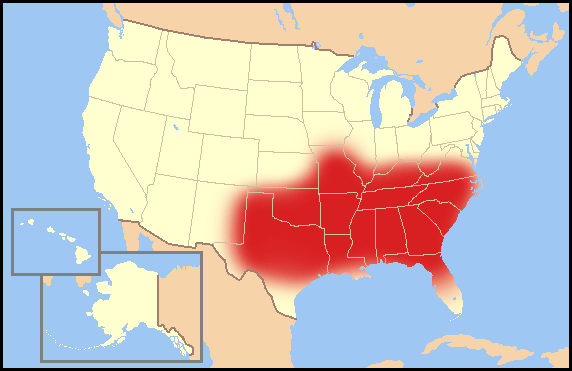
The Bible Belt, for those who are unaware or unclear on it, is a region in the United States South, which is often referenced but not clarified specifically with boundaries. The common consensus is that the phrase was coined in 1920 by H.L. Mencken, "...to designate those parts of the country in which the literal accuracy of the Bible is credited and clergymen who preach it have public influence." The name stuck, primarily because it seemed fairly accurate to all who saw it. Mencken never gave a specific location, though: Stephen W. Tweedie argues in "Viewing the Bible Belt" what he believes the boundaries to be, and they roughly conform to this map.
How it came to be is still a question in and of itself, now that we've attempted to define this very vague region (many journal articles don't even define it, despite talking about features it contains: that's how vague it really is). Generally, it has its roots to some degree in the lifestyle held by Southerners even before the Civil War. The rural lifestyle, greater focus on honor, and different culture in the South when compared to the North helped create an area ripe for religious influence and living. Talking about the growth of evangelicalism in the United States in the early 1800s, David Henkin notes in Becoming America that:
The spread of religious enthusiasm in rural America was not confined to a single denomination. Baptist communities, which were less centrally organized than their Methodist counterparts, flourished in many of the same rural areas..."However they were organized or defined, American evangelical communities tended to emphasize broad themes of conversion and rebirth rather than finer points of theological doctrine. The spread of this kind of evangelical Christianity initiated a pattern in American religious life that remains visible today. The part of the country frequently referred to as the Bible Belt is the area that was influenced most powerfully by evangelical campaigns in the first quarter of the nineteenth century. This development was not the result of the cultural isolation of southern communities, but rather the opposite: Evangelicals in the South and the trans-Appalachian West were connected to growing networks of religious preaching and communication.
This growing religious movement would translate into a larger and larger religious fervor in the South which would eventually come to be associated with the area we know as the Bible Belt. When the onslaughts of modernity hit around the early 1900s, the churches of the South were invigorated once again. Joseph Locke, in "Making the Bible Belt", notes that:
Although evangelical Texans protested the onslaughts of modernity, and declared in a great chorus voice their weakness and vulnerability, their confrontations with the modern world only bolstered their political and cultural power. To put it another way, they prospered because of, and not in spite of, their confrontation with the modern world.
To drive this point home, the feeling of a fight against the "corrupted" modern society of the time was clear. People now felt that religion and "God's Kingdom" as a whole was under attack, beleaguered, and only increased participation in the Church and in religious activities could revitalize morality in the world. Clergymen also took the opportunity to promote themselves as the fighters against immorality and corruption: as society's saviors. Things like liquor, now viewed as immoral, were fought as well by the Church. "'In fighting the liquor traffic,' J. B. Cranfill wrote in 1916, 'I have learned what it means to combat the most gigantic and soul-less corrupting agency this land has ever known.'"
As many have documented, there is a "rally-round-the-flag" effect. The feeling that Southern religion was under attack, as I've noted already, played a big part in bringing about the Bible Belt and increasing focus on it. New clerical champions, so to speak, paved the way for a revival of religion in the despairing religious communities of the late 19th century, which had effectively lost their way. They picked up on the paths blazed by the circuit riders through rural communities (not literally, metaphorically they picked up on them) and reinspired the populace to follow. This was easier in the less-industrial (and thus less-modernized, by many accounts) South, which had always placed a greater focus on religion anyways. Again, an example of this feeling of monumental struggle:
"A crisis in the history of our country is certainly upon us," B.H. Carroll freely admitted, but he asked "How shall we meet it? The opportunity of a lifetime is before us. How shall we use it?"
Clericalism helped "save" the South from the corruption of the modern world, and that helped Southerners take more active positions in the clergy. The spiritual pallor was realized and fought, rather than succumbed to, when the Church realized it had a crop of young, new leadership who could, in fiery passion, whip up the populace. The cause of fighting for Prohibition would help: the long-standing belief of honor in self-restraint that had been prominent in Southern society (think anti-masturbatory campaigns in pre-Civil War America, the teetotallers and prohibitionists, etc.) would serve to once more be inflamed and inspired through the giving of purpose, a purpose against liquor that would help move the entire religious movement as well. Baptist preacher Sumner Calloway effectively argued that "...if the church 'clothe[d] herself with zeal,' it would be saved".
Eventually, the religious zeal would be self-perpetuating, as academics even in the South would write of the religious fervor of their region. It built on itself, and it inserted itself into many, many aspects of Southern society. The South began to be viewed as fundamentalist, especially due to lower education rates, as literacy was poorer in the South around the early 1900s by far.
In 1914, Walter A. Dyer, writing in the World’s Work, claimed that the 1910 census “showed that in North Carolina alone there were 122,189 grown white people who could neither read nor write.
As mentioned in "Building the Bible Belt" by Mary Matthews:
Almost as soon as the journalistic accounts of the fundamentalists turned from unbiased to negative, the reporters, columnists, and editors equated the South with fundamentalism. The success of the anti-evolution campaign in the South only served to reinforce this already extant belief, and the Scopes Trial in 1925 was merely another example to non-Southem observers that the region was a natural home for fundamentalism. The location of fundamentalism in the South allowed proponents of modernism to contain a religious threat within a single area o f the country, and it allowed them to explain how such a movement could have arisen. It also led opponents of fundamentalism to believe, wrongly, that the movement was a passing phase which education could ameliorate.
This is a condensed version of the growth of fundamentalism, and the belief that the South was fundamentalist, that led to the term "Bible Belt". The roots can be traced back very far, as with most things, but this is effectively a crash course in the subject that I hope can help you understand how the early focus on religion which persisted left the South ripe for religious awakening. When, in the North, there was a fear that morality was being foregone, it didn't turn to the Church nearly as much because the Church never figured as prominently into Northern life. The South had always been more religious, circuit riders and prominent use of religious spread among rural communities by evangelicals, and the turning to the Church when there was fear of moral corruption in the South made it perfect for the "Bible Belt" name, and it lived up to it to a fairly obvious degree by most accounts.
Sources:
Henkin, David M. Becoming America. New York: McGraw-Hill Education, 2014. Print.
Locke, J. (2012). Making the bible belt: Preachers, prohibition, and the politicization of southern religion, 1877-1918. (Order No. 3534223, Rice University).
Mathews, M. E. S. (2002). Building the bible belt: How america came to view the south as fundamentalist. (Order No. 3056843, University of Virginia).
Tweedie, Stephen W. "Viewing the Bible Belt." The Journal of Popular Culture XI.4 (1978): 865-76. Web.
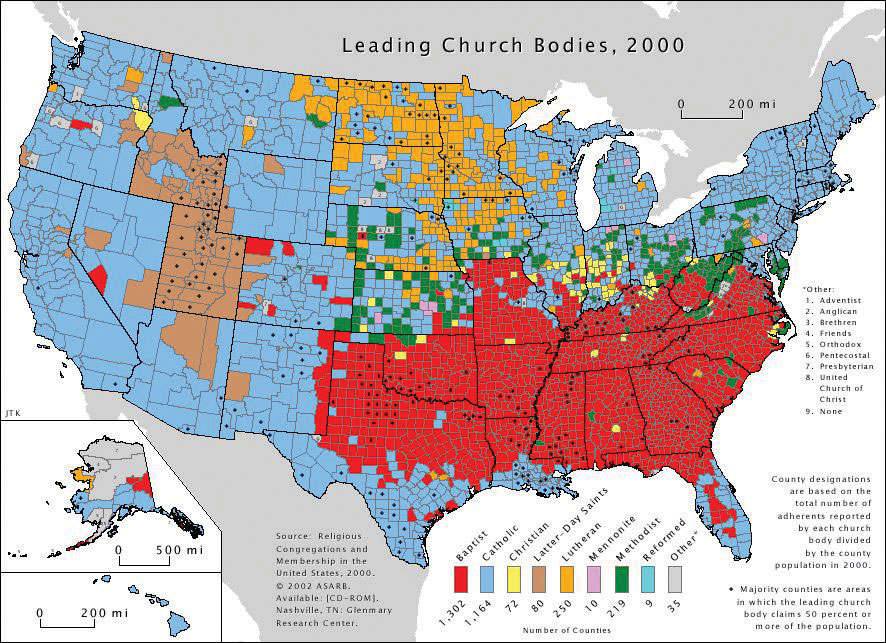
The Bible Belt is strongly affiliated with evangelicalism, which is historically the primary province of certain Protestant churches (such as Methodism and Southern Baptism).
This is a map of denominational distribution in the United States:
http://images.flatworldknowledge.com/berglee/berglee-fig04_019.jpg
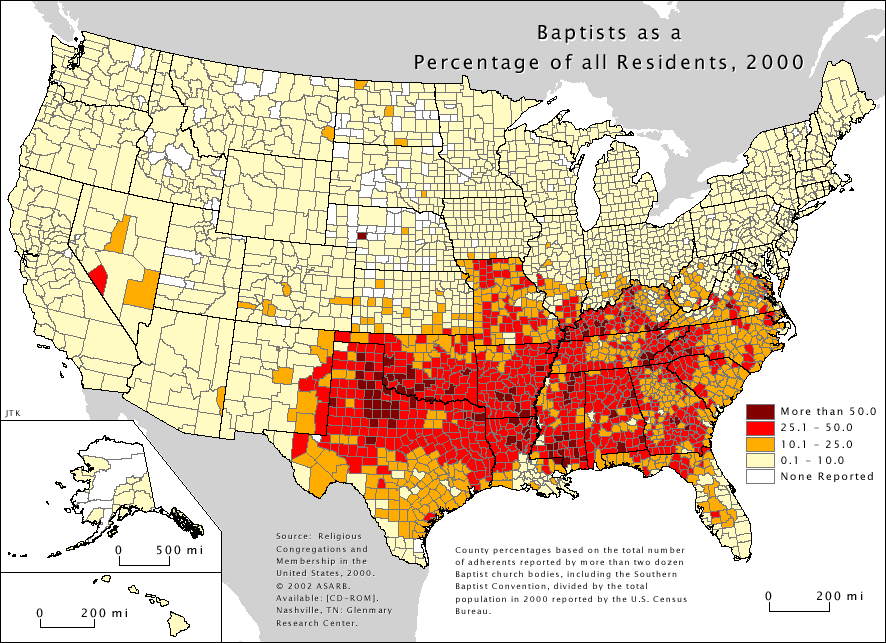
Baptists are way out in front in the Bible Belt because they are the most numerous denomination by number of physical churches, but this map shows a little more of the nuance from a population standpoint:
This is a map of Christian church attendance put together by a Christian lobbying group:
http://images.christianpost.com/full/70040/map-of-church-attendance.png?w=615
Finally, this is a map of the "Bible Belt": http://upload.wikimedia.org/wikipedia/commons/c/c2/BibleBelt.png
The bottom line is that the Bible Belt phenomenon is an expression of evangelical Protestantism, most notably demonstrated by the Southern Baptists. Your question could thus be re-characterized as, how did the South become evangelical Protestant, and especially Baptist?
This kind of thing honestly gets as much into the realm of oral history as into serious academic study. This guy does a good job of summarizing Southern Baptist history: http://www.tngenweb.org/campbell/hist-bogan/SBaptistHistory.html
The short version is, Southern Baptism was well-organized with a more hierarchical structure than most other congregationalist denominations. It has a focus on planting churches and winning converts, which Baptists tend to take seriously. Southern Baptism as a sub-denomination became strongly affiliated with Southern identity, including racial segregation and upholding the status quo. Its greatest period of growth was in the 35 years after the Civil War, when it went from being a fringe denomination to a serious player and part of the mainline of Protestant U.S. Churches.
General follow up question, is the Bible Belt a geographical area?
Another follow up question... when did the African American church start to become a vital institution in the south?
Follow-up Q: Is funding of public schools a factor(or a result)? Does it differ from other regions?
The father of Methodism in America is arguably, John Wesley. He started the heart based, soul saving you see today. At the time America was being settled the enlightenment and romanticism was very influential, instead of teaching parishioners to live like Jesus did, Wesley taught that everyone can be saved from their sins, and he preached in the fields not the church. At the same time, the president Thomas Jefferson, firmly believed in religious tolerance from the state. Being a fan of the enlightenment he believed that the state deal with purely civil matters, and the church leaders deal with the spiritual. He didnt want any form of religious involvement in anything state favoured, including public schools (this was later amended by Adams, who introduced state favoured religion in schools and other public institutes which has lasted to this day). Methodism, and consequently evangelism took off in the south, firstly with bored, uneducated housewives, who found these rousing sermons appealing - and favoured the uplifting, exciting sermons that were people based and not priest based. Americans took religion out of the churches, and made the saving of their souls their own responsibility, which traditionally was the responsibility of the king/queen, and priests.
**edited for spelling errors. Read, John Wesley, 'the nature of Enthusiasm'; David Hume, 'of superstition and Enthusiasm'; Thomas Jefferson on religious liberty and toleration. All should be available online. I have more sources if you are interested.