As I understand it, from the Marian reforms until Hadrian it was common for veteran Roman Legionaries to be given land when they ended their service. This raises a few questions
Before anything, I would like to state that I'm not an historian, just an enthusiast. I'll give you the information I have, in hopes that it can help you in some way or that someone more knowledgeable that me will discuss it, giving you additional information.
I'll begin citing the following:
Besides the creation of a city and its civic institutions, the foundation of a colony also involved a meticulous reorganization of the rural space. The colonial commissioners, with the help of a small army of engineers and technicians, divided the conquered territory into various categories of land, among which were areas reserved for pasture, public land, territory where the remaining indigenous population could live and most importantly the fertile land around the oppidum, which was distributed to the arriving colonists and became private property. This last category in particular required substantial work and organization since the selected area had to be divided into equal plots. (...) the centuriated landscapes "provided a public and highly visible demonstration of Roman power and the humiliation of the enemy; they announced complete Roman control of the disposal of the land, permanent occupation, and a probable intention to distribute the fruits of victory to her own citizens and soldiers"
The article doesn't expand onto retired soldiers because it focus on a period that precedes the Marian Reforms, but as cited, the fertile lands were reserved for the colonists. Being so, farming would be the best means of exploiting the land. However, I can't expand more into it, as I don't have information on that.
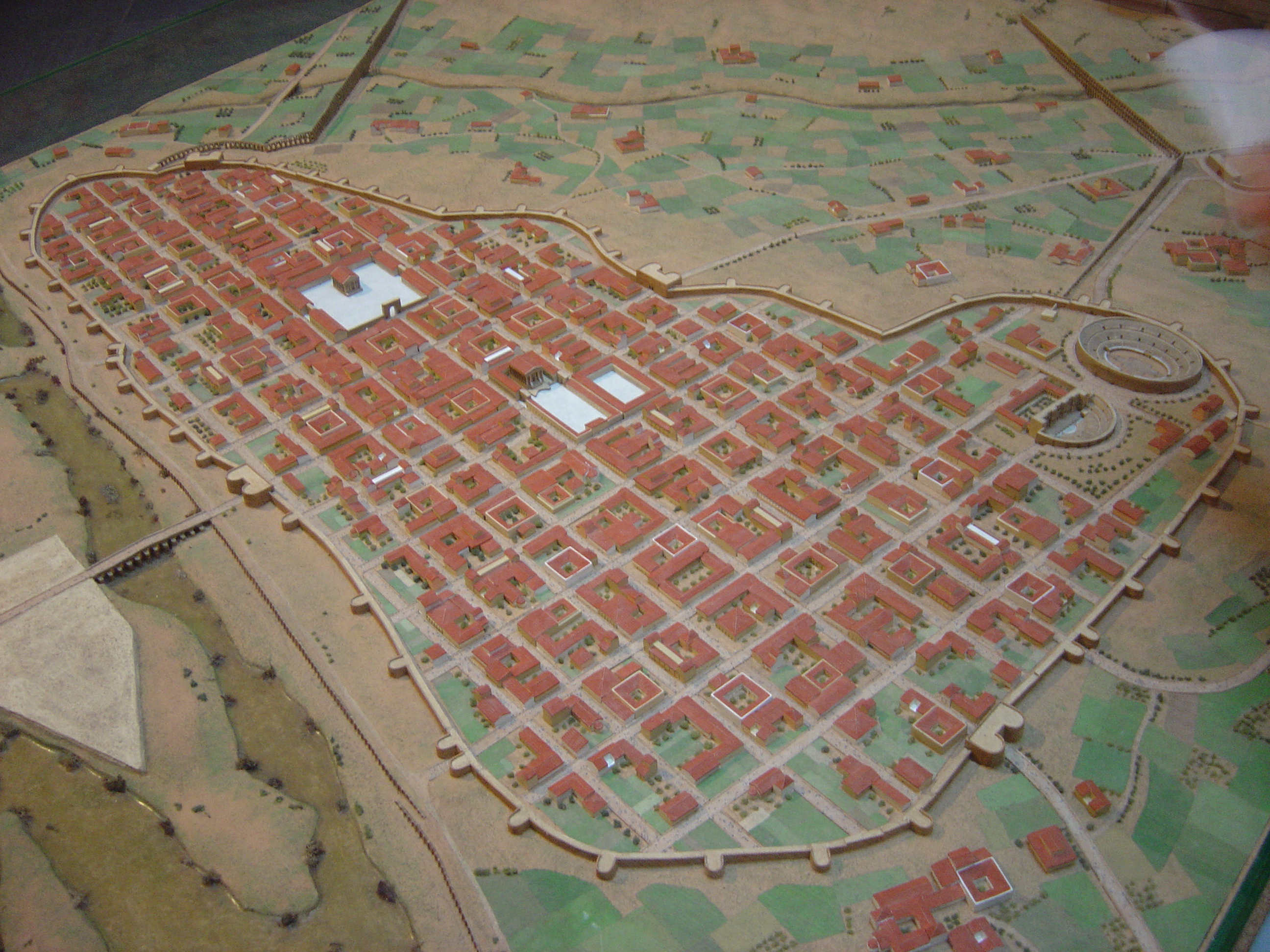
Moving on, I've recently been to Mérida (Spain) - an amazing roman archaeological site, I must add. Here's a scale model of the roman colony. You can still visit most of the monuments, including the Casa del Mitreo on the bottom (outside the walls) and the Circus Maximus, hidden at the top right corner. Anyway, you're probably wondering why I'm mentioning this colony in particular. Well, the name of the colony is enough answer by itself: Emerita Augusta. Augusta for the emperor, and Emerita for its colonists - retired soldiers, the emiriti.
The city was founded by a legate under Octavian, Publius Carisius, in 25 BCE, during the Cantabrian Wars, to house veterans from the same war.
Upon the conclusion of this war Augustus discharged the more aged of his soldiers and allowed them to found a city in Lusitania, called Augusta Emerita.
We know that colonists included soldiers from Legiones V Alauda and X Gemina (the legions under P. Carisius). The retired legionaries received individual parts of land on previously conquered land and their presence would further Rome's influence on the region, controlling the native network of settlements. Caesaraugusta (modern Zaragoza) was another town founded by soldiers from the same wars, to guarantee the protection of the territory against insurgents and to further roman presence in the area. The introduction of coloniae on these lands required roman citizens. Legionaries being readily available due to the wars in northern Hispania (Cantabria and Asturias) grouped with the abundance of conquered land meant that this practice was mutually beneficial to the both the empire and the soldiers.
I hope it helps.
To add to what /u/Borund has said, there is some interesting historical incidences where the idea of a settled legionary veterans didn't work as well for a variety of reasons. For example during the Boudiccan revolt in the province of Britannia in AD 60/61 the targeted urban areas of Colchester (Camulodunum), St. Albans (Verulamium) and London (Londinium). Colchester is documented as a colonia and had a temple to the deified Claudius which was particularly targeted for violent attack. If it is asserted that the settlement of veterans was a means of fully establishing and maintaining a identifiable Roman presence in even provinces as far away as Britain, then it is also to see how indigenous peoples would interpret them as particularly representative of Roman assertion of dominance. (Here is an interesting introduction to some archaeological findings in London that pertain to the above).
Closer to Rome itself, and the original Marian reforms that you mentioned. The settlement of veterans, being linked to the army, conquest and individual generals, was therefore also intensely political. As armies tended to be extremely loyal and connected to their leading General (particularly demonstrated by Caesar when he crossed the Rubicon with his army - described by Suetonius Caesar 31-33). In one instance senators who had become discontented with Pompey Magnus deliberately blocked the granting of land to his veteran soldiers, knowing that this would encourage discontent and rebellion within his army
(From thelatinlibrary.com) He [Pompey] had divorced his third wife, Mucia, and now proposed to ally himself by marriage to the party of the young senatorial leader Marcus Porcius Cato the Younger. But the nobles were closing their ranks against him, and his offer was rebuffed. Lucullus and others were determined to prevent the en bloc ratification of Pompey's eastern settlement and to reject his demand for land for his veterans.
In fact the only city in the near east to be developed as a colony for veterans was Berytus (full name = 'Colonia Iulia Augusta Felix Berytus' now modern-day Beirut, note much like the example given by /u/Borund the inclusion of 'imperial names'). This settlement was developed as such from an early Phoenician and then Greek foundation, but the archaeological remains are much more distinctly Roman in comparison to surrounding contemporary cities. Colonia would have had a much higher proportion of Roman citizens in comparison to other provincial areas too, which would potentially make them particularly interesting cultural hubs, especially as legionaries, once discharged could legally marry and any offspring would also be Roman citizens regardless of the status of the mother.
I appreciate this answer hasn't precisely answered your more technical question, but I hope that it provides another angle on Roman settlement, especially the cultural impact.
You ask a lot of really great questions that are egregiously overlooked in most explanations of veteran colonies and land redistribution in general.
A quick overview: veteran colonies are a late innovation in Roman history. The first bona fide attempt to establish colonies for the sole purpose of settling veterans came under Sulla in about 80 BC. That's over 400 years after the founding of the republic! The first colonies we can securely date are from the fourth or maybe fifth centuries, when Rome was taking over territory in Italy. Ostia claims to have been founded under Ancius Marcus, one of the kings, but it is uncorroborated by archeology. These colonies were founded as military outposts usually on the coast or in the middle of recently conquered territory and occupied by a few hundred people. They were usually laid out like a military camp, further highlighting that purpose. These colonies were established on conquered land that had been marked as "ager publicus", public land. The Romans stopped this practice in the third century after expanding into Sicily and Spain.
As the population of Rome began to expand in the second century, some politicians (the Gracchi) proposed to redistribute ager publicus in Italy to people who had been bought out of their farms by wealthy landowners (Appian seems to have the truth in his description of the economy at this time). Until the time of Caesar, most land issues would focus on using the ager publicus in Italy to settle urban poor/veterans.
Sulla settled his veterans on land taken from Italian cities that fought against Rome in the Social War (Pompeii is the most famous Sullan colony). Thus they actually had the same effect as the colonies founded in the early Republic.
On to the analysis: the Sullan colonies provide us with some of the answers to your questions. Both Sallust and Cicero have a poor opinion of Sulla's colonies in their accounts of Catiline's conspiracy and claim that the veterans quickly got themselves into debt. The implication is that they were unable to sustain themselves as farmers. Gracchus's laws had provisions to prevent the people who received land from selling it, but I am unsure whether we know if Sulla had any such stipulations.
Under Augustus, land grants became commonplace, but mostly because he did not use Italian land. This had the effect of removing most of the political opposition to them (the people of power in Rome were all in Italy, after all), but it was also unpopular if a veteran ended up in some godforsaken swamp in Gaul or a rocky plot in Pannonia (see [Tacitus 1.17](http://penelope.uchicago.edu/Thayer/E/Roman/Texts/Tacitus/Annals/1B*.html for the hardships of the soldiers).
Like the early Republic, these colonies were focused around newly gained territories. But in Augustus's early career (when he was known as Octavian), he had used Italian land to settle and gain the loyalty of Caesar's veterans. This prompted Virgil to write Eclogue 9 when Octavian stripped the land away from the people of Mantua to settle soldiers.
Sometimes these colonies were grafted onto existing towns, and you can see a clearly Roman quarter (with a grid layout, forum, and an amphitheater) and a native quarter with the old temples and public spaces. Eventually these towns would lose their autonomy (the Flavians made every city adapt Roman institutions under the Flavian Municipal Law), but in returned they gains Roman rights.
As for soldiers recruited from cities, while after Marius's reforms there were a lot of urban soldiers, the Roman ideal was still the yeoman farmer and most Roman citizens would be farmers even when the city of Rome was over 1 million. Veteran colonies were a way to ensure that the yeoman farmer was always a part of Rome's foundation even if those farmers were spread further and further away from the center of the empire. So they didn't really care about the lack of training for whatever proportion of their army had not farmed because the ideal was more important. That kind of hair-brained ignorance to impracticality is what caused so much trouble for the Sullan veterans and the gripes of the Pannonian legions in Tacitus.
I think I've answered most of your questions. Let me know if you want anything in more detail. I have no idea where the equipment (draft animals and iron tools would be expected) came from, but the animals and tools could be shared between multiple families.