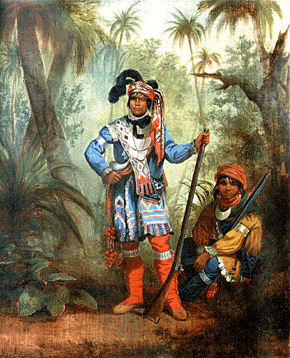
In Florida, at least, the traditional Seminole garb is a long-sleeved cotton shirt (often with a large collar or even a cape) and either long pants (often tucked into boots) or a long skirt, sometimes ornamented with geometric patchwork.
Here's a portrait of Billy Bowlegs, who led the fight against the Union Army in the Second Seminole War.
Here's a photo from the 1900s of some Seminole men and boys.
The Museum of Florida History also has some Seminole "big shirts" on display.
If you've ever been in the Everglades in summer, the reason for covering as much exposed skin as possible becomes very, very clear. Vast swarms of mosquitos will drain you dry otherwise, and the sawgrass will flay whatever they leave behind.
Any question, or answer, that begins by homogenizing every North American Native tribe will fail to provide any useful data. Even if we were to constrain the definition of North American Indian to "Native Americans indigenous to the area that is now the United States" we'd still be talking about hundreds of tribes and individual cultures with numerous vectors of departure, including such relevant impacts as; climate, season, economy, period of contact, period of warfare, and gender.
It sounds like you may be trying to refer to post contact Sioux, which tends to be what most people think about when they imagine a picture of North American Indians. Even then we'd be considering only one indigenous plains group of many, and that one group has three primary separate subcultures, each of which has their own divisions of different bands that can sometimes have very different customs and garb.
The safe bet, regardless of how you phrase the question "Was Native Group X represented appropriately in popular art?" is "Almost certainly not."
For comparison, I assume you're referring to paintings similar to this and this.
While I can't really comment on eastern tribes, it's not really true for western tribes. For example, the Navajo ceremonial war dress does greatly resemble it. However, actual scouting and war parties tended to use significantly more clothing. This makes sense from a practical perspective because clothing provides protection, however thin. Take a look at how Geronimo's Apaches dressed. The leg coverings provide protection from the harsh thorny plants of the Sonoran desert while the upper body is shielded from the sun. The lower body is left exposed to mitigate overheating.
In the plains tribes, clothing made of buffalo skin or other animal hides was very common. For example, this kiowa shirt from approximately 1880 is fairly representative of what a warrior might have worn.
This is all very dependent on gender, tribe, and social context though. In many of the 1903 Oraibi stereographs of the Hopi in the Library of Congress' print media collection, males are shirtless. This is simply more comfortable dress for day-to-day living in their environment. War and ceremonial dress (excepting certain kachina dances, particularly the snake) still involved much more clothing. Women among the same tribe in the same period typically wore full body coverings, often multiple layers.