Obviously there was a lot of racist anti-Japanese propaganda in the USA during the war, and I thought it would seem almost inevitable that this would cause a considerable racist attitude among American troops and subsequently lead to a lot of abuse and ill-treatment of the Japanese people.
However, I've recently heard someone claim that because American soldiers had to interact and deal with with ordinary Japanese people on a daily basis during the occupation, they were actually significantly less racist than the general American public. They also claimed there were even cases of soldiers buying large amounts of sweets with their own money to give to Japanese children.
I'd like to hear your views on this.
Well, giving chocolate to children doesn't necessarily mean you're not racist. It could mean you view Japanese people as a whole as childlike, infantile, and desperately in need of (American) guidance and education. So it could be seen as patronizing and demeaning. It also assumes a rigid hierarchy of dependence.
But in any event this is hard to answer because it depends on what you mean by "racism." Do you mean, Americans didn't continue the violent, almost genocidal racism during the war into the postwar period? Then, ok yeah that goes away. But it didn't mean that racist assumptions about the Japanese disappeared. If you look at US-Japan relations even today, it's a decidedly one-sided relationship where the US assumes a dominating role and Japan the passive, dependent role. The US Occupation officials also summarily dismissed over 20 years of real political traditions and developments toward democracy in Japanese state and society predating the war in a hamfisted attempt to impose democracy from above. And MacArthur shocked a lot of Japanese people in Congressional testimony later referring to the Japanese as immature children needing American help.
So, yes, Americans decided not to massacre all Japanese people as many actually wanted to during the war. So on that score, ok, Americans get high marks for not holding onto genocidal form of racism. But more subtle, patronizing racism certainly continued after the war and ultimately transformed both postwar Japanese society and postwar US-Japan relations.
You're right that some - not all - American GIs grew fond of Japanese culture from their experience in the Occupation. In fact, a lot of the early pioneers in the study of Japanese history and literature in the United States were first introduced to Japan as young soldiers during the Occupation. Of course, other US soldiers raped Japanese women during the Occupation, but that was quickly censored, whitewashed, and forgotten by the US government.
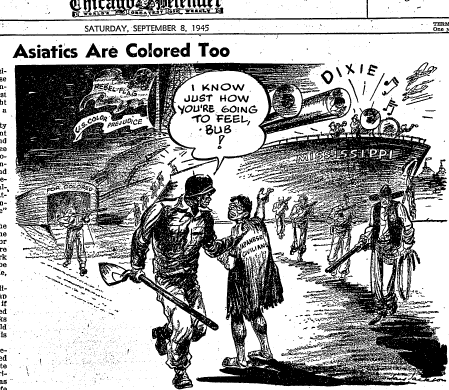
I found this cartoon while looking for something else the other day, which seems relevant...
http://thesocietypages.org/socimages/files/2012/07/Dixie.png
I can't answer you specifically, however, I do have an interesting video that is definitely relevant that may be a piece of the larger puzzle that was how our soldiers viewed the Japanese people during post-war occupation. It's a training film made by Dr. Seuss, interestingly enough, for soldiers going to occupy Japan. Here it is.