Let me repost something I posted here:
As early as 1914, France used tear gas in rifle grenades. Germany deployed tear gas in 18,000 artillery shells on Jan. 3, 1915 at Bolimov, near Warsaw, in the first mass use of gas warfare. It was less than successful -- the gas froze and wasn't effective.
On April 22, 1915, Germany deployed 180 tons of chlorine gas at Ypres in the first large-scale use of lethal gas. German soldiers waited for days to get the right conditions. Then, they used wrenches to open tanks of chlorine gas and let the wind carry it to the Allied trenches. They shielded themselves with surgical masks soaked in chemicals and tore a three-mile-wide gap in the Allied lines.
Respirators, the prototypical masks that come to mind when you think WWI, were developed as a consequence, as were countless weapons designed to deliver gas: grenades, mortar shells, artillery shells, rifle grenades, chemical projectors. New gases were developed: phosgene, mustard, sulphur mustard, and more.
The particularly nasty strategy implemented during the last year of the war was to intersperse vomit gas with phosgene or mustard. The gas canisters that blocked the latter two poisons weren't effective against vomit gas, so you'd raise your mask to puke then inhale a big whiff of poison.
One of the stories I find most interesting is about a gas that wasn't used — Lewisite. This was an arsenic-based gas that the United States developed when it entered the war. It spent considerable effort to develop the research and production infrastructure to produce the gas (the research was largely done at American University in Washington, DC, and the production was done at a factory near Cleveland, Ohio, dubbed "The Mousetrap" for its secrecy). The situation is interesting because the US essentially had no chemical warfare program (even a preventive one) when it entered the war in 1917, and had to built all of its expertise up very quickly. Anyway, they finally produced tons and tons of the very deadly gas, supposedly the deadliest of the war, but by the time they were shipping it to Europe the war ended. The ended up sinking the poison offshore near Baltimore, apparently.
This is of interest to me in particular both because it reflects the very shaky way in which the US was still using scientists and engineers at that time (it was a very late comer to the "let's use science to win wars" game), and this had a very big effect on how things went in World War II. Some of the scientists who worked on this effort — notably Harvard President and chemist James B. Conant, who was in charge of the "Mousetrap" facility — later became some of the most outspoken advocates of preparing scientific resources for war well in advance of hostilities when it came to World War II, and later played key administrative roles in the development of weapons like radar and the atomic bomb.
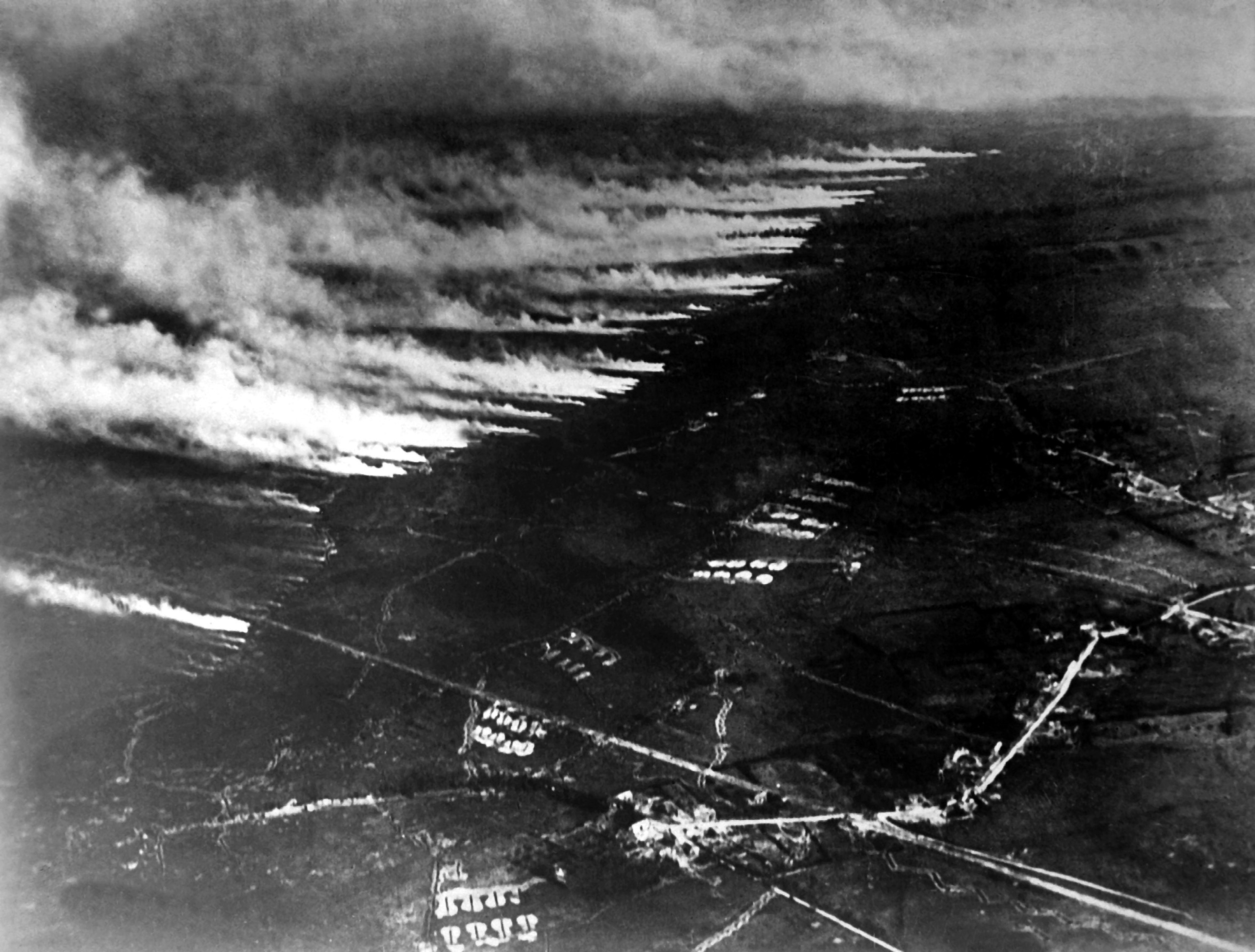
The first full-scale deployment of lethal chemical warfare agents was at the Second Battle of Ypres, when the Germans attacked French, Canadian and Algerian troops with chlorine gas. The scale of the deployment of the these gases can be seen in this photo of Flanders. The gasses would be used prior to an advancement in order to rout soldiers and allow for a gap in lines.
The first deployment of Chlorine gas and the first use of an improvised gas mask occurred that same day during the Second Battle of Ypres. Capt. Scrimger, with the 2nd Canadian Field Ambulance, noticed the odor of the gas and passed the order to use urine soaked rags to counteract the gas. The order enabled Canadian and British troops to retake the position before the Germans could exploit the gap.
The use of the chemical agents was largely unpredictable often relying on the wind direction. Civilian casualties rivaled those of combatants, the use of Chemical weapons had above all a major affect on morale. Injured soldiers put major strain on the Medical staff and supplies. Veterans had such horrid memories of the effects of the gasses that Hitler himself would not deploy chemical agents to the battlefield.