I know a little bit about the Germans' groundbreaking new tactics (brief artillery barrages, followed swiftly by small unit infiltrations) used during their last big offensive of WW1, but I know next to nothing about what made the Allied '100 Days offensive' special. What did the Allies bring to the table in 1918 that the Germans lacked?
TL;DR: With the benefit of significant manpower and resource advantages the Entente forces could apply similar successful tactics used in the Spring Offensive but with less desperation and more strategic responsibility. Combine this with the fact that the German economy and armed forces were crumbling under self destructive governmental policies, blockade, and just general war fatigue along with the best German soldiers being thrown away in said Spring Offensive there was nothing stopping the Entente from rolling over the Germans.
Just a quick pet peeve. The French, Americans, and British Commonwealth were the Entente Powers. The Germans, Austro-Hungarians, and Ottomans were the Allied Powers. Considering the much bigger war 20 years later though most people just say "Allies" and "Central" Powers respectively but just a little tidbit of information right there.
Secondly while the discussion of what the Entente forces brought to the table is certainly an interesting one (and a relevant one which I will discuss) a commonly overlooked factor is what Germany did not have; that being a functional economy. This is going to quickly turn into a "Why did Germany lose the first world war" answer but it's all relevant to why the 100 Days was so successful.
Economically Germany was in nothing short of complete collapse. France's credit throughout the war would expand a total of 242% while Germany's would rise 379%, from 4,508 million marks to 17,126 million. Germany would have more war loans (ie: loan drives with bonds) than the Entente Cordiale combined; a total of 9 while France would have 2 and the United Kingdom 3. Systematic failure of the German government to rethink financial policy for a prolonged war and for long-term employment rather than short term war employment lead to the Darlehenskassen. It would offer an interest rate of up to 6.5% on bonds (as opposed to the Reichbank's 5%) and only required deposits to be fixed for 3-6 months as opposed to years. For the sake of saving you the time of boring financial speak, it was a colossal failure of its intended purpose. In fact the total issue if Darlehenskassenscheine was 15,626 million marks -- ten times the original authorization of 1,500 million. Further instead of relieving liquidity issues of business, it actually pushed business away further. The local governments, who held about 1/4th of the bonds prior to this point rose up to holding an astonishingly 75% while business investments dipped enormously.^[1] These issues compounded with massive overproduction of factories which the government made no attempt to rectify via harsher taxation or increased interest rates would lead to Germany spending over 90% of its ordinary budget by the armistice on interest payments for war loans.
So its economy was in shambles and it had no money left. At least it had a vast source of raw materials for which it could sustain a war, right? Well no, Germany was a highly industrious nation but didn't have much raw materials going for it and the British blockade, which after the Battle of Jutland in 1916 became absolute, absolutely crushed whatever hope they had left. By the end of the war if it was a metal park bench, or a church bell, or a guardrail it was taken and melted down and made into an artillery shell or a rifle action or what have you. They were that desperate. What little food Germany had was sent almost exclusively to the military and out of the regular peoples hands. Only 1/3 of the grain was given to civilians who comprised 2/3rds of the population. Germans were eating ~15% of the amount of meat they were eating before the war and that percentage is in the single digits for fish and eggs. While the agricultural realm of Germany could cope with this, the cities were in shambles. When I say men were starving to death on the job in their factory, I'm being serious. Dysentery, starvation, and murder over a few ounces of bread were not uncommon. Germany was a country that relied on imports to survive and it's a theme we would see repeated right again 20 years later with the invasion of the Soviet Union for the Ukrainian grain fields. Food is the achilles heel of Germany and destroyed them in WWI.
With the blockade came mutiny as well from the navy, as you might expect. The Battle of Jutland in 1916 marked the end of Germany's capacity or intent to wage war on the surface and instead opted to knock out the British navy in a concentrated U-Boat campaign. It would also, however, create much dissent among the sailors of the surface navy who were ordered to sit in port for two years and watch their country be ravaged by starvation. Even when they were ordered to make a last desperate charge into the British blockade the break it, they denied and instead mutinied as hundreds of cities began to be taken over by mutinous sailors, left wind radicals, and various mutinous soldiers on top of that. The navy, which was the Kaisers prized possession and the first truly unified and "German" part of the military (as the land forces were separated by Prussian, Bavarian, Saxon, and Wurttembergian in origin) was now in open revolt and seizing coastal towns.
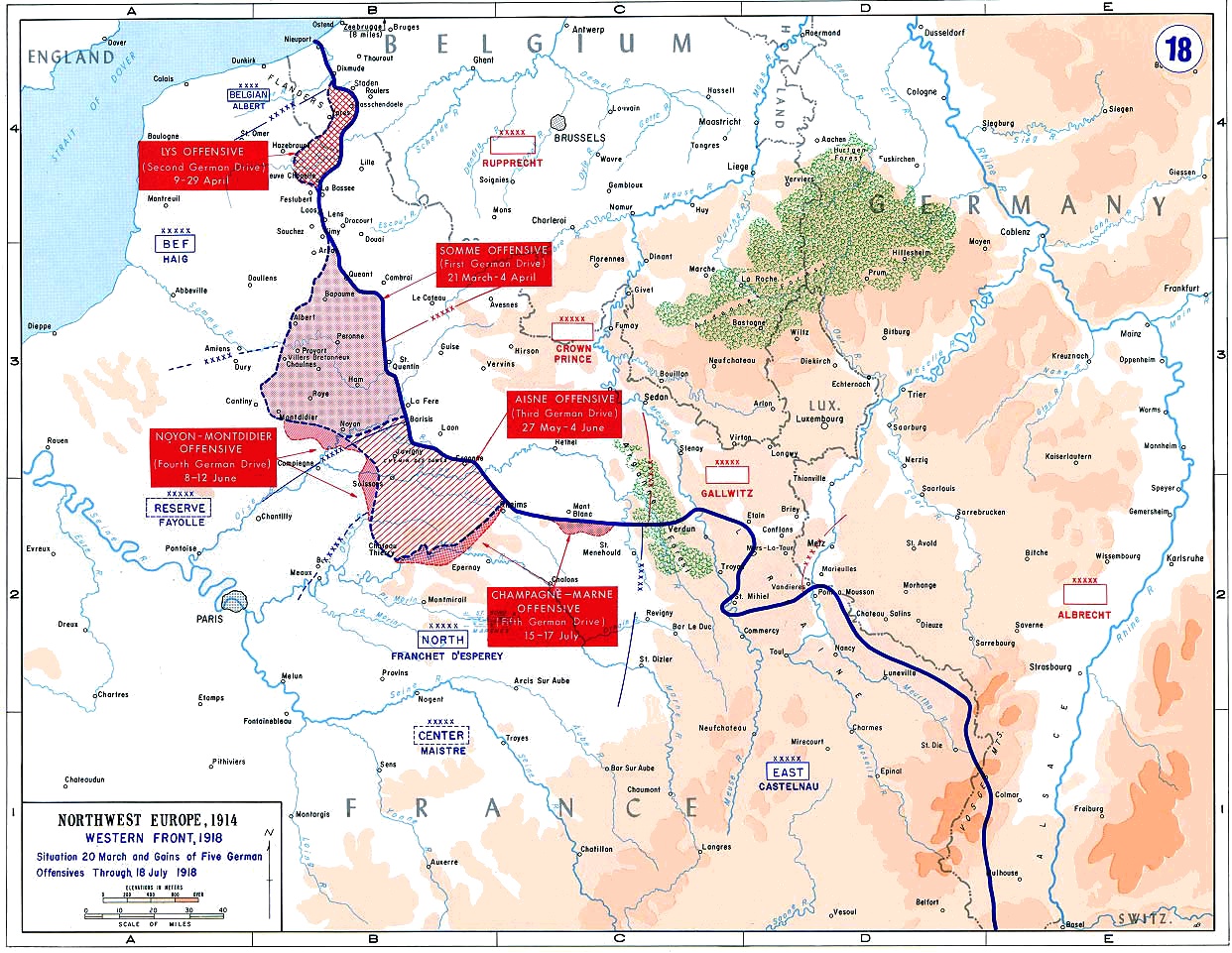
This is where the Spring Offensive of 1918 comes in and is where our narrative begins away from the economic realm and into the strategy and operations one. Germany, as you now realize, was horribly desperate. As this was going on 10,000 Americans per day were landing in France and bolstering the line. Millions of fresh troops were about to steamroll them so Germany had one shot left to win it all and go for broke. The Spring Offensive, or officially known as Kaiserschlacht, the Kaisers Battle, was said last stand. Germany would use the full weight of forces coming from the Eastern Front (which was now being mopped up and ended on March 3rd) to attempt a massive breakthrough of the Allied lines. The purpose was the bulk of the German forces to use new Sturmtruppen focused tactics (that you mention) to make a mad dash for Paris and seize it. Likewise troops in the British sector would attempt to break through, encircle the British and Belgian forces, and basically push them back into the sea by cutting them off.
The results were absolutely staggering. The Germans would achieve 60 mile depth in some regions, the greatest movement of the front since August 1914. It was all a facade however as the limitations of this offensive became clear near immediately. The Germans would lose anywhere between three quarters of a million men to a million men between March and July 1918 where most were Sturmtruppen battalions -- the most experienced men over the past 4 years concentrated together for this offensive and they were being cut down. They had pushed far too fast and the land they held could not be sustained by such depleted men -- men who had far outreached their supply lines and were suffering egregious casualty rates. While they took swathes of land they only attacked those two areas and just went deeper and deeper and deeper. Further that land was completely irrelevant strategically as their goal was only Paris, something which they could not reach being so extended. They were completely cut off from their supply lines, supply lines which even when they were connected already had men starving in trenches.
The Entente powers in response to this performed an offensive using similar tactics but performed on a much more responsible way. Infantry were no longer organized in company's as the principle tactical unit but in platoons which consisted of a couple dozen men at most. Infantry was becoming a flexible and reactive force after four years to build hardened, experienced NCO's and officers to lead them. They would have significantly more mortars, flamethrowers, and especially grenades compared to their 1915 and '16 and even '17 counterparts. Artillery had mastered its art. Instead of being a bull in a china shop unloading on a position for weeks and leveling the battlefield making it impassable they would use a combination of math and aircraft reconnaissance to precisely target a single enemy position, hit it hard and suddenly for a couple minutes, and then the infantry hit right after. It had become combined arms, not artillery bash the enemy and the infantry just walk over them. It had become so coordinated the artillery could literally be firing just in front of advancing infantry for maximum shock factor.
Tanks were, however, what really made the Hundred Days so damn successful. Tanks absolutely changed warfare. It should be noted these are not M4 Shermans or T-34's or whatever else you think of traditionally when you think tank -- these were slow lumbering hunks of metal but they changed everything. It allowed initiative to be pressed. Prior everything had to be carried by hand over no mans land to men who captured a trench. Now tanks could support an infantry attack and once the enemy is defeated immediately provide medical care, provide re-ups on ammunition and replacements for gear, provide reinforcements, and most importantly give the men a ready hot meal. They provided cover for infantry as they advanced enemy trenches and even held men inside of them to make enemy machine gun and rifle fire near useless. Aircraft would use radio communications to give on the minute updates to ground officers, drop supplies for men on the front, and provide other means (like dropping small bombs) to disrupt the Germans and generally be a nuisance.
The biggest change out of all was not a tactical or operational one but a strategic. What the Germans did was the '14-'17 era of WWI styled of fighting. You batter the same position over and over and basically try to bleed the enemy out and widen the bulge and get more depth. When you actually achieve a breakthrough though or the hope for a breakthrough ends they just kept on going at it, leading to massive overextension and egregious casualties respectively. Rather than do that the Entente powers would, after the attack began to slog down and the Germans were starting to react to their offensive they'd pull back and attack elsewhere. The Germans react to area A? You pull back and hit area C. The Germans were, especially in combination with their horrible economic and logistics situation, completely incapable of responding to these constant attacks across their front. Three armies -- the British in Belgium, the French in the center near Luxemburg, and the Americans in the Meuse-Argonne Offensive -- were simultaneously hitting the German army at the same time and all simultaneously constantly changing their focus of attack. Positions in the Somme two years prior that took 2 weeks to take were now falling to Canadian troops in 2 hours. Some positions even fell in as little as a couple of minutes. The infamous Hindenburg Line, a massive fortification line made in response to the Somme as an impenetrable shield against an Entente offensive with hundreds of meters deep of wire in most places, concrete pillboxes, optimized fields of fire for field guns, and sophisticated and very well built trenches would be broken through in about a week and fully subdued in three.
The Germans were just incapable of responding to these constant strikes across its entire front. Rather than getting 60 miles of depth in one area the Entente hit everywhere at staggered times and progressively moved forward the entire front is the summary. Combine this with a very sharp disparity in resource allocation, manpower availability, and logistical capability and you get the Spring Offensive compared to the Hundred Days. The former being a last ditch effort trying to rapidly seize Paris in basically an all in maneuver with the latter being a planned, calculated, and consistent offensive across the entire front by all parties at once for the purpose of crushing the Germans now that they were totally without hope. The Germans would have all their former gains taken and be pushed into the edges of Belgium within a hundred days and the only option was surrender. The "Armistice Line" you see there is where the steamroller stopped. No German territory was taken because the Generals realized they had lost horribly and there was no point in resisting and having their country obliterated. Unfortunately many took this as a sign that Germany never truly lost and were 'stabbed in the back' by its politicians, notably, Jews and Bolsheviks.
^[1] Bogart, Ernest Ludlow, War Costs and their Financing pp. 116-117
The First World War: Volume I: To Arms, Hew Strachan
The First World War: Germany and Austria-Hungary 1914-1918, Holger Herwig
The Kaisers Battle, Martin Middlebrook