Primarily it was the young Karl Marx writing in 1844 from his Parisian exile things that you were not allowed to say back in Germany. That article is was ought to be an introduction to a book utterly destroying Hegel's Lectures on Theology and Right (which Hegel had given in Prussia, in the Berlin University in the 1832), but Marx could not complete his book. He got evicted from France at the request of the Prussia. In Belgium he made himself busy writing the communist manifesto which happened to come out in the February of 1848.
Marx himself would not get popular in Russia until the 1890s but as you can glean from what now is commonly called Russian classical literature there have been other outspoken atheists around.
Russia's ideology back in the day was that Russia was being the very last bastion of some spirituality, of some truely true christendom and some of it's least popular antics were done were done with a vulgar appeal to christian faith. The black hundred, a "cossack" group responsible for the pogroms were particularily bad in that regard.
The Tsar family was rumored to sleep around with a Christian mystic from Siberia - Rasputin.
The socialist movement was fed up to the back teeth with all the church business because of the bloody sunday of 1905. Saint Petersburg workers were slaughtered after a peaceful march towards the winter palace. The leader of the march was Father Gregory Gapon. He was a cleric involved in the socialist movement for a very long time. He was the sole survivor in a column of 40 people.
In 1906 he tried to convert his fellow socialists for state security service and he got strangled for that. It now looked like Gapon had planned the bloody sunday in advance!
In 1918 Lenin gave speech subscribing to the perspective of Marx which stated that man has to break with religion, the "illusory happiness", in order to be able to achieve the real thing; but he also was critical of outright blasphemy which, as he said, has been conducted by Bolsheviks attempting to enlighten the believers. Instead, he said, they were antagonizing them over no good reason.
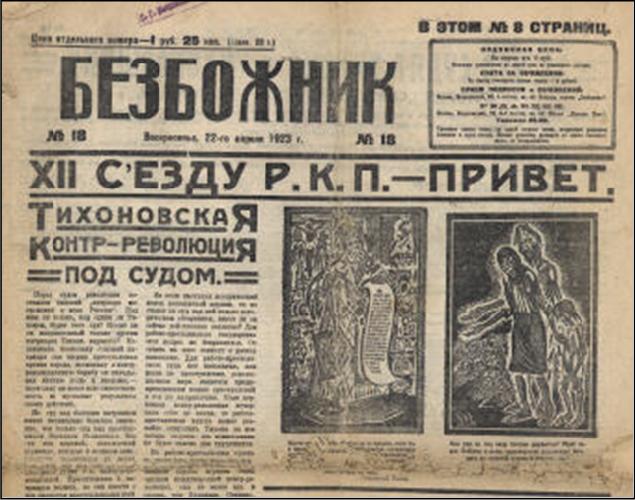
They supported publications in the vein of /r/atheism which were distributed in the churches. That atheism was not footing the writings of Karl Marx alone but on the broader atheist tradition. They would also, for example, print Lucretius or invite their contemporary cutting-edge intellectuals to express their views about religion. Bulgakov pictured such an early Soviet atheist bureaucrat in the beginning of his «Master and Margarita».
During the Stalin the militant atheist publications were closed. Later, again, he would reopen the church. However, he also introduced "scientific atheism" as subject you could study in univerisity. It tried to provide the skeptical reply to all the newest arguments paraded by the academic theologicists and church historians in the West.
After the fall of the USSR 1990s that subject was renamed to "Religious Studies". When theology was (re-)introduced as a subject in the Putin era that was responded to by a collective letter of protest subscribed by some of most renowned academics in Russia.