Hello there. I like history and particularly ancient civilizations that seem to have been more civilized and advanced then we expected. Mayan cities, pueblo dwellings, etc. I'm wondering what they did for fun? What is a typical game of any of the pre columbian societies? I spent a good time trying to find something but can't seem to find anything. Apparently a lot of people want pueblo people to be in Civ V haha. I'm hoping on you could quell my thoughts ?
Stewart Culin's Games of the North American Indian covers this topic quite well for the region north of Mexico. If you try to hunt down a physical copy, be aware that it's sometimes broken into two volumes: the first covering mainly "games of chance" and the second covering mostly "games of dexterity." Now, Culin worked with historical and ethnographic sources, rather than archaeological sources, so the games described in this book are technically post-Columbian, but they didn't spring up fully formed the day Columbus landed in Lucayos. I'll hit just some of the major games from the Eastern Woodlands.
#The Bowl Game
The Bowl Game is a popular Iroquoian dice game. It's played with a bowl (as you probably guessed), and six dice. The dice are crafted from plum stones or, after Europeans arrived, peach stones, polished smooth and painted. One side would be black; the other would be white or yellow usually. It's sometimes called the peach-stone game because of dice (and, of course, has several different Iroquoian names too). There are also variant rules, but I'll only be discussing one particular Seneca version of the game here.
While a friendly round of the Bowl Game might be struck up at anytime, it was also a major feature of autumn and winter festivals. Played between two teams (which might come from different towns or just from opposite ends of the same longhouse), the game drew in large bets. Six referees, three from each side, were chosen. These men arranged the bets into pairs of similar value and function. They also selected two score-keepers, a man and a woman, for each side. The four score-keepers sat around a large vessel full of beans, from which the two men both took seven at the beginning of the game. Then the first two players come forward and sit on either side of the bowl and dice.
Once everyone is place, one of the referees gives a little speech about fair play and being a good sport in both victory and defeat. And the game begins.
The first player gives the bowl a toss. If all six dice came up the same, the female score-keeper for his team takes five beans the other team's male score-keeper. If five dice came up the same, his team only takes one bean. Then play passes to his opponent, who does the same. If a player gets six matching dice three times in a row, the male score-keeper for his side takes fifteen additional beans from the vessel. If he got five matching dice in his streak instead, they only get three additional beans. When he doesn't throw a scoring set of dice, he's swapped out for another player on his team.
The game goes on like this until the bean vessel has been emptied. The team whose score-keepers hold the most beans win. Those who placed bets on that team then claim their original item, along with whatever item the referees had paired with it.
#Snow-Snake
Snow-Snake is a winter game. In it's most common variation, it's played with a polished piece of wood that resembles a ski and is usually about 5-7 feet long, sometimes longer. Often the front end of the snow-snake was carved to resemble an animal, usually a snake (hence the game's name) but ducks were also popular. Other variations use a smaller bone slider trailing feathers.
The object of the game was to throw your snow-snake in such a way that it slides across the snow or ice farther than your opponent's. In some versions, the first player could bounce his snow-snake off some obstacle in the field of play, challenging his opponent's to do likewise if they wanted to score any points at all.
#Snow Boat Another winter game played by the Seneca. It's played on a hill, with the spectators gathered below. Chutes are created in the snow and lined with ice. The contestants, in two opposing teams, gather at the top of the chutes, each with a small wooden boat. The boats are released down the chute and travel as far as their momentum is can carry them. Each boat scores one point for every opposing boat that did not travel as far as it. The first team to receive an agreed upon number of points wins the game.
#Chunkey
With this game, we can safely say that's definitely Pre-Columbian. Culin classifies this as a Hoop and Pole game, a much more widespread genre of games than Chunkey proper, and I think it's safe to say that Chunkey does fit among those games. It just replaces the hoop with a stone or clay disc. We find those discs in the archaeological record, and Chunkey players are depicted in Mississippian artwork. Despite it's pre-Columbian popularity, the game started fading out in favor of other sports, but among the Choctaw at least it managed to survive until after Removal.
While in most versions of a Hoop and Pole game, the objective is to pierce the hoop while it is rolling in order to stop it, Chunkey is a bit different. Since it uses a solid disc rather than hoop, piercing the target isn't the intent. Instead, as the chunkey disc rolls away from them, one player from each team both throw their javelins in an attempt to strike a spot closest to where they believe the disc will come to a stop. If one of the javelins lands within about eight feet of the disc (the length of the javelin), two points are scored. Otherwise, one point is awarded to the team that got closest. In other variants of the game, the two sides alternate who rolls the stone and who throws the javelin, rather than both throwing their javelins simultaneously.
Sometimes special Chunkey pitches were constructed in order to play the game, requiring. One example from the late 18th Century was 200-feet long and paved smooth with a hard clay. In other cases, the game was played in the central plazas common in most Mississippian and post-Mississippian communities.
#Lacrosse
I'll use the name "lacrosse" here for what Culin calls the racket game and others have called the stickball game. Since modern lacrosse developed from this game and takes its name for the old French name for the Native sport, it works better in terms of familiarity for most readers.
The game originated in the Northeast and if it was played at all in the Southeast before Europeans arrived (there's debate about that) it wasn't that common yet, except perhaps among the Cherokee who may have been responsible for bringing it south to begin with. As lacrosse became increasingly popular in the Southeast during the Colonial era, it supplanted Chunkey in important among the post-Mississippian cultures in the Southeast.
If you're familiar with modern lacrosse, you already know the basics of its ancestors. It's a game in which two teams throw and catch a ball using sticks with nets on the end in an attempt to get the ball through a goal at the either end of a field. Modern lacrosse is descended from a northern version of the game, so it only uses one stick. In the Southeast, the game was played with two sticks instead.
While friendly games might be started up spontaneously among friends within a single community, often these games would be organized months in advance when involving different communities within a nation, or even two different nations. Many of the rules were variable and had to be negotiated before hand, including the size of teams, how many could be on the field at any one time, the size of the field, and the number of points necessary for victory. There were women teams as well as men teams. Women teams might play separately, play after the men's game, or occasionally play against their male counterparts. Referees enforced whatever rules had been agreed upon.
There's so many variants of this game and so much written about it that I find myself having trouble summarizing any more of it. I suggest following the link at the beginning and checking out the Racket section of Culin's book, particularly the Iroquoian and Choctaw subsections.
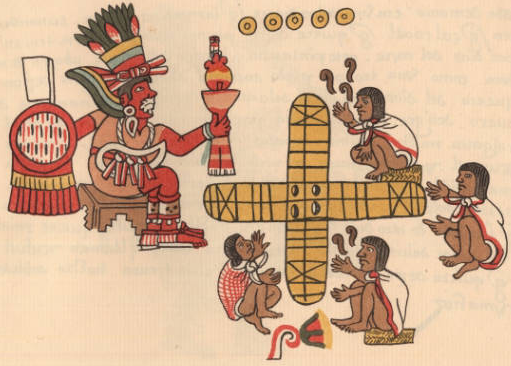
Patolli was a hugely popular dice/board game of Postclassic Mexico. The general concept was similar to backgammon or pachisi, it was a "race" for each player to move their pieces from start to finish. If the player "over rolled" the amount required to move his pieces into the finish area, then they would forfeit their turn.
The pieces were traditionally red and blue painted pebbles, 6 each, but there are accounts of both fancier sets. The dice would be 5-6 dried beans with a dot painted on them. The X-shaped board would be painted on a mat using rubber or, for cheaper sets, crushed herbs or even soot. While the concept is quite simple, there's references to a variety of rules regarding instant-win rules, or double movement for particular rolls. There were also superstitions like turning your home's metate upside-down for luck.
Mostly what patolli is known for though, is it's association with gambling and licentiousness. Bet would be placed on the outcomes of games, or even the outcome of particular rolls. Professional patolli players were known to carry their own playing mat, dice, and pieces in bundles tucked conspicuously under the arm. The wastrel patolli player who loses everything and has to end up selling himself into slavery to pay off his debts pops up in more than one account. The gods associated with the game Macuilxochitl (aka Xochipilli) and Ometochtli were associated with debauchery, excess, drunkeness, and basically wild and crazy youthfulness.
Nevertheless, the game was popular enough to be played at all levels of society, from cuthroat hustlers to regular commoners to rulers and elites. Naturally, the Spanish banned it.
hi! not discouraging loads of responses to represent various cultures throughout the Americas, but FYI, you can take a quick scan through these sections of the FAQ for some examples of pass-times & sports in that region