Today, the hexadecimal color scale (ranging from 000000-FFFFFF) covers every color visible to the human eye. It allows standardization in graphic designs around the world. Before this system came into effect, how did people collaborate on color schemes?
Pantone is what you're looking for, I think. Basically a company sold standardized color/ID pairings (and still do) in printed swatches. Wikipedia will tell a lot more than my fuzzy memory, but hopefully it's a starting point.
A few things:
RGB is a specific color model for additive color. It combines light. This is close but not identical to how the human eye sees things. So I wouldn't necessarily say that RGB covers every color visible to the human eye, because that is a rather big statement about the human visual system. It is, however, a good way of talking about the colors you can generate by combining light in a way that is pretty close to how the human eye will interpret the colors.
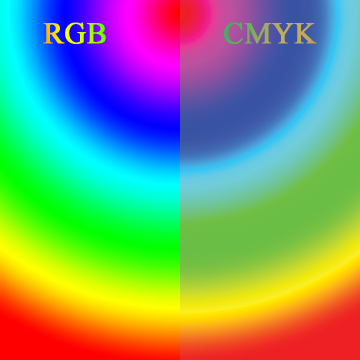
RGB should not be confused with print color models — subtractive models, like CMYK. These are made with ink or paint. They have a very different colorspace, as becomes very clear if you try to use computers to do print design — sometimes colors on the screen look very different in print. This image from Wikipedia gives a suggestion of the translation differences but because you are viewing even that image on a screen there are going to be some things that don't translate! This is a huge pain in the neck for graphic designers, getting your colorspace right, and different printing devices can support different colorspaces as well. Huge headache! This is why things like the Pantone system (1950s) exist — they are little standardized chits of printed color that will tell you exactly what shade of color something is, so you can say, "I want this red to be Pantone XYZ" and you can expect a printer who has a press with a Pantone system to get it exactly right.
So what you are really asking about is how did designers standardize colors prior to the development of these specific color spaces. (RGB is, again, only useful for light — which is why it is used with computer monitors.)
There were many early attempts at making qualitative and quantitative systems for color in the 18th-19th centuries. To my knowledge the most successful was the Munsell color system, which was used to standardize a lot of recording of colors. This would allow one person to say, "ah, I mean this shade of red" and someone else to know what they meant even if they didn't have the red object in color in front of them. One interesting historical aside of this is the von Luschan scale, which is a color scale for human skin color, used by anthropologists to understand human variation in the 19th and early 20th centuries. There are lots of applications of standardizing color measurement.
This is separate, though, from standardizing color printing, which I know little about.