Why did Austria do this and what were the pro's and con's of this?
Thanks.
Because the Empire was made up of a myriad of different cultures and the Habsburgs were too weakened to stem the rise of nationalism in the crown lands throughout the 19^th century.
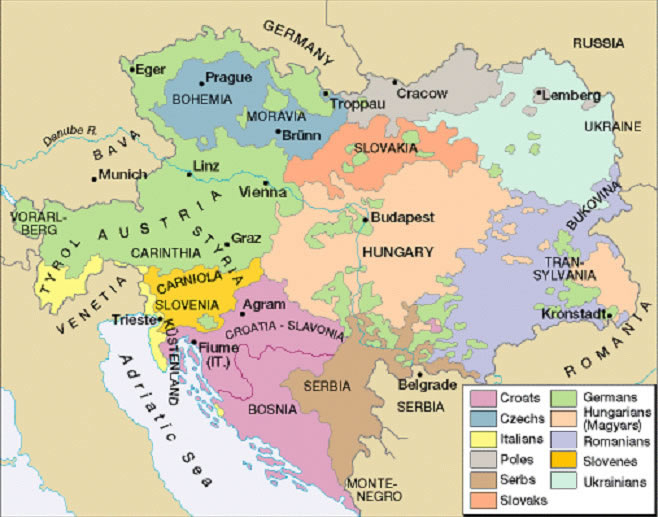
For reference, here is a rough cultural map of the Austrian Empire in 1848. As you can see, it's a proper mess compared with more homogonous states like France or Prussia.
Anyway, our immediate story starts in 1848, the big year of revolution: in January Italians in Sicily and Lombardy revolt against Spanish and Austrian rule respectively and then in February the big guys join in... France once again goes belly up, dethroning Louis-Philippe I. and proclaiming the new Second Republic under its first elected president and former Emperor-nephew, Louis Napoléon Bonaparte. As always, Europe was keen to immitate the French and revolution spread throughout the continent.
Focusing on Austria, we have small and medium ones all over the place due to the diverse nature of the Empire. In terms of large ones there's two mains, Milan-Lombardy (First Italian War of Independence) and the Hungarians.
The Italian forces mainly from Piemont-Sardinia were conclusively crushed by the Austrians under FML Radetzky at Custoza in late July and forced into an armistice (although they'd try to regroup the next year to no avail), which directly led to the rise of Victor Emmanuel to the throne of Sardinia-Piemont.
The Hungarians were a tough bunch though. It's a complex thing but it eventually culminated in an intervention by the Russian Army in Hungary as well as severe civil war in Vienna (October Uprising) with revolutionaries controlling the capital for over two weeks before the Austrians took it back. In the aftermath a then 18 year-old Franz Joseph follows his abdicated father on the throne as a new and youthful figure of the revolution. Hungary loses a lot of autonomy and privileges as punishment.
With that in mind, we move on a bit. In 1859 Giuseppe Garibaldi goes to unite Italy for Sardinia-Piemont, joined by Napoleon III and his Second French Empire (the same person and position as mentioned before, only hereditary again) they quickly defeat the Austrians and take Lombardy. That war also saw the Battle of Solferino, which would inspire Henri Dunant to found the Red Cross and establish the Geneva Convention.
To calm the Hungarians who might try for independence again, Franz Joseph reinstated the essential Hungarian constitution of 1848.
Only 7 years later, in 1866, Austria is again thoroughly beaten in the Austro-Prussian and Third Italian War of Independence, losing the last major Italian possession of Veneto to Italy and Silesia of the Bohemian crownlands to Prussia.
Weakened like this, both militarily and morally, Franz Joseph had a hard time arguing with the Hungarians led by Ferenc Deák, who wanted much bigger concessions. The Hungarians suggested the Dualism solution by themselves, mostly to prevent any other sort of partitioning that would have benefited the Slaws, and the Kaiser agreed because, well, it was preferable to letting the Empire crumble away and it didn't actually change all too much of the autonomy Hungary had before 1848 and actually made a lof of things simpler by introducing a common costums zone and currency.
I think there's much more to say to this topic probably but I'm really tired right now so I'm going to bed but feel free to ask follow-up stuff if you've got it.