I'm having trouble finding reliable sources, but it may just be that I'm not looking for the right thing. Even links or suggested search terms would be helpful.
I'm basically trying to look at the overall structure of the government while Stalin was in power. Unfortunately broad, but I don't need to go in to too much detail. So far it seems like the Supreme Soviet was at the top, but was, in reality, superseded by the CPSU.
Firstly you should keep in mind that the government and party were nominally separate entities, with authority over different things. The party, and the highest levels, basically handled the executive functions of government in terms of forming general policy (the lower levels had a whole array of other jobs) while the 'state' implemented that policy. In practice it was a bit more complex than that and Stalin's methods of rule could make that more complicated still.
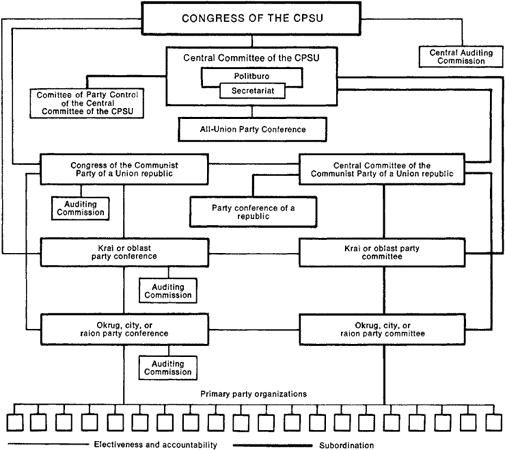
Party The roots of the party were cells - basically any organisation that has three communists or more were to form a party cell. Those cells then send people up through their local/regional party committees, which in turn periodically have to send representatives off to the 'base' of the party centre - the Congress of the Communist Party of the Soviet Union. This body didn't not meet very often (IIRC under Stalin it met quite rarely at times) so it in turn nominated candidates for a Central Committee that would meet more regularly, and handle general business. The Central Committee as well as being a body that convened and voted of things, had a number of attached departments, notably the Secretariat and Orgburo which did a lot of the 'practical' work in running the party but also other functions, like the newspaper Pravda. Since the Central Committee itself couldn't/didn't meet all the time the Politburo was formed, to decide matters when the CC was meeting and in practice it tended to act as the party's executive. So in theory the make up of these committees, bureaus etc. as well as their function was based on votes. But in practice these votes were not always free for alls, much was decided through various informal mechanisms before anything went to a vote in the first place (like picking candidates for jobs, then only having them as an option in the vote). The clearest example of theory vs. practice was the office of General Secretary - in theory they were just the chief of the administative arm of the party... under Stalin it was established as the very top of the Communist Party.
This diagram is perhaps a little messy, but covers all the main bits: http://img.tfd.com/ggse/6f/gsed_0001_0031_0_img9756.png
Government/State Like the Communist Party, the basic units of the Soviet state were offices and committees at the local level. The parliament equivelent was the Supreme Soviet with two 'houses' - The Soviet of the Union, elected by the general population, and the Soviet of Nationalities, which had representation based on the various Union and Autonomous Republics, the smaller oblasts and okrugs etc. When the Supreme Soviet wasn't meeting, matters were handled by the Presidium, the chairman of which was nominally head of state. The Supreme Soviet also voted in the Council of Peoples Commissars (later Council of Ministers), which was the nominal executive of the state and also the guys who effectively ran the economy (so the Commissar for Heavy Industry sits here). The economic commissarates/ministries, Gosplan etc. are also part of the state, rather than the party.
I cannot for the life of me find an organisational chart of Soviet government that doesn't provide an overly detailed account of one arm of the state while neglecting some other function.
Party and State The state bodies could debate and vote on things and according to the rules could knock back laws etc., but in practice the parliament was a rubber stamp for the party. The administrative/executive organs of state were just there to implement what they were directed to do by the party.
Part of the overlap results from the concentration of party members in the government. It would be basically impossible to reach a high position in the government without being a party member. Key party members, like people on the Politburo, often also had formal or informal oversight of government departments. Stalin was both General Secretary (defacto party boss) and Chairman of the Council of People's Commissars (boss of the executive/economy). There was also just the general culture/doctrine that opposing the party wasn't accepted - even in the party any kind of oppositional activity, particularly in the Stalin era, was likely to cause a lot of trouble for those involved (by the time of the Purges it could prove quite fatal). So if you were in government you knew you couldn't actually derail what the party had directed, and besides you were probably a party member yourself.
Post-Stalin the role of the executive and parliamentary elements of the state gets a bit more nuanced (in some ways for example the Supreme Soviet was a better place for debate than the Central Committee), but not by any great margin.
So tl;dr - the party ran the show. The General Secretary was the boss, he ran things through the Politburo, Secretariat etc. and to a great degree the higher positions in the party could play the system to exert a degree of control over the lower level non-centre units. The main notable function of the state in this era was to run the economy in line with party direction, with a parliament to rubber stamp things for the sake of legitimacy.
Hope that made sense, even I get mixed up with this stuff sometimes.