Previous weeks' Tuesday Trivias and the complete upcoming schedule.
Today’s trivia comes to us from /u/zeroable!
Symbols! Please tell us the interesting history of an everyday symbol. Or the everyday history of an interesting symbol? Doesn’t matter, symbols, logos, mascots, Official State Flowers/Birds/Dog Breeds/Mushrooms, things like that, all fit the theme of the day.
Next week on Tuesday Trivia: Life begins after 50! We’ll be talking about historical figures who did their big historically important thing after that pesky half-century point.
This is a very small offering indeed, but we might talk a moment about S.R.D..
During the First World War, British infantrymen serving on the Western Front were normally entitled to one standard ration of rum per day -- with provisions being made for extra rations in the event of attacks or patrols, to steady the nerves and to instill the proper fighting spirit. The standard ration, however, was a privilege, not a right. It had to be justified by the divisional commander, and only on the advice from medical officers that conditions were sufficiently arduous. Few indeed were those who refused to go along.
In any event, the ration was distributed (in theory) under officer supervision during Stand-To, one soldier at a time. The daily ration came to a quarter-gill per man, which is roughly equivalent to a modern shot. The rum came up to the line in a brown earthenware jug that looked very much like this preserved example from the Imperial War Museum. You will note the initials S.R.D. inscribed upon the jug; these stand for "Special Rations Department."
The jug was designed to be sturdy, but only barely portable; it was important that large quantities of rum make their way to the lines somehow, but not in a fashion that would make them easy to purloin, conceal, or drink from alone. This was sometimes a vain hope, but on the whole it worked -- once they got to the line. It was a widely-held belief among the men that their counterparts working for the S.R.D. took many liberties with the rum they were supposed to be bringing up, and as a consequence those initials, like so many other things of their kind, took on a set of informal and scathingly derogatory meanings. The most common among them were "Service Rum -- Diluted" or "Seldom Reaches Destination." In less common circumstances, the initials seem to have become a mere shorthand for the rum itself; one would talk of having received his shot of S.R.D., or even of Essardee. I've only ever seen each of these mentioned once, though, so take it with a grain of salt. It wouldn't surprise me, though, given how common this sort of slang was among British infantrymen at the time. My favourite is probably "Napoo" (meaning destroyed, finished, ruined, etc.), a cheerfully mispronounced version of the French "il n'y a plus," meaning "there is no more."
There's a whole other post to be written here about the transmutation of military initials into words, but I'm not in a position to produce it just now.
Okay, one more. This one is about an interesting use of a symbol.
Where in a United States public building will you find a depiction of the Prophet Muhammad?
Answer: in the Supreme Court. He appears holding a Koran and a scimitar, alongside Justinian and John Marshall, among other figures representing lawgivers and philosophers throughout the ages.
The frieze itself is over eighty years old. The controversy itself is relatively newer. Responding to criticism in 1997*, Chief Justice Rehnquist said that though he understood Muslim objections to the depiction, Muhammad's inclusion was "intended only to recognize him, among many other lawgivers, as an important figure in the history of law; it is not intended as a form of idol worship." Court literature also disclaims any attempt to accurately depict the Prophet; it is a resemblance only.
(* I presume we can discuss recent controversy surrounding appropriately >20 year old things.)
I have been advised that place-names qualify. Some interesting ones from the New York area, then:
"Long Island" and "Staten Island" are quite possibly the most boring names ever conceived. The former is from "Lange Eylandt," meaning, fascinatingly, an island that is long. Stunning. Staten Island, too, equally remarkably, was named to honor the Dutch Parliament, its "States General." Fascinating stuff (from Shorto's "Island at the Center of the World").
Ok, with the boring stuff out of the way, "Jones Beach," the major public beach on Long Island, actually has an interesting story. Though its name has been traced to a couple different origins, in Robert Caro's "Power Broker," about the career of master builder Robert Moses, Caro gives the definitive account. And that is, Jones Beach is named for a pirate. Specifically, the British privateer Thomas Jones, who settled the land in the late 1600s.
Caro also gives an account of the origin of the name "Fire Island," the major barrier island and vacation spot off the central part of Long Island. Basically -- and excuse the Wikipedia -- "Fire" Island is a corruption of another name, possibly "Four" from the Dutch. "Fire" is a recent creation.
One more. Nassau County, one of Long Island's two non-NYC counties, obviously derives its name from Prince William of Nassau, of the House of Orange. And to this day Nassau County's seal is a lion, rampant, on a field of azure, set against an "orange" background.
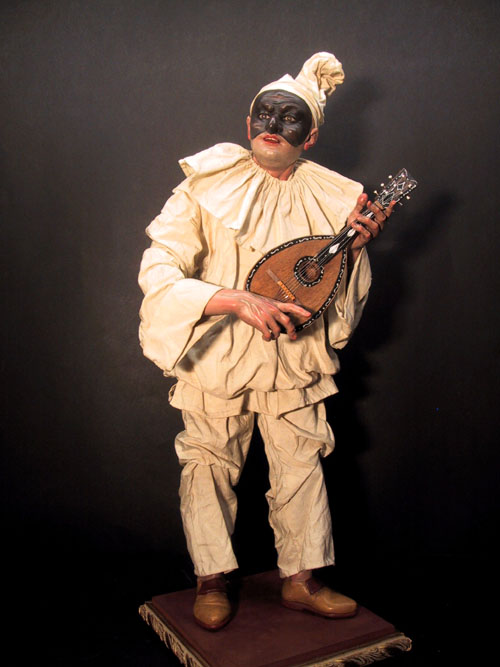
Let’s talk about Pulcinella, who is not really well known in America, but he’s the symbol of the city of Naples. If you go over to /r/italy his mask is the flair for Napoli. Pulcinella is a slightly terrifying clown figure (and this is from a person who likes clowns!) with all white clothes, a black hook-nose half-mask, talks in a “swazzle” voice (that weird kazoo voice that is the stuff of nightmares), who is often depicted with a passel of hungry children, a playing mandolin, or shovelling spaghetti into his mouth with his hands. Sometimes he has a hunchback, sometimes not. In America sometimes you can spot a statue of him lurking somewhere in Italian-American restaurants, which largely serve Neapolitan-style food. I was at an Italian-restaurant-went-out-of-business-turned-sports-bar the other day and there he was holding up the menu out front, which was pretty funny. It was nice of him to stay on at the sports bar, which, to be fair, did serve pizza.
Pulcinella is one of a set of stock characters that make up Commedia dell'Arte (which, along with other popular theater, would have a large amount of influence on opera.) The storylines of these were those of universal appeal, lovers, spousal difficulties, cheats, fools; and you could work in lots of nice timely jokes and political jibes it was done live, with no set script. Lots of these stock characters had some sort of ethnic/regional stereotype basis (such as a miserly, cheating Venetian, or a stuffy professor from Bologna), but largely the regional links have been lost now, except for Pulcinella who maintains his Neapolitan identity. His character is happy-go-lucky, perpetually poor and hungry, but always high-spirited, playful, and surviving. Perhaps these rather positive attributes are the reason why the Neapolitans have kept him.
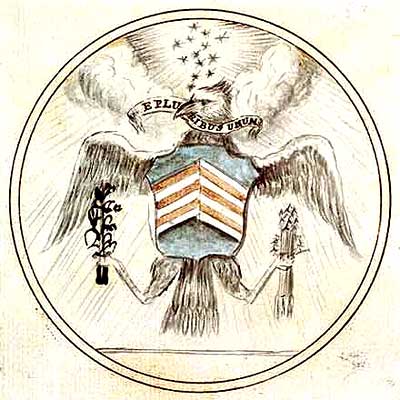
The Great Seal of the United States
If you notice the top of the seal has 13 stars which appear to be in the shape of a Star of David. This is often attributed to the influence and support provided by Haym Solomon (or Salomon) to the Revolutionary cause. He lent/gave an enormous sum of his own money to help finance the war effort. According to legend George Washington asked the designers of the seal to include the Star of David in deference and respect to Haym Solomon. Unfortunately this story is apocryphal at best. The instructions for the design of the Great Seal included no instructions on how the 13 stars were to be arranged. There were three different design proposals put forth by committees and Charles Thomson used elements from all three of them in sketching the final design which was then engraved by Robert Scot. The description provided by Thomson for his design doesn't include any specifics about how the constellation of stars is to be arrayed:
On a field Chevrons composed of seven pieces on one side & six on the other, joined together at the top in such wise that each of the six bears against or is supported by & supports two of the opposite side the pieces of the chevrons on each side alternate red & white. The shield born on the breast of an American Eagle on the wing & rising proper. In the dexter talon of the Eagle an Olive branch & in the sinister a bundle of Arrows. Over the head of the Eagle a Constellation of Stars surrounded with bright rays and at a little distance clouds.
How about names of some events? Those can work as symbols, right?
The "Boston Tea Party" seems like something that's been known in American history since it happened and that it's always been called that. Interestingly enough, the first recorded usage of the phrase "Boston Tea Party" wasn't until December 30, 1825, which reported on a toast made at a dinner party.
"The Boston Tea-party—May tyrants and oppressors throughout the world be speedily invited to a like entertainment."
In 1826 another newspaper story talked about "a temperate, hardy old veteran” named Joshua Wyeth who “often boasts of the 'Boston tea party.'"
An 1829 obituary of Nicholas Campbell reported that he "was one of the ever memorable Boston Tea Party."
It's likely that the phrase was in use earlier than these recorded events--that's the way language normally works after all--but these are two of the earliest usages in print. It's also likely that the most common use of the "Boston Tea Party" was in reference to the group of men committing the act, not the event itself (the 1829 biography seems to indicate that the tea party was the group of men, not the event, though the 1825 usage seems to indicate that the Tea-party was the event, not the people).
Or maybe another famous phrase from the American Revolution?
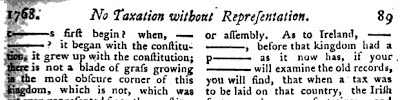
"No taxation without representation".
This phrase was actually coined by an anonymous newspaper editor in reference to the debate surrounding the Declaratory Act.
In 1765 Parliament passed the Stamp Act, which was wildly unpopular in America. It was repealed, but in repealing the Stamp Act Parliament passed what is known as the Declaratory Act which stated the right of Parliament to pass laws regarding the American colonies. Only four members of Parliament voted against it--one of those men was Charles Pratt, first Baron Camden (soon to be Lord Chancellor). He gave a speech, in which he argued that:
My position is this—I repeat it—I will maintain it to my last hour,—taxation and representation are inseparable;—this position is founded on the laws of nature; it is more, it is itself an eternal law of nature; for whatever is a man’s own, is absolutely his own; no man hath a right to take it from him without his consent, either expressed by himself or representative; whoever attempts to do it, attempts an injury; whoever does it, commits a robbery; he throws down and destroys the distinction between liberty and slavery. Taxation and representation are coeval with and essential to this constitution. . . .
In short, my lords, from the whole of our history, from the earliest period, you will find that taxation and representation were always united; so true are the words of that consummate reasoner and politician Mr. Locke
Lord Camden's speech was reprinted in The Political Register in September 1767. In February 1768 The London Magazine, or Gentlemen’s Monthly Intelligencer reprinted the speech. On each page of the speech, the editor of the paper inserted a sentence or two summarizing the content of that page. On the page containing the quotes from Lord Camden regarding taxation and representation that anonymous editor had this line "No Taxation without Representation" as a summary of the content. The first usage of that phrase in America seems to be from Rev. John Joachim Zubly in a pamphlet titled * An Humble Enquiry into the Nature of the Dependency of the American Colonies upon the Parliament of Great-Britain, and the Right of Parliament to Lay Taxes on the Said Colonies* in which he included this paragraph:
"In England there can be no taxation without representation, and no representation without election; but it is undeniable that the representatives of Great-Britain are not elected by nor for the Americans, and therefore cannot represent them…"
From there it spread like wildfire.
Someone on /r/Judaism posted a cracked article that said, "The modern Star of David didn't start to see widespread usage until the 19th century." I wrote a little response to it, explaining very very briefly the history of some Jewish symbols.
Vocabulary: magen david=Hebrew for Star of David [literally "shield of David"], kabbalah=Jewish mysticism, segulot=charms, remedies, Sukkot="the festival of booths", one of the three major biblical festivals, like Pesach/Passover and Shavuot/Festival of Weeks; during Sukkot Jews traditionally perform certain prayers while holding the "four species": a date frond, a myrtle branch, a willow branch, and a special citron, tefilin="phylacteries" [those black straps and boxes used in prayer], mezuzot=the little boxes sometimes outside Jewish homes.
I was amused to find that the peace symbol (the Nuclear Disarmament symbol in Great Britain, and a.k.a. "the footprint of the great American chicken") was actually designed from the semaphore signs for "N" and "D". Link to designer story here.
How about place-names? Since they're kind of symbols, being shorthand ways of describing a place, do interesting place-name origins qualify?