I've been studying the Russian Revolution, and the topic of ethnic minorities comes up often. I've always thought of the Ukraine as historically similar to Russia, and I've assumed that Kievan Rus is Russia's historical beginnings. I'm mostly confused as to when Moscow arose as the center of the Russian state as opposed to Kiev.
The first "Russian" city, and even the concept of a "Russian state" is very fluid and has little certainty. The first settlements in what is now geographically Russia or Ukraine were not Slavic, Scandinavian or Finnic at all, but either Turkic peoples, tartars, Iranians, or Greeks.
From the 7th century BCE onward, the predominate people in Southern Russia were Scythians, an Iranian people, who lived alongside numerous Greek settlements and trading posts. After them came the Sarmatians (also Iranian), who lived there until the Romans absorbed the Greek colonies in the 3rd century BCE.
By the 3rd and 4th CE, Goths, Huns, and Avars made it their home. None of the above really left settlements, if anything they raided and harmed the ability of towns or cities to get started, a tradition continued by Eastern peoples in Russia for centuries.
The first "Russian" city (that is, city in modern Russia/Ukraine founded by slavs) is also up for debate. Legend says Kiev was founded in the 5th century CE, but most historians now place the official founding somewhere in the 9th century, along with the other prime candidate for first Russian City: Novgorod. The Chronicles mention Kiev in 842, when it was ruled over by Scandinavian princes, but without relation to Rurik. It was also written that Oleg established his capital here and formed the "Kievan Rus" in 882. The primary chronicle mentions Novgorod in 862, when Rurik was "invited" to rule the citizens of the city. The issue here is that while it looks like Kiev predates Novgorod by 20 years (or the other way around, because why make it easy), this is merely the earliest dates they are mentioned in Russian chronicles, both cities have been established and are thriving at this point, never mind Norse chronicles that mention Novgorod earlier, but archaeologists can't find evidence from before the 10th century, or that Kiev may have been founded by easterners.
862 was the accepted beginning of the Russian state by the Romanovs, who celebrated the millennial anniversary of Russia in 1862.
The issue is that Kiev was razed repeatedly in the 13th century (fully to ashes by the mongols in 1280), and that left a vacuum for Russian power,and the metropolitan of Russia homeless
As far as why/ when Moscow rose to prominence, you have to look a few centuries later, and, just like all of Russian history, is clouded in argument. The two main camps argue that Moscow rose to power for different reasons. One claims it was because it was an attractive spot to settle on the banks of multiple rivers, making trade easy and prosperous, and moving soldiers to other lands simple. The other due to the fact that Moscow is surrounded by forests, which made it difficult for the tartar horsemen to reach, providing a secluded safety. We know little about the "why," but the "how" has been agreed upon.
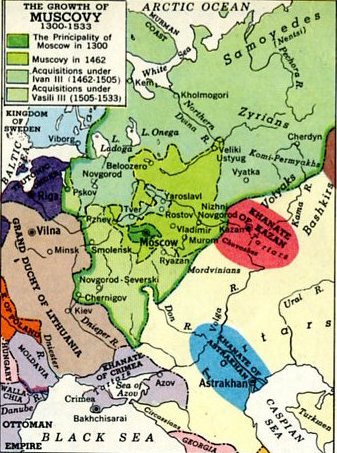
Muscovite expansion came in three large waves: the end of the 13th century, Daniil Aleksandrovich ruled Moscow, a tiny pincipality about 120 miles east to west, and 70 north to south, and he about doubled it in a few short years. After him there was a long lull in expansion of land, but not influence. His son, Yuri Daniilovich was shifty and managed to murder and marry his way into increasing power, the most important being granted the principality of Vladimir and earning the title of tax collector for the Tartars, who ruled over nearly all of Russia at this point. His son, Ivan "moneybags" Kalita skimmed generously off the top of these taxes and built a massive Muscovite treasury. It was during this time the previously Kievan Metropolitanate of the Russian Church settled in Moscow, and others stayed after him in 1326. The greatest expansion of Muscovite territory was under Dmitry Donskoy (1359-89) and Vaily I (1389-1425, who stretched the territory eightfold over 70 years of conquest. The last being under Ivan III, and I'll let this map show just how impressive his reign was
To answer your questions quickly: Kiev was the first Russian city by 20 years, or maybe it wasnt, or maybe it wasn't even a Russian city by a few centuries, we don't know. And the tartars are to blame for the major (historical) differences between Ukraine and Russia, due to their differing control of the areas, and Kiev was reduced to rubble more than once, and Moscow hit the lottery to get to where it is.
It's not very helpful to think of Kyivan Rus' as a "state" in the modern sense of the term. The region from the Baltic to the Black Sea was made up of a series of city states, of which Kyiv was the most prominent, that were connected by trade routes. So Kyivan Rus was more like Ancient Greece, in that the cities were all nominally independent, but were under the sphere of influence of the ruler of Kyiv. There is also some evidence that Scandinavian explorers/traders had set up this series of cities along their river-based trade routes between Scandinavia and Constantinople, and established their own kingdoms in the process. The mythological story of Riurik mirrors this concept. Kyiv sought to establish more of a political hegemony in the second half of the 10th century, particularly under Volodymyr I the Great and his successors to some extent, but this unification process was short lived, and the area devolved to a completely decentralized series of polities. Any prominence achieved by a Russian monarchical state came much later - 14th to 15th century, growing out of the power of a polity that had previously been on the fringe of the Kyivan Rus' sphere (if a part at all) - Moscva (Moscow). All of this is my recollection from a book called A a History of Ukraine and a class I took on the subject while in high school. I'll find the books author and edit, possibly with link.
Edit: author is Mykhailo Hrushevsky. Book was first printed in 1941, and in retrospect the class I took was definitely sponsored by an organization with a pro-Ukrainian national identity/heritage agenda. This isn't to say the book or it's ideas were wrong, but some . . . Discernment is in order.