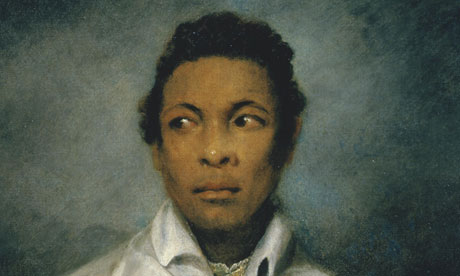
This is a portrait of Richard Burbage from around 1600. Regarded as one of the best actors of his age, Burbage originated the roles of Hamlet, Richard III, and King Lear, and was almost certainly the first actor to play Othello. His portrayal of The Moor of Venice in 1604 is noted in multiple sources as being fantastic and he made the role famous.
It is unknown whether or not Burbage darkened his skin for the role and there are no descriptions of the costume he wore, but he set the convention of Othello being portrayed by white actors that would last for two centuries.
In 1825 American (and later English) actor Ira Aldridge was the first black actor to play Othello. Aldridge's Othello stunned critics and made him famous in the London theatre scene. Aldridge is honored with a bronze plaque at the Shakespeare Memorial Theatre at Stratford-upon-Avon.
To add to texpeare's answer, one of the difficulties of this is that we aren't really certain whether the 'moor' in this case was meant to represent a full black-skinned man, or whether it would refer to a lighter skinned North Africans like the Berbers. The notion of skin colour wasn't nearly as ingrained in Elizabethan and Jacobin England as it is today, and didn't carry nearly the same political message. It is entirely likely that to an Elizabethan-era inhabitant of London, a moor would be just as acceptable to be thought of as a dark skinned black man or a lighter skinned Arab.