Saw this today - http://i.imgur.com/6eUoctT.png and it made me think.
Germany invaded the USSR in 1941, creating [the Eastern Front](http://en.wikipedia.org/wiki/Eastern_Front_(World_War_II), the largest theater of the war (and, in fact, in human history). The vast majority (>75%) of German troops were committed to the Eastern Front. It was also the scene of the largest battles of the war - the Battles of Moscow, Stalingrad, Kursk, among others. Ultimately the Soviets were successful in halting the German offensive and driving the Germans westward all the way to Berlin.
It is kind of hard to do this question justice since your question is too broad. Trying to summarize the role of the USSR during WW2 it a couple of paragraphs is basically impossible. I'd suggest that you do a bit more research on the topic and follow up with more specific questions.
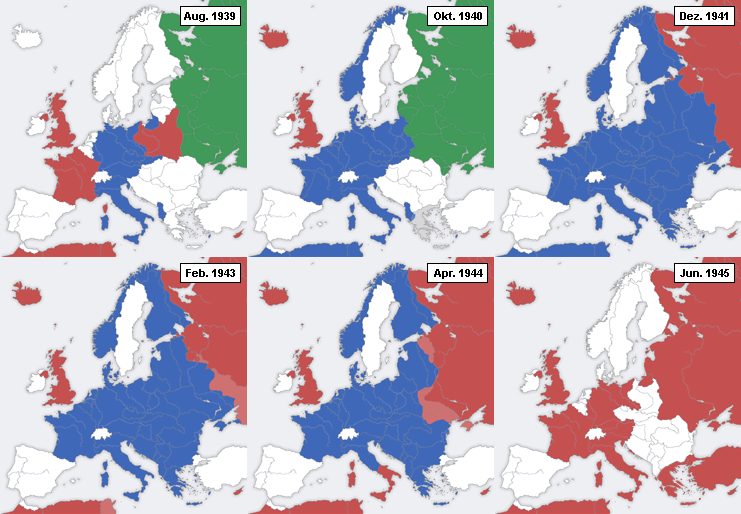
EDIT: So picture is worth 1000 words - here is a gif version of the Europe during WW2. The entire top-right quadrant of this map is the Eastern Front. http://upload.wikimedia.org/wikipedia/commons/1/19/Second_world_war_europe_animation_small.gif
From the 22nd June 1941 to the end of the war, the majority of German troops were on the Eastern Front. Even after the Normandy landings, 60% of the German army was facing the Red Army. Of the 13.5 million casualties the Wehrmacht suffered, 10.8 million were taken on the Eastern Front. For much of this period, the Western Allies were involving themselves in sideshow campaigns, that had little effect in terms of winning the war.
The Red Army's war can be split into several general phases. The first is the period in which the Germans hold the strategic initiative, making deep penetrations towards some of the USSR's major strategic targets. This starts in June 1941, with Operation Barbarossa. This destroyed much of the Red Army's units in the border regions. It would then progress into a series of offensives aimed to destroy the Red Army and its ability to fight back, as well as capturing Moscow and Leningrad. Soviet counterattacks, while taking immense losses, prevented these targets from being captured. As winter hit, the Soviets began offensives across the front. Some failed miserably, but the Germans were pushed back from Moscow, and pressure was put on the Germans across the front. Summer 1942 saw Operation Blue, the German push in the south. This pushed the Soviets back from Kharkov to Stalingrad. At Stalingrad, the German 6th Army became bogged down in city-fighting.
The second period sees the strategic initiative begin to shift, and begins in winter 1942. This sees two major offensives by the Soviets, Operation Mars, which was a failed offensive against Rzhev, and Operation Uranus. This encircled the 6th Army and allied Italian and Romanian forces at Stalingrad. The Germans attempted to break the 9th Army out, but failed. In summer 1943, the Germans attempted to crush the Kursk Salient, which had been formed by earlier Soviet offensives. This was the largest tank battle in history, and pitted 2.5 million Soviet troops against 1 million Germans. As the Soviets had seen this offensive coming, they prepared a thick defence, defeating the Germans. At a similar time the Allies invaded Sicily. This pitted 160,000 British and American troops against 60,000 Germans. Following the failure of the Kursk offensive, the Soviets launched an offensive along the majority of the front. This offensive pushed the Germans back to the Dnepr river, providing jump-off points for further offensives.
The final period sees the strategic initiative firmly with the Soviets. From January to March 1944, the Soviets launch a major offensive in the south, reaching the Romanian and Polish borders, and liberating the majority of the Ukraine. A simultaneous offensive in the North liberated the Leningrad region. June 1944 saw the launch of Operation Bagration, a massive offensive in Belarus, which completely destroyed 3 full Army Groups, causing 800,000 casualties. This reached Warsaw, as well as the borders of Hungary and Bulgaria. In January 1945, an offensive was launched against East Prussia, towards the heavily defended city of Konigsberg. By February 1945, the Soviets were across the Oder river, a mere 40 miles from Berlin. Between February and April, the Soviets captured the remaining parts of Poland and East Prussia, and advanced into Austria. A German counteroffensive in Hungary was also defeated. Finally, the Berlin offensive began in April, capturing the city and bringing an end to the war.
For more information, I'd strongly recommend reading David Glantz's essay on the myths and realities of the Eastern Front. It can be found online here. It goes into a lot more detail than I did, especially on less well known operations.