Hello there, I was wondering about when the stone age and hunting and gathering ended in the Middle East. I know that Mesopotamia was the first civilization in the world. When did other civilizations begin the middle east? Where there many neolithic cultures in the middle east that are not considered civilized? I know that in Anatolia there was Catal Huyuk and other cultures that were permanent but not considered "civilization".
What were the first Mesolithic cultures of the Middle East/Near East?
Can you recommend any books/studies on the preshistoric middle east?
As you say the Near East^1 was the home of the world's earliest civilisations.^2 Not coincidentally, it was also the home of the world's earliest farming societies. And before that, again not-coincidentally, it was home to some of the most successful foraging societies in the prehistoric world.
Basically, the common thread is population density. But lets start from the beginning.
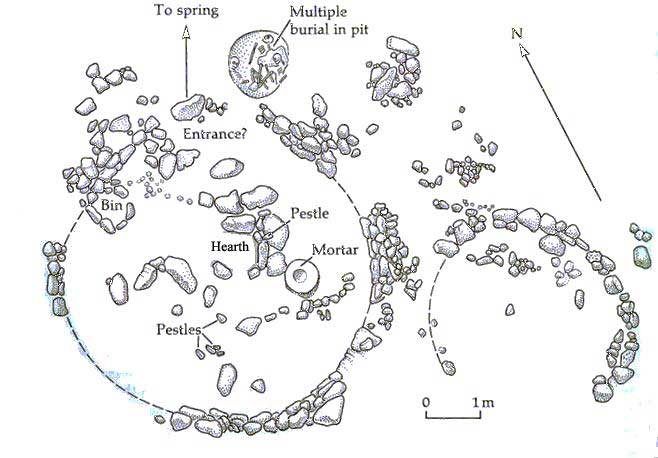
We're currently enjoying a warm spell (an interglacial) in a two and a half million year long Ice Age. Most of human history took place in the colder parts of that Ice Age, when the inhospitable climate kept populations low and meant that, even though they were just as smart of us, our ancestors lived in small foraging groups and were limited to relatively simple technology.^3 Between when the Ice Age was last at its coldest 23,000 years ago and the start of the current interglacial 12,000 years ago, foraging groups around the world took advantage of the warming conditions. There was more food, so populations grew, and in turn people sought out new sources of food and inventive ways of exploiting difficult-but-rewarding foodstuffs like wild grains. For reasons that are not altogether clear, foragers in the Near East were at the forefront of this trend. Especially towards the end of what's known as the Epipalaeolithic period (roughly equivalent to the European Mesolithic), they engaging in labour intensive processing of wild foods to get more out of them; gathering in large numbers to take advantage of things like wild grains or herds of gazelle; building substantial houses out of stone; using intricate specialist tools; and spending more and more time on things like art, decoration, ritual and ceremonial burials.
All this meant that when the climate did tip into the interglacial, foragers in the Near East were already well on the way to things that were conventionally considered "Neolithic". It's in this context that we start to see sites like Göbekli Tepe, where foragers came together to build a large "temple" complex, make elaborate sculptures, bury it all and start over again, and generally do things that require a lot of people with a lot of time and a lot of food to do. With the Epipalaeolithic foundation of large, semi-sedentary populations relying on intensively processed grains, it was not so much a Revolution as a small tweak for them to settle down and start growing their grains – hence why the Near East was the first to farming, and got such a head start on all the things that farming makes possible.
Similarly, the fact that the Near East had flourishing Neolithic societies means we shouldn't be surprised that it was home to the first civilisations. You mentioned Çatalhöyük. Like Göbekli Tepe, that's a very well studied and very well known but otherwise utterly unremarkable site. All over the Near East there are sites where people came together in very large numbers, intensively cultivated the surrounding landscapes, made a substantial investment in their built environment and led highly complex social and symbolic lives. It's only a slight simplification to look at sites like that and say that if you throw a wall around them and give them a God-King to boss people around, you've got a city.
So although history textbooks often look at the civilisations of Mesopotamia as the start of the story, for Near Eastern archaeologists its the climax of one – the earliest cities were underpinned by the equally precocious Neolithic societies they grew out of, and those in turn by a peculiarly active and diverse foraging scene at the end of the last Ice Age. That is not to say other parts of the world didn't also have vibrant Palaeolithics and Neolithics and eventually their own urban societies, but the Near East built a lead in population density early and maintained that momentum for thousands of years.
=====
^1 "Near East" and "Middle East" mean essentially the same thing. Archaeologists conventionally use Near East, so let's stick with that.
^2 Civilisation is a very problematic term but lets just take it as short hand for "state societies with urban centres" and not get into all that.
^3 Again I don't want to get sidetracked too much into the link between population density and cultural/technological complexity, because I think it makes intuitive sense for most of us in the generation that grew up playing Civ. The short version is that even though people might be just as likely to invent new technologies (or other forms of culture) in societies with smaller populations, it's more likely to be forgotten again, because there aren't as many people around to remember it. So small groups have trouble maintaining cultural diversity, and consequently complex technology and specialist knowledge, in the long term. The most vivid illustrations of this link are when populations go from big to small and drop cultural diversity, e.g. Tasmanian Aborigines, who had a much simpler technological toolkit than the mainland Australian societies they branched off from when they migrated to Tasmania.