From what I've been reading, the primary argument against a secession from Britain by the Scots is that the economies are very inter-dependent and that currency issues would destabilize trade.
My question is, looking back at India's decision to secede (definitely not trying to compare quality of life or other factors that are obviously different), what was their dependence / economic situation during the Partition? Were they more willing to give up some sort of promise of economic stability because they were starting from such a low base and had nothing to lose? Or did they already have a pretty a strong case for an independent economy?
To better understand India's economic situation at partition, you have to look at what led up to that particular economic climate. The partition did not occur in a vacuum, and the circumstances surrounding it didn't just randomly come about for no reason. In taking a macroscopic look at the situation, you can better understand the nature of the relationship between the British Raj and the Indian sub-continent.
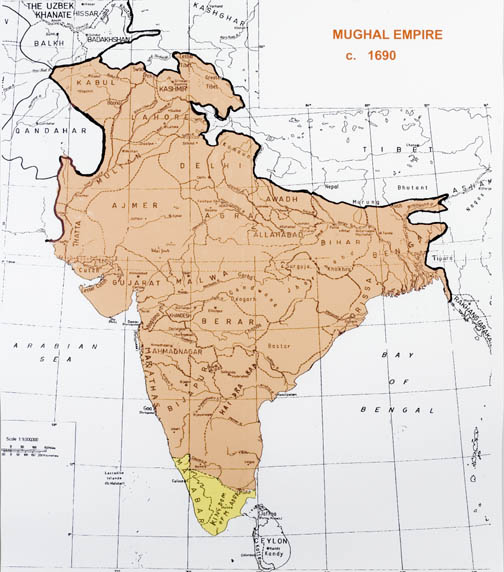
So for starters, lets take a broad look at the situation. Here you can see a diagram based on data from the paper by Angus Maddison that charts 'percent world GDP @ PPP' throughout the ages. As you can see, for most of the past two thousand years, India and China have invariably held approx. a quarter of the world GDP each. But with due respect to traditional, pre-industrial economies, this is by no means surprising. They were the two most populous regions through all this period. For reference, 1700 AD, that last significant period of independent Indian economic presence corresponds with Aurangzeb's rule of Mughal India. The Mughal state at this time encompassed nearly 30% of humanity, so it naturally follows that the GDP would correspond in that day and age.
As you can see on the chart, India's global GDP share falls drastically from 1820-1940, roughly the period of British rule. Now some of this is clearly attributed to the growth of places elsewhere as India's traditional markets lagged behind industrializing nations. And yes, this is a map of GDP share and not simply the figure. But for the most part, the stagnation and 'collapse' of the Indian economy can be attributed to British economic policy as seen at both the macro and micro levels:
“As British living standards increased from the mid-seventeenth century, India fell increasingly behind. Whereas in 1600, Indian per capita GDP was more than half the British level, by 1871 it had fallen to less than 15 per cent.” (Broadberry&Gupta)
It's no coincidence this- inverse relationship between Britain and India's economy. What it boils down to, is that instead of making India's various markets into healthy economies in their own right (as previous empires had a vested interest in), Britain turned India into a source of wealth at the cost of destroying all the native industry. For nearly 2 centuries Britain would have direct rule of India, and for exactly 0 of those years was India or the welfare of India the main concern, if you're getting my point. Policy blunders didn't only cost the subcontinent generations of a healthy economy, but in the cases of the Bengal Famines 9both 1770 and 1943), actually resulted in millions of deaths.
The reason for my elaborating on all that is because it gives you an idea of what had been going on for 2 centuries to set the stage for the Partition. These are the circumstances that precipitated India's independence. So was India dependent on Britain? Hell yeah it was, it was made to be forcibly over the course of many generations. All major industry in India was hand-me downs from Britain on the eve of revolution. For the past century, India had only known this Imperial system. It entered British Dominion and left it in two different eras of the world. So yes, it was dependent. But was it worth leaving the stability of being a colonial possession even with an uncertain economic future? Absolutely. Under the conditions of Partition, an Indian state of that size, even sans Hyderabad initially, is a massive state with huge territory, population, and resources. Of course it could pitch an independent economy, and even if the immediate situation was worse than under British Rule, the only healthy future for India was in the way of independence.
Post-independence however, failed Nehurivian policies and the license Raj really hurt India's economic prospects. Even with that having been the case, I stand by my assertion that independence in the case of India was the only way. I hope I have addressed your question, if you have any other questions let me know.
Having made my actual response, I would just caution you in comparing colonial India with Scotland today. The two cases are dramatically different to the point of almost being alien to each other. Of course there are valuable lessons to be had in studying the past, but just keep that in mind I guess.
Sources:
“Statistics on World Population, GDP, and per-capita GDP , 1-2008 AD”, Angus Maddison, University of Gronnigen.
Broadberry, Stephen N., and Bishnupriya Gupta. "INDIAN GDP BEFORE 1870: SOME PRELIMINARY ESTIMATES AND A COMPARISON WITH BRITAIN." (n.d.): n. pag.Http://www2.warwick.ac.uk/. Department of Economics, University of Warwick, 18 Oct. 2009. Web. 31 July 2014.
Davis, Mike. Late Victorian Holocausts: El Niño Famines and the Making of the Third World. N.p.: Verso, 2001. Print.