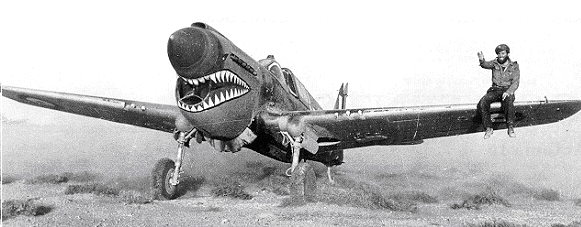
I'm asking about this kind of artwork. It seems to have been especially popular in the Vietnam War, but there are pictures of newer helicopters that have been painted on in a similar fashion.
Shark mouths on aircraft date at least as early as World War I, which is the first occurrence mentioned in my sources. While I think it is safe to say that the American Flying Tigers during World War II brought the style to the peak of prominence, the first recorded use was in fact German around 1916, found on a Roland C.II, flown by Ritter von Schliech, although it is a pretty lame rendering, compared to later versions, as it is really just a black line roughly comparable to a mouth. It seems to have been popular with the Roland C.II, and a number of the aircraft carried it.
At roughly the same time, at least one British aircraft used the Sharkmouth design, one of the butt-ugly Maurice Farmans, serving with the Royal Naval Air Service in the Med. I'm not finding a copy online so I'll scan it from my book later, but the aircraft is much more in line with what we think of, with the teeth and whatnot. It doesn't seem clear who the pilot was, but apparently he was the only one who did it to his aircraft, and it wasn't found on other machines from the Wing. A few examples can also be found here and there of French and American uses, but again, it wasn't that widespread.
While there are examples here and there, the concept pretty much died out once the war ended, and it isn't until World War II that we see the "Sharkmouth" make its come back.The Germans restarted it in 1939, with a few singular examples to be found on a Me 109 and a Ju 87. It really made a splash though with II/ZG 76, a unit of Me 110s, who put it on a number of aircraft. After fighting with the British over the Mediterranean, the Brits of Squadron 112 thought that the paint scheme was sufficiently badass to copy it themselves, putting it on their Curtiss P-40s. Their picture ended up being published in the Illustrated London News, a copy of which made its way to the far east and into the hands of the American Volunteer Group, aka the Flying Tigers, who also thought is was badass, and painted their P-40s in the same style, and because the world is all American-centric, basically getting remembered as the "Shark Mouth" unit, even if they were really doubly derivative...
Now, I'm not going to bother making a full list (if you are interested check out sources below), but suffice to say, the "Shark Mouth" looked really cool, and it got copied by a number of units by the end of the war - fighters, bombers, attack aircraft; American, British, Canadian, Aussies, French - everyone wanted in on it. And it remained that way after the war. It pretty consistently remained one of the "go-to badass" paint, schemes for aircraft, which numerous squadrons across many countries utilizing it. The use in Vietnam simply represented this long tradition, as do more recent examples.
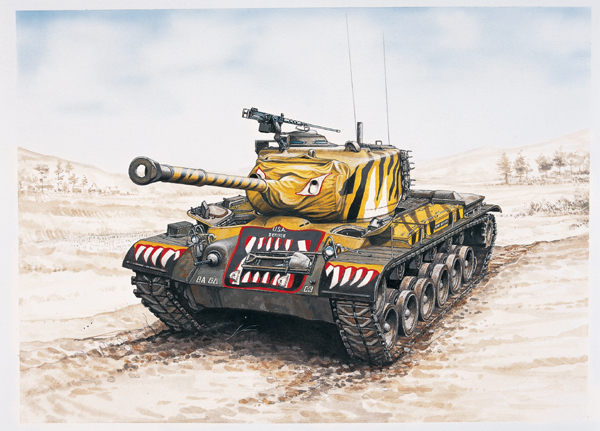
Side Note: It was also not uncommon to see on American tanks during the Korean War, the most famous being the M46s of the 6th Tank Battalion. Apparently the belief was that the design would scare the very superstitious North Korean/Chinese soldiers, although I've never seen anything to substantiate this belief, so it might really have just been an American superstition.
For a ton of photos and drawings, I would recommend you track down the following sources which I drew upon here:
"Sharkmouth 1916-1945" - Richard Ward, Osprey Publishing
"Sharkmouth 1945-1970" - Richard Ward, Osprey Publishing