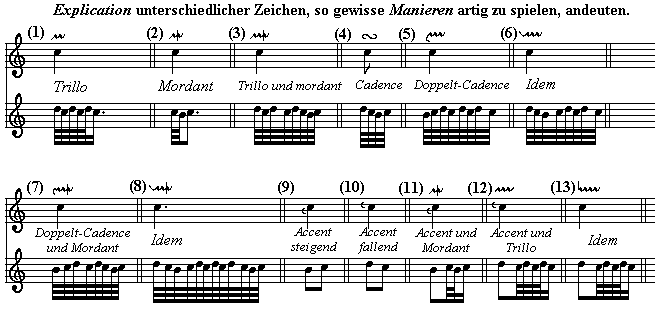
I'm currently playing catch-up on some music theory I've missed over the years, and today we came to ornaments. As it was explained to me, the acciaccatura is written with a line through it because it's optional if you play that note or not (NOTE: When playing piano, I've always been taught to perform it as a very short note before the written note). The appogiatura is the same on paper minus the strikethrough, indicating the note is obligatory. In that case, why not just write two eighth notes rather than an appoggiatura attached to a quarter note?
The answer I got was to do with castrati who liked to add flourishes their own way regardless of what was actually written, but that still doesn't explain how the tradition of writing an appogiatura ever started. It really does seem redundant and I'm not sure how castrati fit into recording music. Also my teacher seems a bit confused about ornaments, claiming that a trill and a mordent are the same, so this is another reason I ask.
I can't exactly answer the question in the title, but I can comment on a few things.
Ornaments are tricky... First, there's have been a big lack of consistency: in the symbols used, in their meaning, and in how they are (and have been) performed. Second, there's the influence of improvisation: these things come from a time full of improvisation. We are talking about stuff from different times and places, vastly different ways of playing.
Most people learn about modern standard notation, and play things in a modern way (we have good reasons to believe the "romantics" were doing things differently, and everything suggests earlier practices were a hell of a lot different from ours). If you look a bit into the past, you quickly find it's not all black and white. A lot of pianists these days don't even know about the different symbols used in, say, England or France...
why not just write two eighth notes rather than an appoggiatura attached to a quarter note?
If you write two notes, the idea of "this is the main note, the other oneis a nice ornament, an extra note to make things nicer" is less obvious. Also, we can read from this notation that you are trying to say "this is no ordinary note, this has a different intention."
You are not always meant to play "two eighth notes." Notation was not meant to be taken as a super precise set of instructions, scores were not gospel to be followed precisely and without questions... Scores were a base for people to build on, until a little into the 19th century people were adding their own ornamentations. The ones that were specified in sheet music were not metronomically played (hell, apparently people were not at all into the precision we now expect in terms of duration of notes), ornamentations were some times ignored/omitted or replaced with something else (that happened to whole passages, a couple little notes were nothing to be particularly pedantic about).
castrati who liked to add flourishes their own way regardless of what was actually written
That doesn't sound like a valid answer to me.
It was not just them, everybody was doing their own thing. Yes, castrati were super stars and people expected super singers to do amazing things (that's why they made the big bucks). But instrument players were also doing this, Quantz tell us any decent musician was expected to be able to add flourishes and improvise variations. If you couldn't do that, you would have to find a competent musician to write them for you (he tells us some singers had to do this because they were incompetent, not being able to add ornaments and be creative).
my teacher seems a bit confused about ornaments
We all are...
claiming that a trill and a mordent are the same
Yes, they can be the same thing. C.P.E. Bach (son of J.S.) tells us that what we now call a mordent was a trill back then, and was played frequently in a way different to how we play trills these days. Check this reference.
So, yeah. It's a complicated topic. I might be able to give some suggestions if you tell me what you are playing and what edition you are using (pics would be nice). I don't know if that would be better suited for PMs...
I can also suggest some reading on ornaments, and might be able to find something more specific about the time and place of the composer who wrote the music you are working on.
Yeah, as much as I'd like to credit the entirety of music history to castrati, I don't think they can take this one. Ornamenting music was standard practice for both singers and instrumentalists (as erus said), well predating the hey-day of castrati on stage. It was something all virtuosi did. And the music was written by the composer with the intention that the performer would finish it out in his or her style to match their personal talents and preferences. Sort of like when you buy a spec home and finish it out with your paint, carpet and appliances maybe? So they weren't really "ignoring" what was written, they were just doing their job. This idea of a singer vs. composer rivalship for artistic control dates from the Romantic period or so, it's not really how baroque/late classical composers and singers worked with each other.
Now, for writing it down, there's the funny thing. Some totally did write their ornaments down, some did not. It was common practice to make like Bill O'Reilly and do it live, but some had it a bit more planned out. Farinelli wrote his ornaments out in his sheet music so we have good record of his ornamenting preferences and styles. I get the sense from Farinelli's writings that he was a real fussbucket though, and this meticulous planning wasn't really common. Caffarelli once claimed to have lost his little book of ornaments and so he couldn't perform, but I think he was being a shit and just wanted to get out of the gig, he was fond of improvising to make fun of people on stage, so I doubt he couldn't get through one evening without an ornaments cheatsheet. But having some sort of formula or plan to doing your ornaments seems to be common.
Also, for any given run of the opera, the top singers would be expected to periodically provide fresh ornaments for the major arias in the opera or at least vary the aria quite a bit to keep the audience amused (gotta do something when they're watching the same opera 5 times in a row), some arias have 2 or 3 known sets of ornament variations, but a lot of it was done live.
With bagpipe music a grace note is technically played before the beat, so it would incorrect to write it as a regular - but very short - note. Instead, a grace note is its own species, hovering in time before the beat, upon which the accented note is struck. Could we be looking at the same sort of thing?
Going out on a limb, but I'd suggest they are written small because the "grace notes" don't form part of the true harmony with the chord. They merely express a decoration of it.