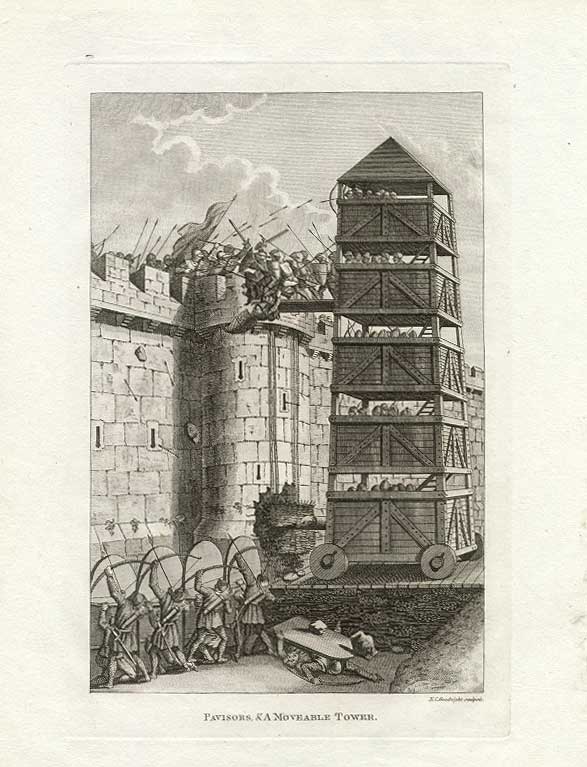
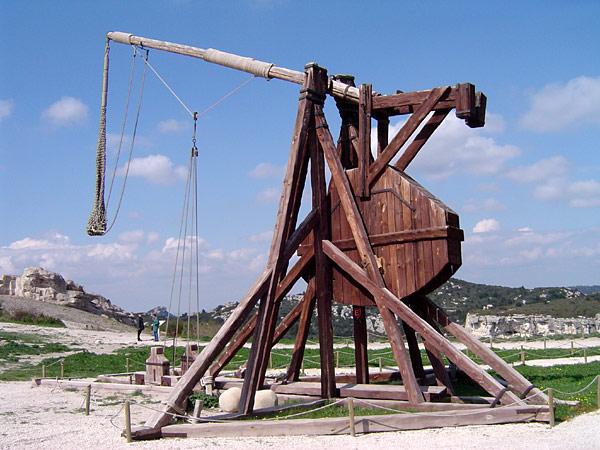
The simplest were scaling ladders for taking the walls and defensive fortifications to protect against counter attack. You're also probably familiar with the battering ram, which in its earliest incarnations was used to either collapse the top of the enemy walls or weaken the walls at their base and was later used against gates. Tunnels were dug under enemy walls to collapse them (not technically a siege weapon but more of a siege technique). Mobile towers were invented so that archers could negate the height advantage of enemy fortification and these eventually developed into siege towers, which functioned as both an archer tower and a way to deliver soldiers to the top of enemy walls. Borers were used to drill holes in or otherwise weaken enemy walls. Defensive structures were created to protect attackers. Larger structures (often called "tortoises") were used to protect siege equipment, like rams, while they worked or protected a large group of workers (repeated image) while they worked to dig tunnels or fill in embankments. Smaller shields were used to protect individuals or small groups, usually missile soldiers engaged in counter-archery with the defenders on the walls. Lastly, throwing machines fired projectiles at defenses or defenders. These could be arrow-firers, such as the scorpion or oxybeles, or throw projectiles, such as the onager or trebuchet.
This information comes from Ancient and Medieval Siege Weapons by Konstantin Nossov. I'd recommend it as an introduction to the subject of siege warfare. It's easy to read and contains a large amount of drawings, pictures, and historical diagrams.
Images used are examples found through google image search. I can't guarantee their accuracy.
Trebuchets were used by Edward I 'the hammer of the Scots' in his wars in Scotland. They were wooden frames which used counterbalances to launch lumps of stone. Edward built one of the largest ever made, called 'warwolf'. He refused an offer of terms when he besieged Stirling Castle so he could get to use it. It ended up taking down a section of the exterior wall.
More generally though, sieges in the era before cannon would involve more waiting and attempting to starve out the enemy, or draw him out of the castle through various means.