Or if not, what kind of training regiments were there?
From Hans Talhoffer:
in your knightly practices:
throwing апd pushing stones,
dancing апd jumping,
fencing апd wrestling,
http://wiktenauer.com/wiki/Hans_Talhoffer/K%C3%B6nigsegg
I did HEMA for a time which basically reenacts these old fencing books, which are the only source for western martial arts and pretty sparse before the 14th century.
As you might imagine a peasant pretty much didn't need to workout so I won't address that. For nobility and those training to be knights or young boys (even peasant boys) in general, in Germany, they were first taught to wrestle. You learn how to wrestle before you do anything. Melee fighting has a great amount of wrestling involved because swordsmanship involves a great deal of grappling, especially when things go wrong. After kids reach a certain age or level of training they would learn the fine art of swordsmanship if they were lucky from a book, but most likely a teacher, likely a master at arms or a fencing instructor at an actual fencing school if they were lucky.
If you were lucky to be taught swordsmanship your exercise would probably going through the motions of swinging your sword on a daily basis through the motions described in a fencing manual, mimiced through teachers (books are rare). Swinging a sword out of combat for a thirty seconds is a exhausting full body effort for most of us. If anybody here has ever fought before you know how the feeling is magnified when you actually fight someone compared to practice and how much more exhausting it becomes. People likely practiced in pairs using wooden or blunted swords, and when they were good enough, practiced on each other using sharp swords.
So a regime, of wrestling and fencing likely on the menu. Pushing stones and throwing stones, dancing and Jumping all seem very self explanatory but the only thing I could find from a quick glance. All these things, you probably didn't need to run, do push ups or sit ups to keep in shape. Pushing stones is the equivalent of doing push ups, and your core would be activated a ton more ways doing all this stuff rather than sit ups. I'm sure a typical swordsman would also ride, hunt, etc.
My viewpoint is skewed from this one vantage point of medieval fencing. Medieval fencing definitely needed to be practiced so it needed a training regime AKA exercise. I don't know for certain if its right and doesn't factually account for much before the 14th century. I would theorize that knights would probably practice swinging their swords/ moves and doing similar things to what Talhoffer said before the 14th century.
Arguably though, bowmen, hunters were far more prevalent and more practiced in European history. But that's another story.
A list of fencing manuals:
http://wiktenauer.com/wiki/Treatises
MAJOR EDIT:
Check out this site:
http://www.thearma.org/essays/fit/RennFit.htm
There is a focus on the Renaissance but it will answer every question you could imagine on the subject.
While the ordinary man was engaged in exhausting farming and trades with less time for military expertise, evidence shows that the primary training of the feudal classes consisted of riding, jousting, wrestling, strength training by lifting large stones, and later calisthenics and even gymnastics. A chronicle from the year 1075, the Annales Lamberti, complained of a lack of physical fitness among laboring peasants which discouraged nobles from pressing them into military service as foot soldiers. In contrast, the warrior class accepted that their leisure time often made them soft while their role in society demanded peak physical performance. One Victorian historian observed at the turn of the century, "The first professional fighters were the aristocracy, who spent their time almost entirely in the daily practice of arms, and kept themselves in perfect training by constant exercise…And this superiority they gradually supplemented by means of armour…"
Unlike the Ancient Greek gymnasias, there were no public training regimes for bodies of men - exercises were done on an individual basis whenever the times allowed for it. I have never found a source on a knight's training regime, only sources and attributes of what a knight should have.
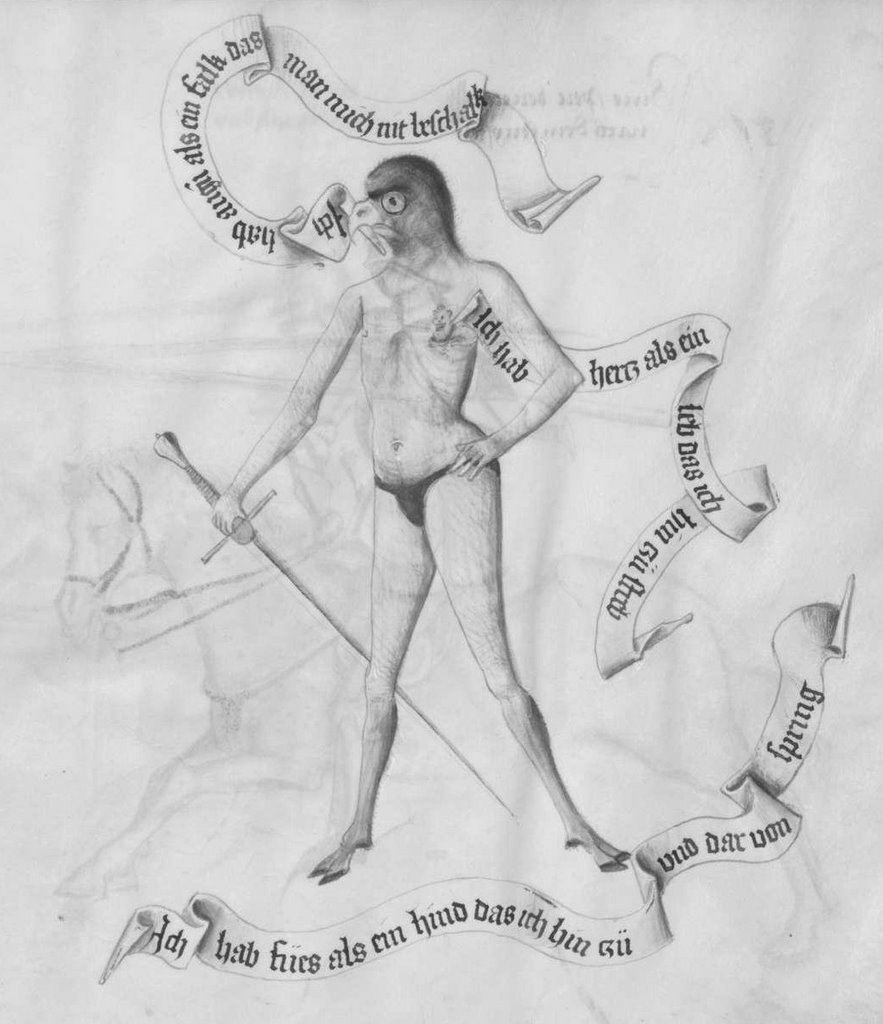
Fechtmeister Paulus Kal has this image in his manuscript; depicting the head of a falcon, the heart of a lion and the feet of a hind (deer). The writing says:
I have eyes like a hawk, so you do not deceive me.
I have a heart like a lion, so I strive forward.
I have feet like a deer, so I can jump forward and backward.
Since his manuscript covers both fighting in and out of armour, as well as on horseback, it can be inferred that these attributes are conducive to the employment of these combative techniques.
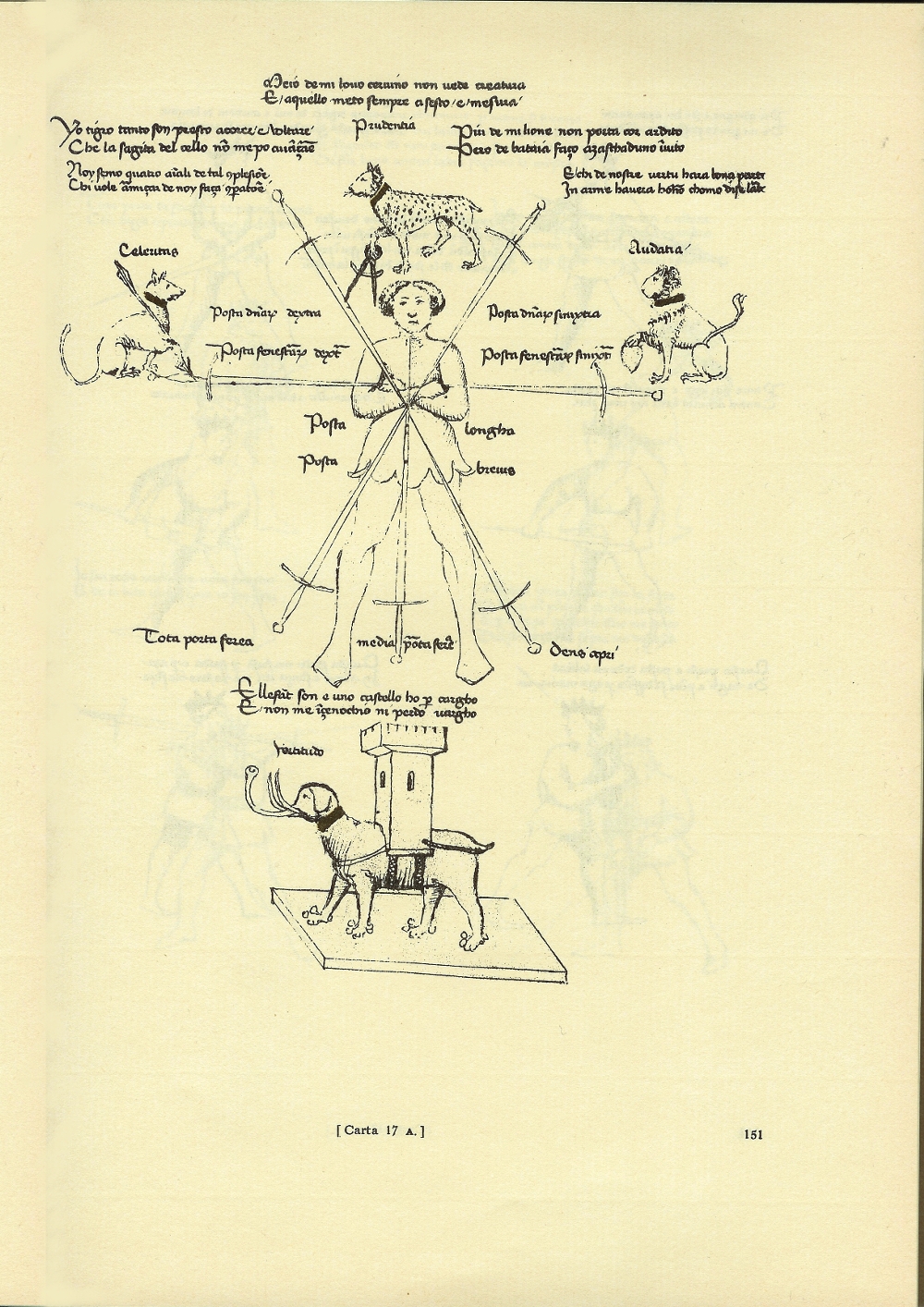
Fiore dei Liberi, an Italian master, has a similar sort of image; the Lynx representing prudence, the Tiger for celerity, the Lion for Audacity and the Elephant as Fortitude.
So, we have established that knights needed to be conditioned such that they were relatively quick on their feet and needed to fight/ride and wrestle well.
The only primary source I have ever seen men-at-arms training his this image. It depicts knights wrestling, fencing and doing calisthenitcs. Indeed, a man in armour was expected to be able to climb ladders, walls, run, hop skip and jump as well as fight, so it would make sense they would do some sort of training for it. But what, exactly, is not documented and can only be inferred.
I'm also curious to this. How many people were muscular back then? It can't just be from wearing heavy clothes/armor...