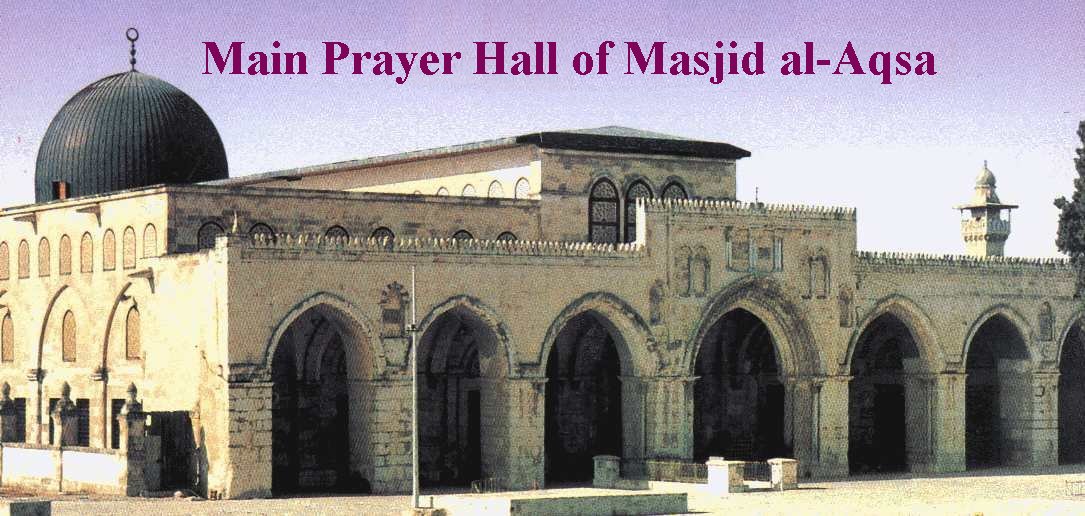
Because they used it of course! Just for some preliminary context this is the Dome of the Rock that everyone knows about. But the Temple Mount is also home to Masjid Al-Aqsa. It is actually this which is the 3rd holiest site in Islam, not the DotR. This was the first directions towards which Muslims prayed. Incidentally, it is holy because it was mentioned in the Quran, despite the mosque not even existing then, as the site from which the Night Journey and Muhammad's trip to Heaven took place. The exact location where he left this dimension or whatever? The namesake rock of inside the dome. But I digress.
Anyways, back to your actual question, after capturing the city the Crusaders turned the DotR into a Church, and turned Al-Aqsa into a Palace and then it later served as a headquarters for the Knights Templar for nearly a century. In fact, many works of Templar architecture is modeled after the Dome and also the Church of the Holy Sepulcher.
As /u/Cyrus47 has already mentioned, the Temple Mount was renovated and consecrated as a Christian religious site, the Church of the Templum Domini, in 1141. The Temple Mount became integral in the liturgical processions and ceremonies, as well as an integral in the coronation rites of the Latin rulers of Jerusalem.
The Temple Mount exercised a strong pull on the Latin kingdoms of the twelfth century. The site is, of course, pivotal in Judaism, Christianity, and Islam and the association of the complex with Solomon was so strong that as early as the ninth century, a Frankish monk by the name of Bernard identified the Dome of the Rock as the actual Temple of Solomon. Fulcher of Chartres makes frequent reference to the site, identifying it as Solomon's Temple (I'll need to check when I get home whether or not he believed it as the Temple). Opinions on the nature of the physical site weren't monolithic; some crusaders identifying the structures as ancient structures erected by past emperors to commemorate events in the life of Jesus that occur at the Temple Mount. Likewise the al-Aqsa mosque features prominently in the minds of contemporaries, at times being interpreted as either the temple and/or Solomon's palace. It is no surprise that the site would become the center of government, the Latin kings inheriting the tradition of Solomon himself.
In essence, the crusaders did not tear down the Dome of the Rock because, whether in actuality or in representation, the Temple Mount was strongly associated and read in the context of its relationship with the Temple of Solomon itself. Why this happens is a bit mystifying; the Dome of the Rock, after all, was not unknown to the Latin West and was not heavily associated with the Temple of Solomon by the Byzantines in the years following its construction. Jerrilyn Dodds suggests that the antiquity of the constructions combined with the site's impressive appearance (compared to the dilapidated Holy Sepulchre), presented a formidable and awe-inspiring image to the crusaders following the the capture of the city. David Morris, writing on crusading imaginings of Jerusalem emphasizes the eleventh and twelfth century tendency to read apocalyptic and eschatological meaning into the physical world, what he refers to as the self-actualization of Scripture. Contemporary events and places were read in terms of their biblical antecedents or their cosmological parallels, such that the eternal and the temporal blend together. In such a sense the Dome of the Rock becomes the Temple of Solomon. The result is that the value projected onto the Dome of the Rock and the al-Aqsa mosque by the crusaders ensured their role as prominent religious centers throughout the period, becoming holy sites integral in the liturgical practices of the Latin kingdom.
Further Reading:
Morris, David. "The Servile Mother: Jerusalem as Woman in the Era of the Crusades," in N. Paul and S. Yeager (eds.), Remembering the Crusades: Myth, Image, and Identity. (Baltimore: Johns Hopkins University Press, 2012), 174-194.
Dodds, Jerrilynn, “Remembering the Crusades in the Fabric of Buildings Preliminary Thoughts about Alternating Voussoirs," in N. Paul and S. Yeager (eds.), Remembering the Crusades: Myth, Image, and Identity. (Baltimore: Johns Hopkins University Press, 2012), 99-124.