I'm assuming by "temple" you mean large, public sites of religious practice. If so, some of the answer lies simply in differing religious traditions.
We'll start with more familiar examples. Rome's Temple of Mars Ultor and Paris's Notre Dame look different because they represent different religions. Mars' temple provides no room for a congregation and no space for a preist's activities. Likewise, Notre Dame has altar for sacrifices from commonfolk ouside of it and no focal cult image. Cathedrals are inclusive spaces to house large numbers watching/participating in ritual. Greco-Roman temples are exclusive spaces for individual offerings and customs.
The same variance is seen in the Americas. The tall pyramids of the Yucatan were statements of both political and religious power, concepts not often differentiated. They stood on large public plazas, which were dotted with smaller altars and monuments to past and present kings. Pyramids had small chambers at the top, decorated floor to ceiling with textual histories or scenes. These were reserved for priests during ceremonies, kings during their coronation, and the like. Common folk don't really appear in textual accounts of ceremonies. This was a religion of elites, performances, and displays of power.
The Kivas of the southwestern US are drastically different: sunken, covered, integrated into other architecture, and only in maybe one or two cases of a comparable scale. The religion practiced within involved small groups. The elite were not as drastically differentiated, the settlements were smaller, and each kiva served fewer people. (Edit: see ALotOfReadings post for a better formulation of this point) If I need a location for a private familial ceremony, an open plaza in the middle of a city at the base of a giant pyramid is an awkward place to do it. Likewise, if I'm the first in a new dynasty after a turbulent period of city state warfare, building a 20-ft wide sunken kiva will not demonstrate my divine right to be seated as ruler, and it would provide an awful view of year-end celebrations.
The earliest pyramids in Mesoamerica, such as the Olmec's Great Pyramid of La Venta, were gigantic earthen structures. Likewise, across the Gulf of Mexico from the Olmec, there was an even-more-ancient tradition of building earthen pyramids. Now whether you consider the 5400-year-old structures at Watson Brake, Louisiana as pyramids or proto-pyramids could be debated, but they belong to a tradition that gave rise to the Bird Mound of Poverty Point around 3700-years ago. The Bird Mound, like the Great Pyramid of La Venta, is an earthen structure, rather than stone like a classic pyramid, but the Bird Mound was larger than its later Olmec counterpart and, in form, more classically pyramidal.
Now, if we can recognize the Great Pyramid of La Venta and the Bird Mound of Poverty Point, as pyramids, then, yes, there are plenty of pyramids north of the Rio Grande. They're just made of earth, incorporating little to (usually) no stone in their construction.
While one class of Woodland earthworks is the conical mound, most famously produced by the Adena and including some very large examples like the Grave Creek Mound in West Virginia and the Miamisburg Mound in Ohio, are relatively simple structures. While they're not terribly similar to the stepped temple-pyramids of Mesoamerica, they do serve a similar function as the stone pyramids of Egypt--containing the burials of prominent individuals.
The subsequent and varied Hopewell cultures also engaged in significant earthen pyramid-building. The Ohio Hopewell followed their Adena predecessors in making conical mounds (though with some subtle differences), as well as various geometric earthworks and some relatively low ramped flat-topped platform mounds such as the Quadranaou and the Capitolium of the Marietta Earthworks. Far to the south, the Hopewellian Troyville Culture were carrying on the ancient pyramid-building tradition of their Poverty Point ancestors with sites like the Troyville Earthworks. Mound 5, the large central mound at the Troyville Earthworks, rather unique features a steep conical mound built on top of a two-tiered platform and, prior to its destruction, was among the tallest Pre-Columbian structures in North America.
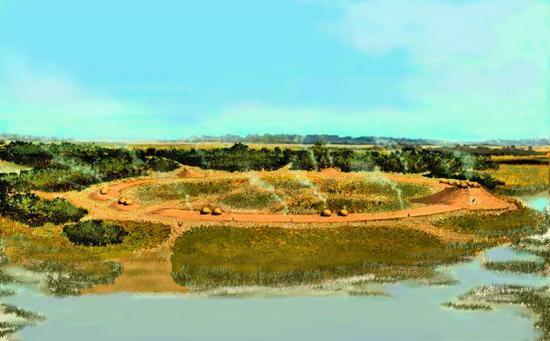
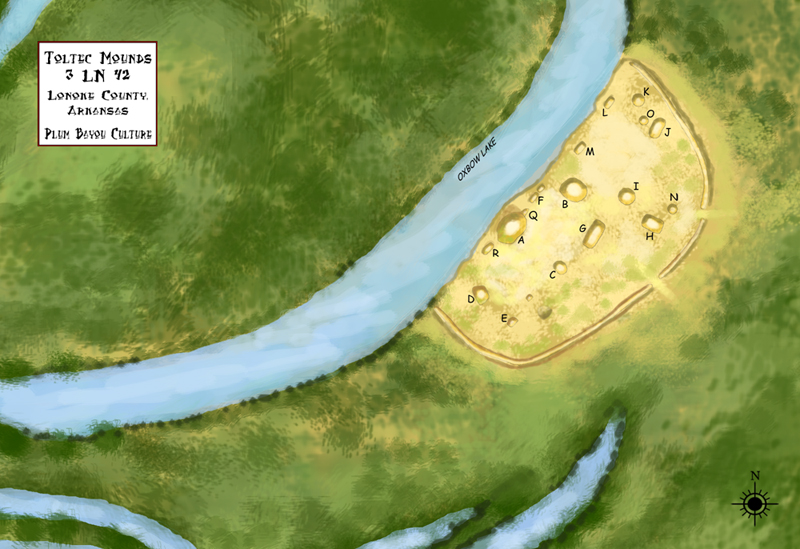
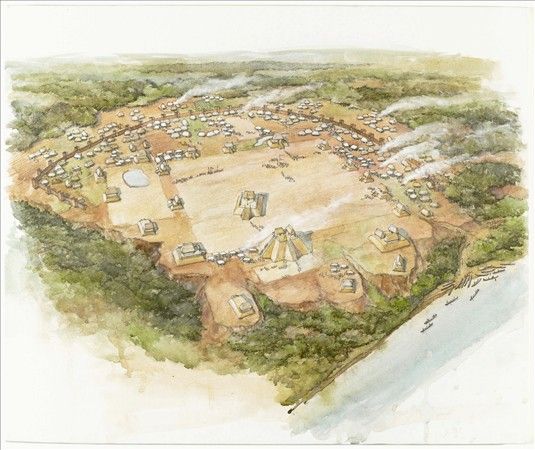
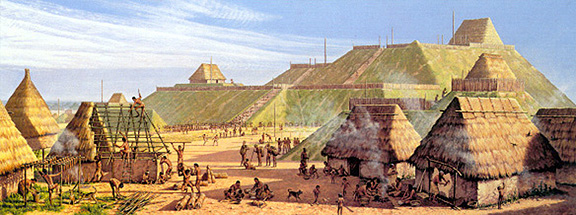
After the collapse of the Hopewellian interaction sphere around 500CE, there was a lull in mound-building throughout most of the region, but places like the Toltec Mounds in Arkansas kept the tradition going through the Late Woodland period. From there, it was picked up again and spread by the Mississippians, resulting in the construction of sites like Moundville in Alabama, Etowah in Georgia, and, of course, Cahokia in Illinois, which features the largest earthen pyramid--The Monks Mound. In terms of size it's followed by its contemporary Emerald Mound in Mississippi and the aforementioned and much older Bird Mound at Poverty Point.
As you noticed in the reconstructions I liked to, most of these flat-topped earthworks were topped with other structures. Based on historical sources (such as the De Soto entrada, which encountered many polities that following these traditions), we know these buildings were usually the homes of the local leaders or temples. Many of the other earthworks, especially the geometric ones built by the Ohio Hopewell, were used as ceremonial sites, filling the social "temple" niche is other ways.
Not too long ago, a large portion of North America featured such earthen features as part of their human landscape. Each red dot represents an earthwork complex or an isolated mound. Since the 1800s, however, the majority of these have sadly been lost. The Troyville Mound 5, for example, was cannibalized for various building projects. Cahokia's sister city in St. Louis was demolished as the modern city grew over it. Others have been plowed to pieces to clear space for farms. Some were even destroyed in the process of studying them archaeologically. But if you know where to look, there are still many around that you can visit.
Mexico is a part of North America. Mexico is full of both of those things.
hi; there's lots of room for more input on this, but meanwhile, you may be interested in some of the sites mentioned in these earlier posts
Why are there no large, stone monuments in North America (north of Mexico)?