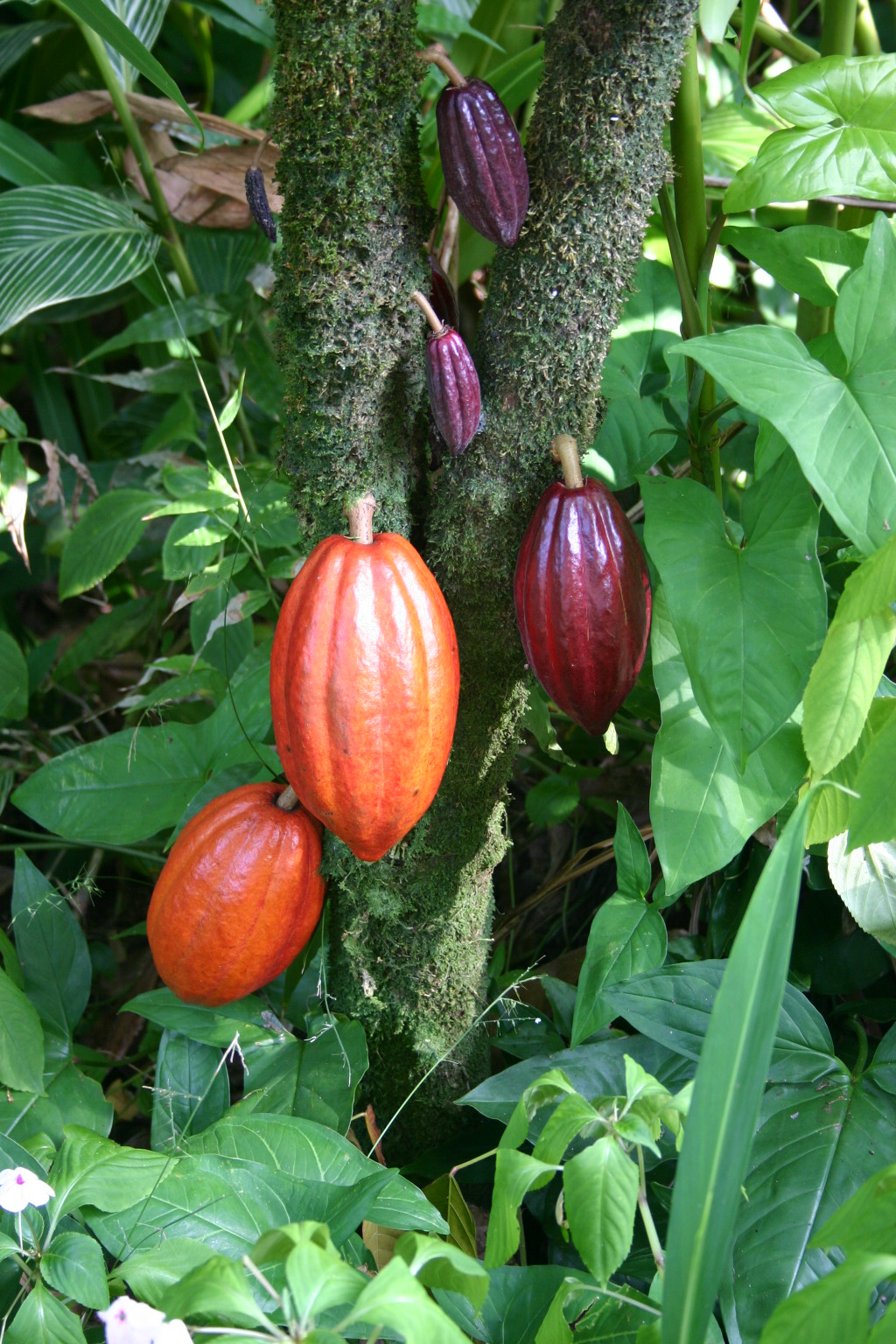
My teacher caught someone eating chocolate in class and said that chocolate is the only acceptable treat allowed because of it's history pertaining to that era/region of world history.
I was wondering how important it really was to daily life, royalty, and trade between empires before the Europeans arrived.
The solid confection we call chocolate wasn't around in pre-Colombian Mesoamerica. Instead, a drink was made using ground cacao beans, likely flavored with fruit juice or spices. Cacao (the drink, tree, and bean) was practically ubiquitous in elite Classic Maya art and culture.
Liquid cacao was the go-to drink in the court scenes which were popular on ceramic vessels. As can be seen on that cup, the drink was often consumed while frothy, achieved by pouring it between vessels. Scenes also depict folks grinding cacao beans before use. In that tripod vessel, you can see both a cacao tree (center right, with pods on its branches) and a fellow kneeling at a grinding stone to process the beans (whiter figure lower left of center). We know good cacao was valuable not only because of its association with royals and the effort that went into, but also because it was used in burnt offerings along with blood (often human) and stinging/psychoactive spices.
The cacao tree appears in Maya myth too. Hun Hunaphu and his brother, two of of the first humans, were tricked into losing a ball game against the lords of the underworld. Hun Hunaphu was beheaded and, in Classical versions of the story, his head was hung in a cacao tree. He then spat into the hand of a princess of the realm, Xquik, who gave birth to the famous Hero Twins. Through cunning and trickery, these brothers, Hunaphu and Xbalanque, defeated the underworld's rulers, and their father was resurrected.
The cacao pod and tree were often used as decoration, whether as 3D appliques, as repeated patterns, or as design elements. It was frequently associated with monkeys.
Lastly, as you may have noticed, many of these vessels contain a row glyphs along the top. This is an incredibly common (i.e. hundreds of examples) and highly formalized pattern of glyphs that we call the Primary Standard Sequence. It basically always says the same thing, and it's so consistent that it's not really entirely written out making translation difficult. The gist is typically "Here is dedicated his writing/painting on this [cup/bowl/jar] which contains [a variety] of [a drink]." Because of this, we can know just how many of the fancy vessels we find were used for cacao; turns out it's an awful lot of them. And it's not just generic ka-ka-wa. (Our word comes from the Maya word.) This jar's lid says it contains yax kakaw, red cacao, as opposed to white varieties also attested. This one contained ta tzih te'el kakaw, cacao fresh from the tree. Other vessels indicate the region the beans came from. This seems to indicate a sort of haute cuisine: we have 20-somethings who seek out the best local microbrews, the Maya had cacao snobs.
In fact, it wouldn't be bad to think of cacao in Maya culture as you would wine in the Greco-Roman world. Fine wine was a staple of elite dining in Classical art and literature. Grape vines and bunches decorate numerous Mediterranean artworks, and the plant has it's role in several myths.
Since /u/CommodoreCoCo already covered the Maya, I'll hit the second part of your question regarding the Aztecs. (The Inca didn't have cacao).
Like among the Maya, cacao was made into a beverage that was either spiced with chili or sweetened with honey. It was popularly consumed by the elite. However, cacao consumption was not as regular among the Aztecs as it was among the Maya. We don't get the same kind of elaborate drinking vessels in Aztec funerary offerings that you see with the Maya.
The Aztecs had a rather interesting relationship with cacoa, since the temperate climate of the Central Mexican plateau made it difficult to grow there. Instead cacao had to be imported from the tropical lowlands along the Gulf and Pacific coasts, or from the Maya region to the east. It was an exotic good that was a regular ware of interregional merchants and was exacted in tribute by the empire from provinces where it could be grown. The most primary source of cacao within the empire was the province of Xoconoxco, on the pacific coast of modern-day Chiapas. This area was actually directly adjacent to the highland Maya area where the K'iche Maya kingdom of K'umarakaj was still dominant, and the highland Maya likely imported cacao from the same region.
In fact, cacao filled such a large role in trade among the Aztecs that they used it as a kind of currency. There were several different goods which could be used as a medium of exchange among the Aztecs. Large purchases or payments were made with quachtli, also known as mantas, which were cotton capes of standardized length and quality. Smaller purchases, however, were made with cacao beans.
Here's a list from Smith (1996 - see book list) on the price of various goods in cacao:
The exchange rate between cacao and quachtli depended on the quality of the quachtli, but the most common grades of quachtli went for 65, 80, or 100 cacao beans a piece.
The use of cacao as currency actually resulted in people making counterfeit cacao beans. Motolina describes a common practice where unscrupulous merchants would take the skins of peeled cacao beans and stuff them with sawdust. The forgeries were then mixed in with real cacao beans and passed off as genuine. There were punishments in place for doing this, of course.