This picture got me thinking: http://i.imgur.com/WAUeajg.jpg
The wall doesn't seem all that high to me, and also seems far too long to defend adequately. One would think that it wasn't possible to man the wall in such a way that its entirety could be protected from enemies simply building ramps or ladders in the middle of the night and invading.
Well most walls weren't a great deal higher than that.
Consider the land defenses at Constantinople - the Theodosian Walls - which stood for around 1000 years without falling to a single siege. They were extraordinary defenses. Here's an image. The middle wall is 8 metres tall and the final wall is 12 metres with 20 metre guard towers. Here are lots of detailed photos and a great podcast episode related to them. Take a look at the height of the people in the picture you linked. I reckon that wall could easily be five or six metres tall at the least (and a friend who's been there says they are likely around 8 metres tall). It may not sound like a lot, but you are unlikely to be even two metres tall. Imagine seeing that in front of you. A barrier like that is going to be at least somewhat formidable. It might also be worth thinking about whom the Chinese were trying to defend against - would they have been aware of the technology necessary to get over the wall?
However, in terms of long frontier walls, such as those built by Hadrian around the Roman empire which were generally more like turf walls or basic stone walls, they weren't really built with the aim of being besieged. It's more to provide a distinct and troublesome barrier and project an image of power, as well as to make it easier for defenders to man a frontier. If you're controlling the easy ways through the wall and someone has to build ladders or a ramp to get over somewhere else, it makes it easier for a smaller force to be manning that frontier and for a patrol to locate the incursion and direct defensive forces to fix it.
You're right that defending a long frontier like that is simply unrealistic. But the walls are not expected to be manned like those of a castle or city and tend to have more varied and less obvious purposes. For example, the wall built by Hadrian in Northern England was built right through tribal territory in order to make them easier to control. It was also potentially built to reflect the sheer power of Rome in that Rome was able to just build an 80 mile wall right across the island, and the Great Wall of China was far longer than that.
Ha, it's actually funny that you use this picture to talk about this. That part of the wall (and the pass in the wall associated with it) is called ShanHaiGuan 山海关 literally "The Ocean and Mountain Pass", named for the fact that it's where the wall quite literally runs into the sea as you can see. It's also the site of a very famous and noteworthy case: when the Manchus passed through the wall. This wasn't really a failure in the wall though, so much as it was a failure in the guy in charge of guarding that pass, a general by the name of Wu Sangui, who let the Manchus in for reasons that would require another post to talk about.
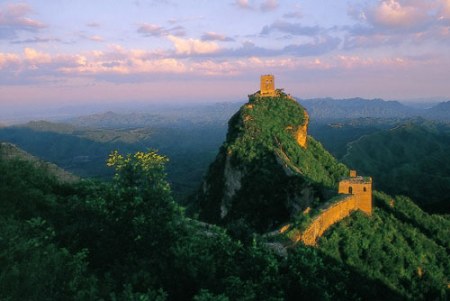
Now, other bits of the wall look a little more like this (that particular section is referred to as SiMaTai) with the wall snaking around the mountainous regions North and West of Beijing. For an army to actually cross the wall itself, it first would have to trudge through this forest and mountain terrain before even considering scaling the wall. But this wasn't really the main function: the main function of the wall was to serve as a garrison and guard post, watching the Northern borders, warning of and warding off raiders and any army that might approach. Rammed earth fortifications had stood in roughly the same area that the great wall of the Ming dynasty stands for long before, and the concept of border garrisons was nothing new to China (in the Tang dynasty, when the borders of "China" were extremely far West, border garrisons staffed by veteran soldiers and led by full-time generals were utilized to watch over these regions).
hi! you may be interested in a few previous discussions on the Great Wall