If a kid gets his leg broken at soccer practice, it's kind of a "no harm, no foul" sort of thing. They go, get the leg set, get a cast, boom, back in business.
When did this happen? I imagine that a few blacksmiths got their arms broken. Would that end their career?
Believe it or not, humans have been able to properly set fractures, even quite serious fractures, for a very long time. We have good evidence, for example, that even Iron Age civilizations around Europe were able to properly assess and set fractures.
For example, this study of fractures in bones discovered in Dorset, England, dating from both the pre-Roman and Roman periods, shows that at least several people were able to have serious fractures in their tibiae and fibulae set so that they healed properly and did not lead to infection.
Indeed, the study goes on to show that the arrival of the Romans actually reduced the success rate of properly healed fractures -- due to what the author concludes is likely less time allowed for fractures to properly heal, perhaps due to increased labor pressures under Roman rule -- and increased the rate of amputations, trepanations, and other surgeries. We know, as well, that the Romans had fairly advanced medical techniques across the board (certainly highly advanced for the time), and that they knew to put serious fractures in traction and that slings for arm fractures were used.
But it goes back even further. There is an Egyptian document ca. 1600 BC called the Edwin Smith Papyrus. In it techniques for dealing with a fractured humerus are discussed, including placing the arm in traction and tightly wrapping it in linen to restrict movement. We have the bones of some Ancient Egyptians (Middle and New Kingdom Periods) that show properly healed fractures.
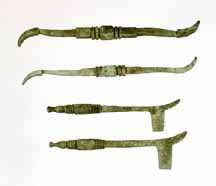
Back to the Romans for a second, I would be remiss if I didn't mention these tools, which were used to lever broken bones back into position, and could even be used to properly line up compound fractures. This must have been a none-too-pleasant experience. It was, however, effective.
In China, the focus was on their traditional medicine and on prevention of fractures, or quick healing through herbal remedies. This kind of stuff has been around in one form or another for a couple of thousand years, and some clinical studies have shown that it does help promote bone health and repair times -- though others have shown it has no clinically significant effect. However, lineaments and ointments such as these were (and continue to be) popular treatments for broken bones.
At any rate, all of this presupposes that you break your bone at a location (in the world) that someone is around to help with. While it is possible to set certain bones oneself, the ancient world did not have nearly as effective an ambulance or transportation service to help those with broken bones. Allowing a bone to remain broken or fractured too long could lead to infections and then to amputations, as there were no antibiotics at this time, however, early treatment and rest were quite effective, even 3000 years ago.