From this r/BadHistory thread. Having just finished The Sleepwalkers and The War That Ended Peace, German ambitions don't appear to have been expansionist. Certainly the military had offensive plans (like practically every other European power), but I don't recall reading that German aims in WWI were to incorporate Belgium/northeastern France into the Reich. What am I missing?
It may be a bit of a faux-pas considering you're talking about my post but I do think it's appropriate to defend myself here as that was a point I glossed over.
First we must define what 'expansionist' means and we must understand that does not strictly mean territorial expansion but also includes power balance and influence. I would, for instance, consider a theoretical war where one party completely disarms the other and turns them into a completely broken state and thus gaining uncontested influence over the region as an expansionist war if that was their intent.
With that said, however, Germany's gains were certainly expansionist and we have to remember that the war was not isolated to Northern France to realize this. In the East Germany would win crushing victories against the Russians and sign a treaty in early 1918 called the Treaty of Brest-Litovsk. Here is a more in depth map. You will notice that the most rich (in both population and resources) territories would be taken from the Russians as well with the 'breadbasket of Europe', the Ukraine, which would not be directly annexed but fall under basically German vassalage. In this it would lose one million square miles of territory and one third of its population, approx 60 million people. All of its natural resources in the form of coal, iron, and oil along with the majority of its factories would be lost. It was, by all definitions, an expansionist treaty.
In terms of the West however we do know what the Germans wanted to do and they were clearly expansionist as well. They released on September 9th of 1914 something called the Septemberprogramme which spelled out their generalized aims in the West for the war. The sparknotes being:
All fortifications from Dunkirk to Boulogne will be destroyed.
The ore rich area of Briey will be annexed outright. Coastal strips in the North would also fall under German control.
War debts shall be imposed on France so large that she is incapable of rearming herself for 15-20 years
The French will cease all trade with Great Britain and will be reliant on the Germans economically.
Either the outright annexation of Belgium or the seizure of lands up to Antwerp and making the rest a "vassal state" [it uses those terms explicitly, yes]
Luxemburg integrated into the empire as a "Germanic State" [think how Prussia, Bavaria, Wurttemburg, and Saxony were quasi-independent states in the Empire]
The creation of a Central European economic sphere of the German client states in the West and the newly formed states created in the East from a supposed Russian defeat as well. All client/buffer states of Germany, of course. The document translated states "including France, Belgium, Holland, Denmark, Austria-Hungary, Poland, Italy, Sweden and Norway. This association will not have no common constitutional supreme superficial equality of its members, but actually under German leadership, must the economic dominance over Central Europe stabilize."
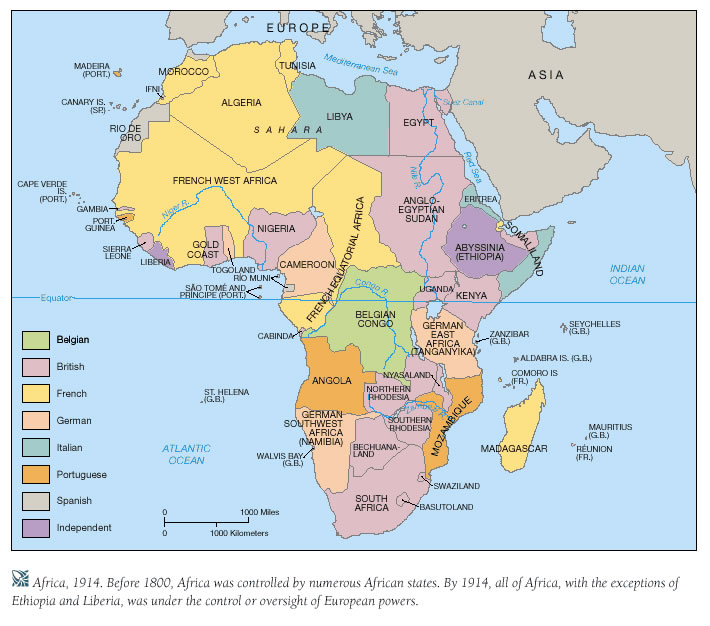
The annexation of all Central African colonies controlled by Belgium and France -- basically creating a continuous state across the continent.
This is, in essence, calling for a European empire with Germany at the head and a seizure of large swathes of Africa -- almost the entirety of Western Africa and the Congo . Now while we can certainly say that while the war went on and Germany started losing post-1916 they were more willing to basically cede all of these options for just a general peace these were a perfect picture of what Germany intended in the best case scenario. These goals encapsulate the German pre-war idea of Weltpolitik and Weltmacht oder Niedegang, World Power or Downfall. The war was a means to an end for the German nation who felt isolated and underrepresented in the world power balance; they wanted to become the number one power where they felt they belonged 'as a people' in their social darwinist mindset.
Franz Fischer, "Germany's Aims in the First World War"