I was just thinking about how insanely synchronized the entire world is today in regards to time. In every single time zone on earth people use the same minutes and even seconds. But before computers how did people keep track of that? When Europeans colonized the Americas were they on the same schedule, even across the sea? Have two different groups (countries, regions, universities, etc.) ever contested what time it is?
Hope I articulated this right.
An interesting, largely unknown, local time dispute:
In late 1935, Chicago’s city council passed an ordinance changing the city from Central Time to Eastern Standard Time year-round. Several suburbs and satellite cities agreed to follow the city’s lead. The ordinance became effective 1 Mar 1936. However, the Interstate Commerce Commission had jurisdiction over railroad timetables, and on 21 Aug 1936, denied Chicago’s petitions to have the railroads serving Chicago change to Eastern Time, perhaps because of the confusion it could cause with timepoints nearby.
Through the autumn, discussion continued and the question was placed on the November ballot as an advisory referendum. The Chicago Tribune supported the change to Eastern Time, perhaps as a way to screw the rival afternoon newspapers by making it impossible for them to publish closing stock quotes. Naturally, the Chicago Daily News waged quite a fight against it.
The November referendum went 2-to-1 to retain Central time, so the city council passed a new ordinance. Since the change had only been in effect during the “summer,” when daylight time had been observed since the World War, the big time zone change of 1936 affected ordinary citizens very little, and expired quietly 15 Nov 1936, a few weeks later than the usual time to “fall back.”
Between 1582 and 1923 (when the last European country adopted it), many nations in the world did not agree on what the date was. The Gregorian Calendar, invented by Pope Gregory in the late 1500s, differed from the Julian Calendar in the way that it calculated leap years, and thus was roughly ten days in difference.
Protestant nations (i.e., Britain) resisted the adoption of the more accurate Gregorian Calendar because, well, they didn't want the Catholic Pope telling them what the date was. Thus, depending on where you lived in the world, the date could differ.
The best example is Thomas Jefferson's tombstone, which claims his date of birth to be April 2 (O.S), April 13 (N.S.), 1743. When Jefferson was born, he was a British subject in Virginia, and hence, used the old calendar (O.S. meaning old style). We now know that the ACTUAL date of his birth was April 13 (N.S. meaning new style).
a picture of Jefferson's tomb. It doesn't say "April 13 N.S.", but you can see where O.S. is marked.
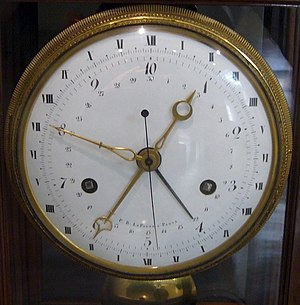
During the French Revolution, there was an attempt to move time to a more uniform (meaning base 10) system.
Metric Decimal time divided the day in to ten hours, made up of one hundred minutes each. Each minute was one hundred seconds, and each second was slightly shorter than the seconds we count by today.
I cannot access the JSTOR article that describes this, but here is a picture of a clock from the French Revolution, ala the Wikipedia Commons. I like this clock because it lists both the ten decimal hours and the twenty four corresponding hours we use today.
*Edited for accuracy
I don't know about arguments over time, but until standard time was adopted (beginning in Britain in the mid-1800s) there were just variations. Travel was slow enough that it didn't matter, though. If London says it's 10AM at the time New York would think it was closer to 11, nobody would even notice. The Europeans at home and the colonists were roughly on the same schedule, dividing the day and night into the same amount of hours and minutes and retaining ideas of what happens when, so it was effectively the same. But since time zones hadn't been invented yet, if anyone noticed the time differences between continents they wouldn't have been able to figure out what was due to it just being a different time of day and what was due to unsynced clocks.
When rail travel became common, people realized that the time in the first town, the time on the train, and the time at their destination were all different and in order to make accurate schedules people had to sync up. In the later 1880s time zones were established in the US/Canada and the railroads all agreed to sync to them. It wasn't until the 1900s that it was actually law in the US, and I don't know about elsewhere.
If you have ever used a computer the time you see has almost certainly relied on the Olson TZ Database. In fact the timestamp on this comment uses olson tzdb. The Olson TZDB is a very interesting beast, it is a database of data and history. The different timezone files are littered with disagreements over what local time was at a certain point in history. Off the top of my head I know that the TZDB describes a few disagreements over time in Chicago, Indiana and Detroit.
For example Detroit:
 # From Paul Eggert (1999-03-31):
 # Shanks writes that Michigan started using standard time on 1885-09-18,
 # but Howse writes (pp 124-125, referring to Popular Astronomy, 1901-01)
 # that Detroit kept
 #
 # local time until 1900 when the City Council decreed that clocks should
 # be put back twenty-eight minutes to Central Standard Time. Half the
 # city obeyed, half refused. After considerable debate, the decision
 # was rescinded and the city reverted to Sun time. A derisive offer to
 # erect a sundial in front of the city hall was referred to the
 # Committee on Sewers. Then, in 1905, Central time was adopted
 # by city vote.
 #
For a high level overview see A Literary Appreciation of the Olson TZDB. But do not stop there take a couple minutes to check out what the TZDB has to say about the history of time in your area:
To get an idea of how often timezones change see the NEWS file.
Note to mods: The olson TZDB does not fit match up perfectly with your requirements for a peer reviewed source but I think that an exception should be made in this case.
One that I always found amusing is that the bells of Tom Tower, at Christ Church, Oxford, are rung five minutes past the hour, signifying "Oxford Time" which is five minutes past GMT, and as far as I can tell they have done so for hundreds of years.
http://en.wikipedia.org/wiki/Tom_Tower
Oxford was, is, and shall be the center of the world, of course.
This might be more local than what you mean by "dispute" but it certainly caused a major change in how accurately synchronized time needed to be: http://postalmuseumblog.si.edu/2013/04/the-great-kipton-train-wreck.html.
In basic the watches used by two trains are believed to be off by four minutes, causing a major disaster. As a result standards for the pocket watches used by the railroad were established.