Did the Romans conquer Greece by land or by sea?
Was Greece a disconnected group of city states or still a Diadochi kingdom? For what reasons did the legion prevail over the phalanx?
Were Greek citizens enslaved en masse?
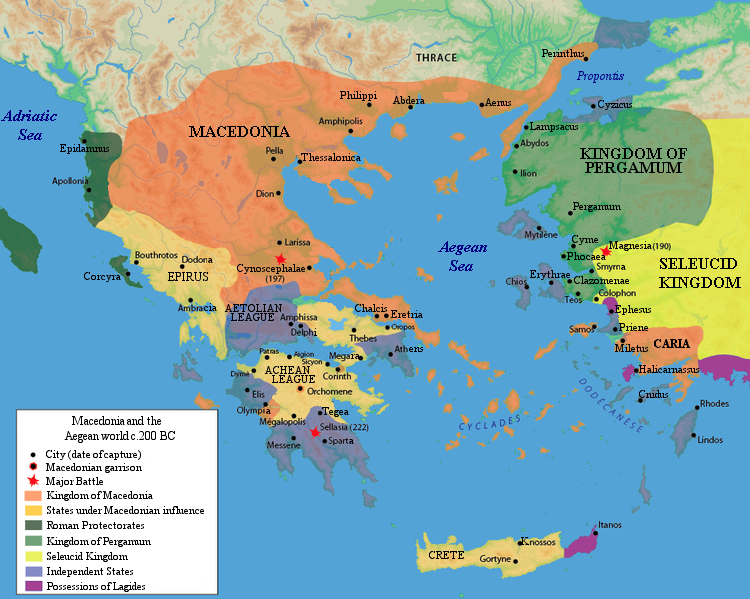
Greece was not politically unified as it is today. It was divided between the Kingdom of Macedon in the north - the remnants of the Diadochi kingdom, the Kingdom of Epirus in the west, and the Achaean League and Aetolian League in the south. Macedon and the Achaean League stood in opposition to Rome, Epirus was neutral at first, but eventually joined them, whilst the Aetolian League was pro-Roman, as they wanted freedom from further Macedonian domination. Here's a map for reference.
There were four wars against the Macedon, called the Macedonian Wars. The First Macedonian War occurred from 214-205BC. This war was primarily fought between the Aetolians and the Macedonians, but the Romans did fight the Macedonians at land and at sea. However, there were no major battles between the two powers, primarily due to Rome's ongoing commitment in the war against Hannibal. The war ended in a stalemate.
The Second Macedonian War occurred from 200-196BC. Rome had just completed the subjugation of Carthage, and turned her full attention to Macedon, which had been a thorn in its side. Initially, a slow lingering war was fought by first Sulpicius then Publius, with little Roman gains. Flamininus was then appointed, who brought with him the veteran troops from Scipio Africanus' campaigns. He quickly turned the tide, defeating the Macedonians in battle, and forcing their withdrawal. He also had a sort of "hearts and minds" campaign, in which he proclaimed the cause of Greek liberty. Seeing the way the wind was blowing, the Achaean League defected to the Roman side of the war. The defining battle of the war then came in 197BC, at the battle of Cynos Cephalae, in Thessaly, which was between Macedon and Rome with her Aetolian allies. The Macedonian forces had the higher ground, and swung the right flank of their phalanx into the Roman forces, doing significant damage. However, the left flank was broken up by rocky ground, preventing the Macedonian phalanx forming properly. The Romans struck this flank, and in man-to-man fighting the Macedonian troops were outmatched. These troops routed, and the Roman troops moved down the engaged Macedonian line, causing massive Macedonian casualties and causing the Macedonian army to be put to flight. According to Plutarch, some 8,000 were killed and 5,000 captured. The Romans then seized the Macedonian camp. However, the Macedonian king, Philip V, managed to escape. Philip sued for peace. Peace was negotiated on the terms that Macedon would withdraw from Greece, pay an indemnity of 1,000 talents to Rome, hand over his navy, and hand over one of his sons, Demetrius, as a hostage. Clearly, this war was a significant Roman victory.
The Third Macedonian War was fought from 171-168BC. Now Macedon was under the rule of a new king, Perseus, who was the son of Philip. He signed alliances with Epirus and a number of Illyrian and Thracian tribes. Seeing the balance of power changing in Greece back in favour of Macedon, Rome declared war. Initially, Rome suffered setbacks, with an army being defeated under Publius Licinius Crassus, resulting in some 2,500 Roman deaths. The Romans appointed Aemilius Paullus as commander, who then fought a decisive battle against Macedon at Pydna. The Macedonians were ascendant early, with the Roman officers being terrified of their spear wall. However, as the Macedonian phalanx advanced, some parts moved faster than others, leading to gaps in the formation. Roman troops swarmed into these gaps, breaking the phalanx and again proving their superiority in individual combat over the heavier phalangites. Plutarch reports 25,000 Macedonians dead, and between just 48 and 100 Roman dead, though the actual number is probably higher. King Perseus tore off his royal regalia, and escaped to his capital, Pella, in disguise. From there, abandoned by his advisors, he took his family and fled. Eventually he was captured, brought to Rome, and he was paraded in chains at Paullus' triumph. Macedon was broken up into four separate republics, and the war was over. Some 300,000 Macedonians were enslaved. Rome then attacked Macedon's ally, Epirus, capturing the kingdom and enslaving 150,000 Epirotes.
The Fourth Macedonian War occurred from 150-148BC. It was a very brief war, with the Achaean League and a Macedonian pretender, Andriscus, rising up against Rome. Macedon and the Achaeans were defeated once more at Pydna in 148BC, bring the revolt to a swift end. In retribution for this revolt, the Achaean League was forcibly dissolved and the city of Corinth was razed in 146BC. Greece was formally annexed as three provinces, Epirus, Macedonia, and Achaea. Greece would remain under Roman rule until AD1460.
Sources: Polybius, The Histories, and Plutarch, Life of Flamininus, Life of Aemilius Paullus.
So to answer your question individually:
Did the Romans conquer Greece by land or by sea?
By land, but there were naval conflicts, and maintaining naval control was important in winning the wars.
Was Greece a disconnected group of city states or still a Diadochi kingdom? For what reasons did the legion prevail over the phalanx?
Partly Diadochi kingdom, partly leagues of Greek cities under the influence of said kingdom. The legions prevailed due to their greater tactical flexibility, whereas the phalanx was a one-trick pony, even if it was a good trick.
Were Greek citizens enslaved en masse?
Yes, but just those Greeks who defied Rome and were defeated.