Yes, though it's a hard question to realistically source. The Western Front would be the best example I know of. In WW1 it stretched from (roughly, dependant on date) east of Dunkirk in Northern France all the way to Switzerland. This is a massive line through France and Belgium (In places, at specific times, mainly in the last year of WW1) Due to the nature of WW1 and it's static forms of combat, the main line in western Europe barely shifted, but WW2 was very much based on mechanized warfare to counter the stalemates of the first. This led to battlefields changing location very quickly.
In terms of the invasion of France in 1940, the German plan of attack was to invade through Belgium and the Ardenne Forest. This was a relative mirror to the Schliffen Plan of 1914, though in this circumstance the goal wasn't to crush Belgium and the deployed British forces quickly, but to avoid the French Maginot Line which was a series of complex defences covering the German-French border.
The invading forces of Germany would have pushed through battlefields fought over in World War 1. The best examples to give is the major centres of population. Most of Belgium/Holland was invaded and saw conflict in WW2, both in the initial invasion stages and the later liberation stages. Cities like Lille, Antwerp, Liege and Brussels were all centres of Entente Defence in 1914, and were the same in 1939/40.
In terms of what I mentioned before about the fall of France, the British BEF were cut off from the French forces around the Maginot Line, and began setting up a rolling, aggressive defense around Calais and Dunkirk in order to initially contain the German Blitzkreig, and later to stall the advance in order for some kind of evacuation, though Winston Churchill believed in fighting to the last man for Calais. These were all areas fought over in the race to the sea in 1914, when it became clear that WW1 would involve digging in and grinding forward slowly. Countries on either side knew having the sea on their flank was the best bet and raced towards the Dunkirk area to cut each other off.
In terms of liberating France in 1944, it wouldn't be until Autumn 1944 when Allied Forces would engage upon the old Western Front. Following the liberation of Caen and Paris, British/Commonwealth forces pushed east, with Americans on their south. By Christmas time, they had pushed into the initial areas of German land, and had made large captures of land in Belgium. This shows us that the Allies had by and large passed over the WW1 line of conflict.
Like I said, sources are scarce because it's an odd question, and though I have a working knowledge of the Eastern Front in WW2, I don't know much of Russia during WW1 as of yet.
Couple of further reading (Specifically what I've read recently) that might help you see some comparisons;
Taming the Panzers by Patrick Delaforce, 2003
To Win a War: 1918, 2000
There were certainly some battles in WWII that were fought on old WWI battlefields. I'll try to give a few examples, but there are likely more that I'm not familiar with. Here's the first one.
Battle of Arras
The city of Arras and its environs were the focus of no less than three major battles in WWI. The city first became important during the "Race to the Sea" phase of the war, following the first Battle of the Marne in 1914. The massive offensive led by the German First (Kluck) and Second (Bulow) armies had been thrown back from Paris, and the lines were stabilizing along the Aisne River. The French Tenth Army (Maud'huy) attempted to outflank the main German position by attacking farther north, but they were met by reinforcements from the German 6th Army (Rupprecht); which were themselves trying to outflank the French positions. German light cavalry troops had briefly occupied Arras itself, but these troopers were thrown back by the French offensive. The Germans made several attempts to flank the French position in Arras from the North, but by the use of interior lines and superior logistics, the French were able to hold their position. The front eventually stabilized just to the East of the city, with both sides digging extensive trench-works.
The Second Battle of Arras was fought in three years later in 1917, as the British portion of the Nivelle Offensive. The operation would consist of the British army (including the colonial and dominion soldiers of Australia, Canada, South Africa, and New Zealand) making a narrow front attack to the east of Arras, with a focus in the North at Vimy ridge, and the south along the Scarpe River. This offensive was planned to take the high ground to the East of Arras, while drawing German reserves away from the planned French offensive to follow along the Aisne further South. The British First (Horne), Third (Allenby), and Fifth (Gough) armies faced the defending German Second (Marwitz) and Sixth (Falkenhausen) armies. The attack was relatively successful on the first two days, with the Canadian Corps capturing the crest of Vimy ridge, and advances of several miles being made along the entire front. However, German reinforcements bogged down the attack in the following days and weeks, and the front stabilized several miles further to the east, with little long term strategic consequence.
The final battle near Arras in WWI was part of the Hundred Days Allied offensive, and was called the Second Battle of the Somme. The German army had launched a massive offensive in the Spring of 1918 far to the South of Arras, and had advanced as far west as Amiens; creating a large salient. The Allied Offensive had the goal of reducing this salient, and driving the German Army back to the formidable Hindenburg Line. The British Third and Fourth Armies, along with the US Second Corps attacked the German Second Army along the Northern shoulder of this salient. The attack was wildly successful, breaking the German lines and driving them back along a 35 mile front.
In WWII, Arras would again be the sight of fighting between the Allied and German armies. Keep in mind that the WWI battles around Arras were fought over 4 years and with successful advances often being measured in thousands of yards instead of miles. In the Battle of France in 1940, Germany Army Group A (Rundstedt) was able to advance some 350 miles in 2 weeks, from May 10th to May 24th. In that time, they advanced through the Ardennes Forest, then along the Aisne and Somme rivers, finally reaching the Channel coast near Abbeville. By doing so, they had cut off the entire First Allied Army Group in Western Belgium and Flanders (consisting of the 3 Corps of the BEF, the French First, Seventh, and Ninth Armies, and the entire Belgian Army of 5 Corps) from the main French positions to the South. To counter the rapid German offensive, the Allied armies drafted the Weygand Plan, a simultaneous attack from the BEF in the North at Arras, and the French Army in the South on the Somme. These attacks were planned to cut the German corridor to the sea, and link up the surrounded Allied army with the rest of France. Unfortunately, Billotte, the French General commanding in the pocket, was killed in an auto wreck three days before the attack. His subordinates had no clear understanding of the planned operation, and the attack was scatted and ineffective. British Major General Harold Franklyn had 2 infantry divisions and a French armoured division available for the attack, but did not realize it's importance. Instead, he used the French division in a flank protection role, and attacked from Arras with only two infantry battalions and two tank battalions. The troops advancing passed the remains of trenches and shell craters from the original Arras battlefields as they stepped off to attack. Even with the attack being severely understrength, it made substantial gains against the 7th Panzer Division (Rommel) before being stopped, and forced to withdraw. This attack so frightened the German command that they ordered a 24 hour stop to the advance, to consolidate their positions. This stop would prove instrumental in the successful evacuation of Allied troops from Dunkirk between May 27th and June 4th.
The town of St Mihiel France was liberated by Captain George S Patton in WW1 and by General George S Patton in WW2
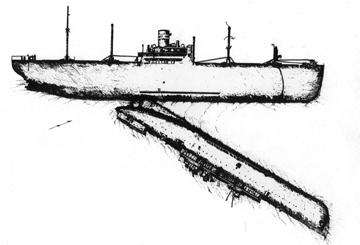
Perhaps one of the most interesting ones in my opinion... though it's hard to call it a battlefield; is Apra Harbor in Guam.
During World War I, a German merchant raider, the SMS Comoran was scuttled with nine crew members perishing on the ship. The ship had pulled into Apra harbor to resupply as the German ship attempted to evade the Japanese fleet searching for it. As the US was still a neutral power for the early years of the war, it allowed the German ship to remain in the harbor, but refused to allow it to leave. Eventually the Germans decided to scuttle the ship and as they tried to the US Navy fired on the SMS Comoran, essentially firing the first shots of World War One between the US and Germany. The German crew was arrested and eventually sent back to the American continent to be interned during the War.
Then during the Second World War as the US was pushing towards liberating Guam from Japanese occupation (or recapturing it anyway), a US submarine, the USS Snapper fired a couple torpedoes into the harbor and hit a Japanese ship the Tokai Maru causing it to sink; where it now sits in about 100ft of water, right next to the SMS Comoran.
The harbor is pretty big, so its impressive, and a bit bizarre that somehow these two ships went down right next to each other. Though its perfect for divers who don't mind venturing to the bottom of the sometimes murky harbor.
You may find this article from the Sept. 21 issue of the New York Times interesting. It discusses in part how Germany deliberately destroyed many of the WWI memorials to Americans during its occupation of France, and why and how some survive today.
One of the shared battlefields i find most interesting is Verdun, in WW1 verdun is fought over for around 9 months with casualties on boths sides being around 300k-500k, it came to define the french involvement in the war as a meat grinder with no end, something like 80% of the french army division served in verdun at one point or another. While in WW2 it falls in a day to the germans with almost no casualties, keep in mind in WW2 it has been upgraded and is probably the most advanced fort system in the world. However it is taken after the battle of france is basically already over. A shocking reminder of how wrong france took in its mid war doctrine.
Source: The Price of Glory: Verdun 1916 To Lose a Battle: France 1940
The German SMS Cormoran II (WWI) and the Japanese merchant ship Tokai Maru shipwrecks lay within touching distance of each other in Apra harbor at Guam:
A divers drawing/perspective of the "battlefield" wreck site
The Cormoran II was scuttled to prevent capture and the Maru was hit by torpedoes from the USS Snapper submarine
I think you'd enjoy reading Up Front by Bill Mauldin. He was a combat cartoonist for the Stars and Stripes newspaper, and Up Front was his reflection on the war as well as a collection of his best comics.
He had a few stories/cartoons that were totally relevant to your question.
In one of his cartoons it shows two GI's walking around an anonymous European town. One of the GI's has a very distinct hairstyle, and in the background you'll notice all the townspeople have the exact hairstyle. The caption reads "My pappy told me about this town!"
-Supposedly there is a bunker in Europe (no idea if it's still intact) in which the following graffiti was scrawled upon a wall:
Joe Smith, 1918
Joe Smith, 1944
And this is the last damn time I want to be in this bunker!
-There's the story about an American Colonel that was repeatedly adamant about not sending his unit to capture a specific town, electing instead to bypass it. When asked why he was so insistent upon bypassing the town, his response was "I made some pretty tall promises to a young lady in that town during the last war and don't aim on delivering now!"
-Finally, I remember reading an account of a young German soldier who was about to leave for the front lines and was having a final meal with his family. At one point his grandfather pulled him aside and stated something to the effect of "First chance you get, surrender to an American. They will treat you well." Interesting how a single act of kindness can carry over to the next generation.
I suspect many areas of the Eastern front were battlefield in both wars, but some research is needed!
Neupommern/New Britain - in the Pacific.
Australians invaded the then German colony.
It was administered by Australia after the war, and invaded by Japan in WW2, then liberated by US, Australian & NZ troops.