On another forum, I recently saw the assertion that "it's known that some Viking communities, while predominantly white, had thriving ethnically Mongolian subcultures." I've looked around a bit to try to find any sources for this, but I haven't been able to find anything past "Mongols vs Vikings: who would win?" and people complaining about the casting in the Thor movies. Does anyone here know anything about this?
The Viking Age is generally considered to have lasted c.800-1100, whereas the Mongol Empire didn't hit its height until the time of Genghis Khan in the 1200s. A more likely connection is the Huns, another group of people from the Asiatic steppe, and therefore "Mongolian" in a very loose sense of the word. The Huns hit their height under Attila the Hun in the 400s, and their attacks are generally credited as a major factor in the collapse of the Western Roman Empire.
The Danish archaeologist Lotte Hedeager (now at the University of Oslo) has argued that the Huns had an undocumented but nonetheless significant influence on pre-Viking Scandinavia. As some Huns were joyriding through Italy, others may have been trying to project their power northward as well.
Hedeager identifies their influence in the acceptance of gold as an important measure of wealth, the spread of a new type of decoration that archaeologists call animal style, and even conversion to a new religion, importing shamanistic elements from central Asia and possibly also a new pantheon of gods, with Odin and the Æsir modeled on the real-world Attila and the Huns. (Hedeager follows a common hypothesis that the old gods became the Vanir.)
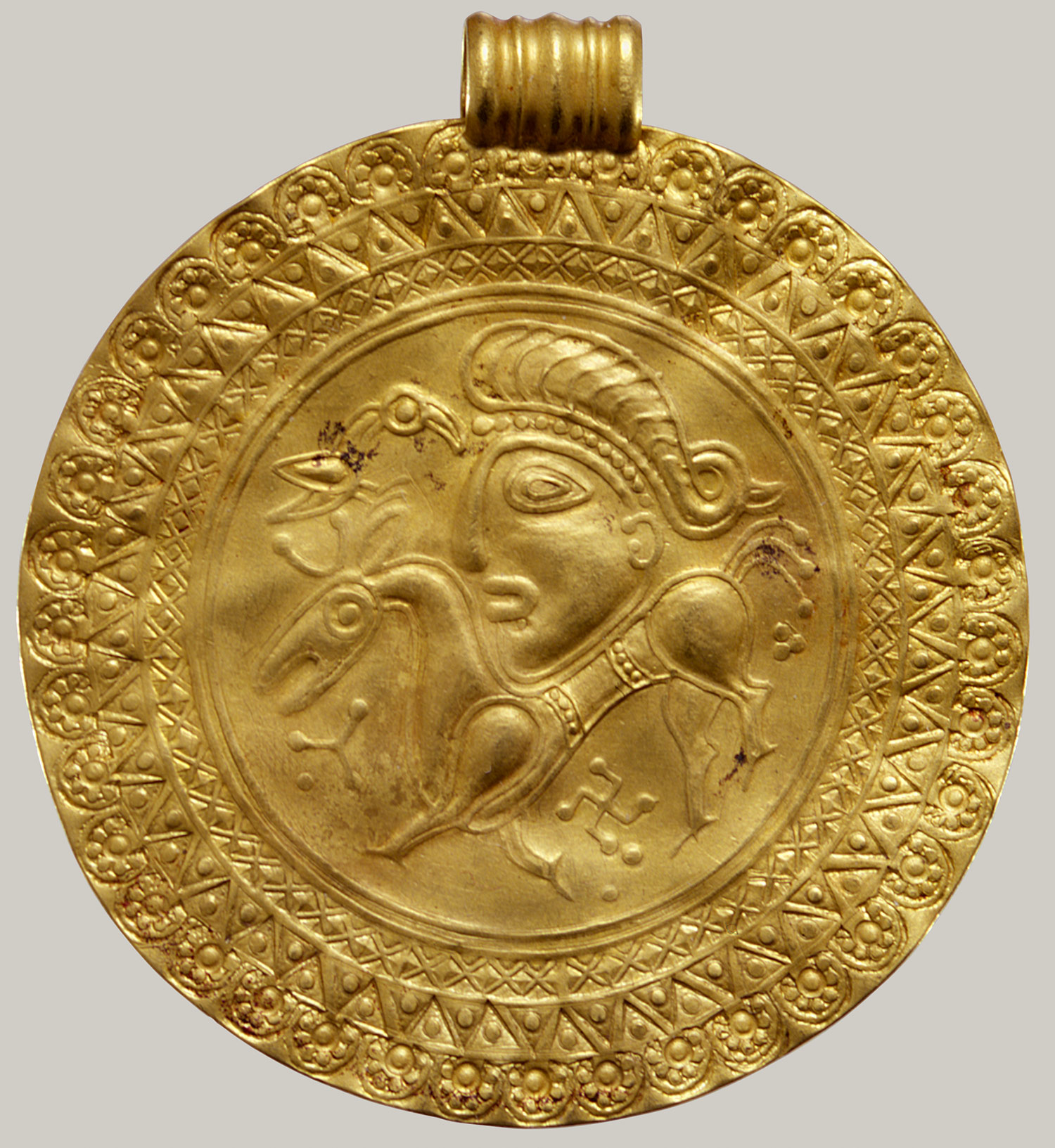
This gold bracteate might be an example of the Huns' influence. Bracteates were originally silver replicas of Roman medallions, but this is a gold medallion, and its figure looks more like an Asiatic horseman than an enthroned Roman emperor. The bird that accompanies the figure suggests this might also be an early portrait of Odin, which Hedeager adduces as further evidence that Odin was a god imported from Asia. And the close connections between the human figure, the horse, and the bird might all suggest some sort of animistic or shamanistic belief, again presumably imported from Asia.
Hedeager continues to argue that these cultural imports laid the groundwork for elites to begin consolidating more power and thus catalyzed the social processes that would eventually erupt in the Viking Age. She does point to some instances where persons from central Asia may have in fact migrated to Scandinavia, but she seems content with most of these changes being caused due to cultural contact and emulation rather than immigration.
While her arguments are useful for rethinking how and why the Viking Age happened, they certainly haven't achieved scholarly consensus. But from an archaeological standpoint, this is about the only argument I've seen that might support talking about "thriving ethnically Mongolian subcultures" in Viking-era Scandinavia.
TL;DR There was probably no such thing as "thriving ethnically Mongolian subcultures," but at least one respected archaeologist has argued that Scandinavian contacts with another Asian steppe-people, the Huns, catalyzed the social changes that produced the Viking Age.
Were you on some sort of white supremacist/"race realist" forum? Those types of people often used "Mongolian" to describe all people who look East Asian.
Oh hey, I might have found where this idea came from!
1 The Genetic Link of the Viking – Era Norse to Central Asia: An Assessment of the Y Chromosome DNA, Archaeological, Historical and Linguistic Evidence by one David K. Faux.
I have never heard of this. Maybe he confused Mongolian subcultures with the Sami people http://en.wikipedia.org/wiki/Sami_people It's a stretch, but I have no idea otherwise.