This, as you might guess, is a very broad question in that you're both asking about 3000 (well, let's be fair, 2500) years of history, and about a whole bunch of different tasks (I don't want to call them jobs). Therefore I've decided to subjectively pick out some of the ones I find more interesting/important to know about, so bear with me. You're are of course free to inquire further.
First off, I believe it's important to point out that pyramids were only really built during one specific period over the whole course of Egypt's history. That period in itself isn't even fully coherent, but divided into two shorter periods. Basically, the first pyramids are starting to be built during the 4th dynasty (2600 BCE) and stops again during the 6th dynasty (2325-2137 BCE) because of economical decadence during the period. As you might be aware of, the 6th dynasty is then followed by the First Intermediate Period, which lasts through dynasty 7-10. Then there is an upswing again during the 12th dynasty (1991-1783 BCE), but with significantly smaller pyramids than those of the 4th dynasty. To give you numbers: Khufu's (Cheops) pyramid is 146.5 meters high, while the pyramid of Amenemhet I (the first pharaoh of the 12th dynasty) is just 55 meters high. Discounting the Macedonian, the Ptolemaic and the Roman periods, Egypt had 31 dynasties; so pyramids were built during 4 out of 31 dynasties of varying length. What was built during the rest?
Well, pyramids were sort of built even before the 4th dynasty, but not in their true form. Already in the 1st dynasty mastaba tombs were built for members of the aristocracy - pharaohs, officials, etc. During the 3rd dynasty experiments began with putting several mastaba tombs on top of each other, eventually resulting in Djoser's step pyramid; which in turn began the experimenting for the true pyramid form that we know from Giza. Although it's the pyramids people generally know of, there were also huge pyramid complexes surrounding these things. Complexes that included chapels, altars, a full enclosure wall, pavilions and even boundary markets. Suffice to say, these were alive places where a lot of people worked, salesmen (well, modern term, but you get the point), priests, scribes and so on. All the people needed to run the huge burial complex. These kinds of pyramid complexes exist around the Giza pyramids as well.
Moving on. During the 5th dynasty, these things called "Sun Temples" starting growing up, the most famous of those is the sun temple of Niussere; the whole temple complex measuring as much as 100x76 meters. To the south of this complex is a 30 meters long model solar boat in brick and in the middle of the complex is a 37 meters high obelisk. There is also a room that Egyptologists call "The Chamber of the Seasons, in where the walls contain images of the inundation season and the harvest. As far as I know, we don't actually know what these temples were used for, but inscriptions tell us that six of them were built during the 5th dynasty.
So much text! Well, let's make a quantumleap over a heap of dynasties and land in the New Kingdom. You can probably guess what we're going to be looking at now, The Valley of the Kings - but only in passing. It is such a big deal that I can't really just jump past it though. The Valley of the Kings was not just one valley, but several were the tombs of the deceased pharaohs of the New Kingdom were hidden in secret. The distinction of 'pharaohs' is necessary, because nearby was another set of valleys called The Valley of the Queens, where the queens were buried. These were of course not just random holes in the ground, but like the building of the pyramids they required a huge force of workers who cut them out, who brought and crafted clothes, furniture, valuables and much more.
And moving on again, to the five finishing things that I want you to know about! First off we have The Colossi of Memnon, raised by Amenhotep III at Thebes. These are two 21 meters high quartzite statues of Amenhotep III and a testimony to the immense wealth and prosperity that Egypt had during his reign. Fun fact: these statues contain graffiti from Roman times.
The second thing brings us from one Amenhotep to another, here is a building project you've probably heard of. Amenhotep IV, also known as Akhenaten, founded a new city, known as Tell el Amarna, in the middle of the desert, as well as a new religion. Imagine the building project this actually is. The reason the Egyptians normally lived along the Nile was partly because the land was fertile there, but also because there was water there, Tell el Amarna didn't in fact have such an important thing as easy access to water. Also, when founding a new religion there is a huge demand for artwork, for sculptures, for inscriptions and so on, all of which requires a dedicated work force. All joining in building a city that wouldn't even last the full reign of one pharaoh. Some 80.000-90.000 building blocks have been recovered from other locations in the 20th century, all brought from Tell el Amarna and reused elsewhere.
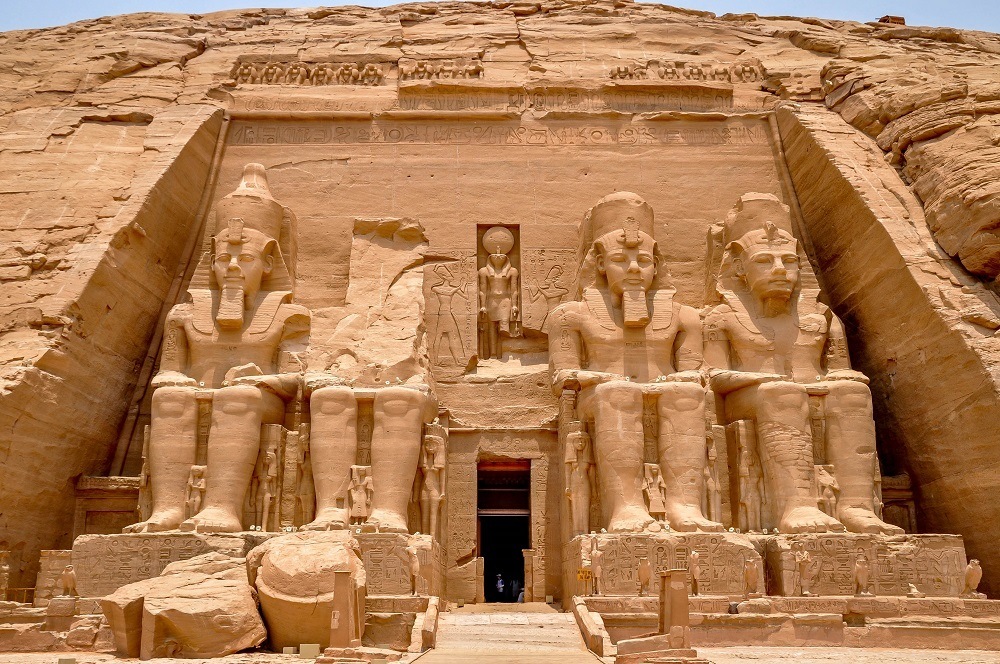
Let's call the three last ones "The Impressive", "The Beautiful" and "The Awe-Inspiring", starting with "The Impressive". That being the monument at Abu Simbel, erected by Ramses II in the 19th dynasty. If you've looked at a tourist brochure of Egypt, you've probably seen these huge carvings, 22 meters high no less, of seated figures, cut out of a mountainside and perhaps guarding the temple behind them.
Next up is "The Awe-Inspiring" Karnak. Once again, if you've looked in a tourist brochure, you've probably seen this. Karnak itself is a mortuary temple, located on the opposite side of the Nile from Thebes, but while Karnak itself is what I wanted to mention primarily, it is probably the hypostyle hall that is the true sign of Karnak. Covering 5500 square meters it is the largest pillared hall in Egypt and one of the largest in the world. I'm not going to bore you with too many numbers, but 122 columns, 21 meters high each, are enough to make even modern people amazed! And this isn't the only mortuary complex from ancient Egypt.
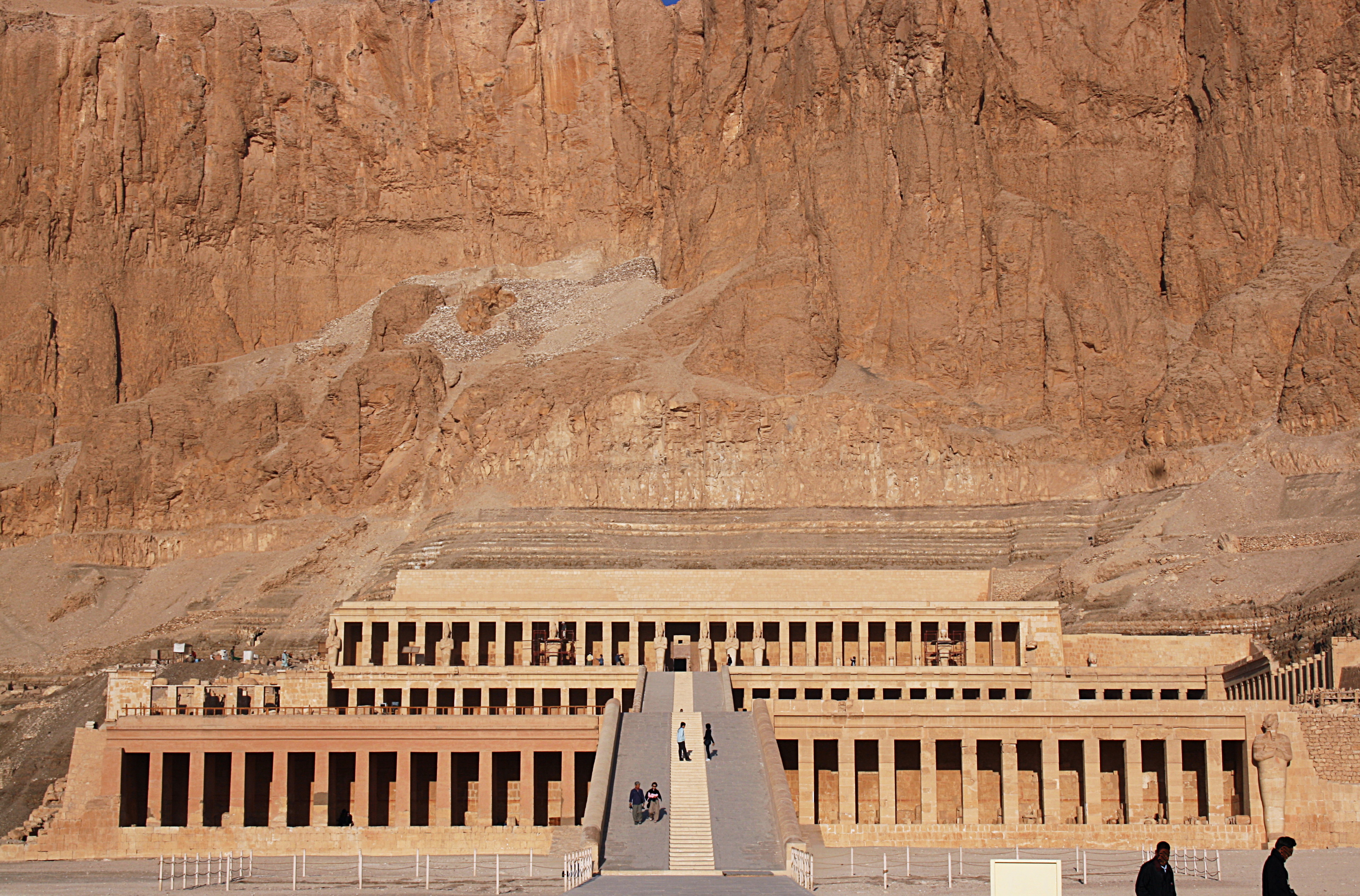
"The Beautiful" is also a mortuary temple, constructed by one of the most powerful women in history - Hatshepsut - at Deir el-Bahri. Build against the side of a huge cliff, this mortuary temple provides some truly beautiful pictures. A great ramp is leading up from ground level up to the festival court; and another one, guarded by two sphinxes, leads up to the Hathor sanctuary and statue chamber. To one side of the festival court is the sun court, and on the other side is the funerary offering chamber.
Obviously not everyone in ancient Egypt had building pyramids as their profession, there were also scribes, miners, carpenters, farmers and so on. So as a bonus point, I figured I'd tell you (briefly) about the scribe profession in ancient Egypt, because it's such an important part of all of these building projects.
Being a scribe in ancient Egypt was extremely prestigious, it was basically the most prominent profession there was. Scribes were the intellectual elite. But being a scribe in ancient Egypt didn't mean the same thing as we would think of today, it wasn't limited to writing stuff on paper (read: papyrus), there was for example such a thing as a "scribe of contours". Scribes could be priests, officials, story writers, copiers, theologians, and lots of other things. So you see how, while you asked about what the labourers built besides pyramids, I thought it a good idea to also bring up scribes.
Sources:
Arnold, D. (2009), The Monuments of Egypt.
Bard, K.A (2008), An Introduction to the Archaeology of Ancient Egypt.
Lehner, M. (1997), The Complete Pyramids.
Wente, E. (1995), "The Scribes of Ancient Egypt" in Civilizations of the Ancient Near East, 1995, vol.4, pp. 2211-2221.