I would imagine they would contract civilian blacksmiths?
If a time period needs to be provided for explanation, maybe 100 AD?
You are absolutely right that they would likely contract civilian blacksmiths, to a degree! Most of the supplies for legions were actually purchased from local suppliers, not shipped from Rome, which also helped contribute to several of the Castra (that is, the larger, permanent legionary camps) having relatively large towns spring up around them.
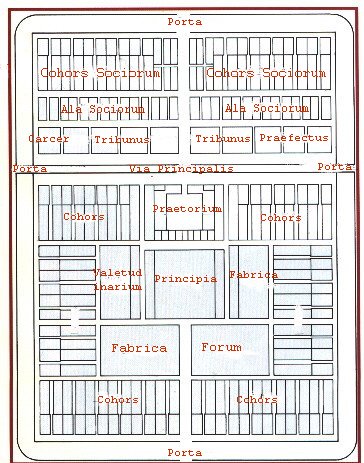
However, it is a bit more complicated than that. The Castra also contained a building called the 'Fabrica' (see this map) which was basically the workshop. Now, this workshop was both for working in metal and wood, and would have employed legion men themselves for the work. We can expect that those men who formed up part of the engineering corps would have been employed there. We also know that these Fabricas were capable of a great number of constructions, including simple things like nails, all the way up to artillery. Now, here's the rub. Certain pieces of armour, like the lorica segmentata, seem to be very complicated to make, but are actually not that hard if you break down the production process. Same goes for the mail armour. And here's where the limits of our knowledge are. Did the Fabrica manufacture armour from the ground up? Did it utilize civilian contractors to manufacture large pieces to be assembled on site (such as components of the lorica segmentata, or the rings of the lorica hamata)? Were weapons and armour basically assembled in full off site by contractors, and then 'finished' on site and repaired there when needed? All of these are possible. If I were to guess, I'd say that the most likely scenario is that civilian contractors would supply base components such as metals, even possibly smaller components such as rings, plates, and nails, while the Castras themselves would finish the products to fill their needs as they arose, and, if the needs outpaced the capabilities of the Castra, local blacksmiths would be contracted to fill the requirements. This fits the pattern used for requisition of other products used by the legions that we have a little more evidence for.
Sources:
Adrian Goldsworthy, The Complete Roman Army
M. C. Bishop & J. C. Coulston, Roman Military Equipment