Just in a museum right now and that question hit me.
North America was originally colonised at least 13, 000 years ago?
Weren't they more nomadic and tribal as opposed to a colony?
First, you seem to be getting the idea of a 'colony' muddled with other ideas concerning urbanized living. Second, there were many sedentary and semi-sedentary societies living in North America before Europeans arrived.
At 3700-years old, Poverty Point in Louisiana provides an early example. Here's a reconstruction of the site, showing the rings of houses. It's a bit outdated, as further excavation of the site has revealed even more houses beyond the rings, particularly in the vicinity of the Ballcourt Mound. The Poverty Point culture was a contemporary of the Olmecs in Mesoamerica, and built their gigantic pyramid (Mound A on that reconstruction, also known as the Bird Mound) before the Olmecs built their Great Pyramid of La Venta. Poverty Point was the epicenter of a large culture based in the lower Mississippi, and they had extensive trade contacts all the way up to the Great Lakes. Interestingly, however, despite their size, the Poverty Point Culture does not appear to have relied on agriculture to sustain itself. Though Poverty Point seems to have got by without agriculture, at this time, cultures in the mid-Mississippi and Ohio Valleys were developing their own unique agricultural systems independently from those that were developed in Mesoamerica.
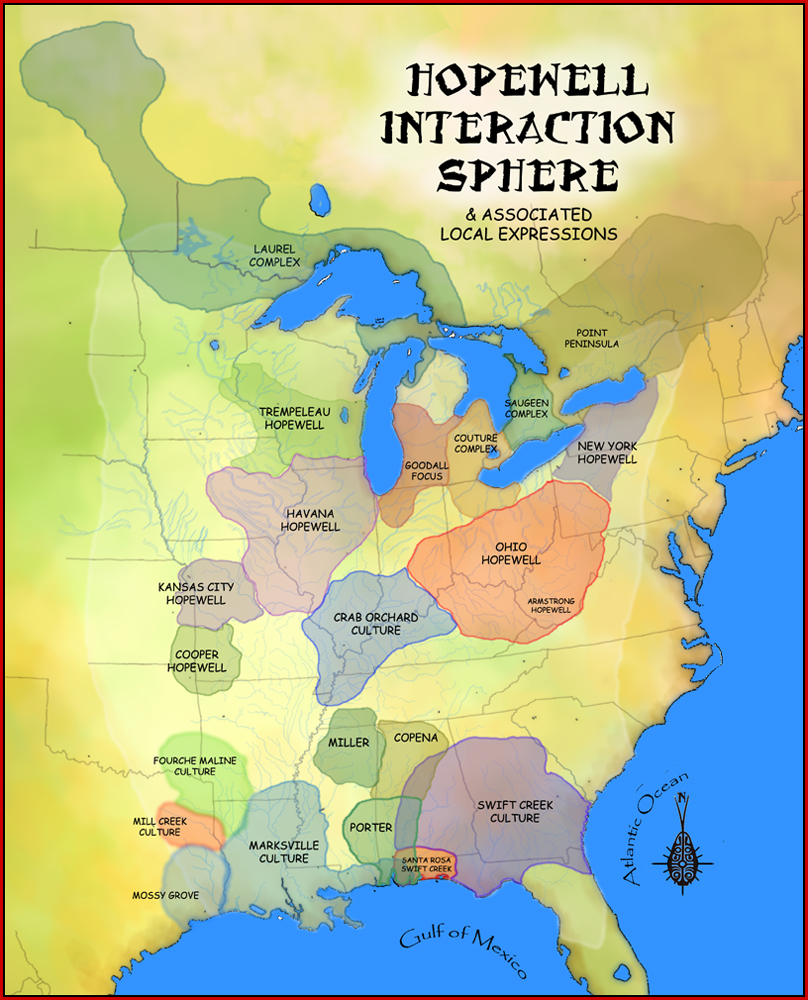
The Poverty Point culture lasted for a thousand years, after which it was "replaced" by the more insular Tchefuncte culture which in turn was "replaced" by the Marksville culture about 2100 years ago. The Marksville culture was the southernmost constituent of the vast Hopewell tradition, a collection of cultures bound together by common ceremonialism, trade networks, and a few other features. The Hopewell tradition was initially developed by the Havana Hopewell, but it really took off once the Adena got a hold of it and became the Ohio Hopewell (though some conservative Adena communities remained on the periphery of the Ohio Hopewell for a long time). The Ohio Hopewell are particularly interesting with regards to your question. Though they built monuments as large as a small modern city, they don't appear to have built cities or towns of their own. What little we know about their residential life indicates that they preferred to live in scattered homesteads, a large family or a few smaller ones farming and hunting in the local forests. Throughout the Hopewell period (~100 BCE - 500 CE), evidence for large-scale violence is absent from the region, and this Pax Hopewelliana likely allowed the Ohio Hopewell spread out and live in these rather indefensible homesteads.
But the Pax Hopewelliana would not last. Toward the end of the Hopewell period, fortified villages begin appearing, the trade networks break down, and many areas abandoned the elaborate ceremonialism that prompted the building of the Hopewell's monuments. Places on the southern periphery of the Hopewell tradition, such as Troyville in Louisiana (to give a rather skeletal reconstruction of the site) and Toltec in Arkansas (named for but unrelated to the Toltecs of Mesoamerica), now became more important in the larger scheme of things, but this was still a more insular time than the eras that preceded or followed it.
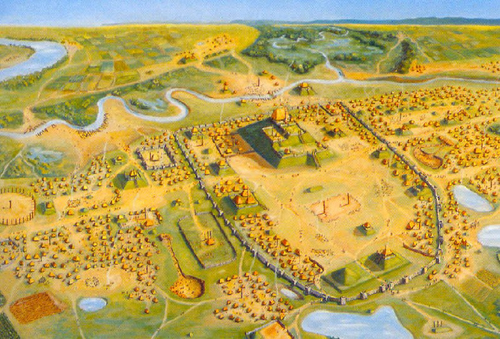
During this period, maize from Mesoamerica (by way of the Southwest) finally became a staple crop in eastern North America. It had actually been introduced hundreds of years earlier during the time of the Hopewell tradition, but remained a novelty - likely it couldn't be grown in these northern regions just yet. The people in the mid-Mississippi Valley were the earliest adopters, which led to the development of several large communities in the area during the last few centuries of the first millennium CE. By 1050, Cahokia emerged as the largest and dominant community, with its population eventually peaking somewhere above 20,000 people. Some estimates reach upwards of 50,000, but there's a lot of ambiguity over where to draw the borders of Cahokia, so some of these larger estimates often include other large neighboring sites like East St. Louis, which was connected to Cahokia via a corridor of smaller suburbs along an oxbow lake.
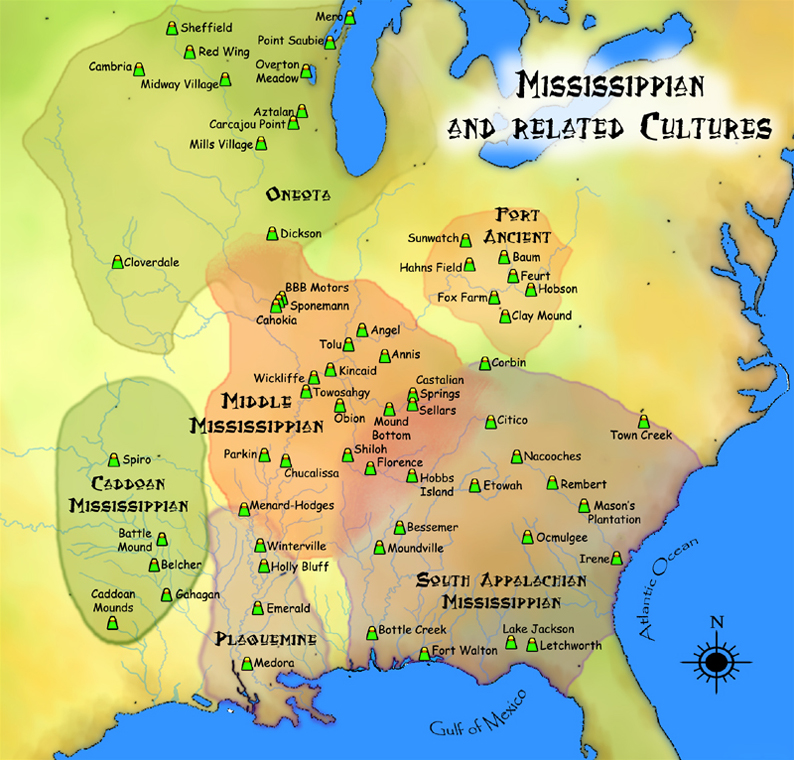
The rise of Cahokia established the Mississippian era which would persist until (and in some places after) the arrival of Europeans. Like the earlier Hopewell tradition, Mississippian traditions also covered a large area and incorporated many different cultures. Interestingly enough, there are a few proper colonies during this time, the most famous of which is Aztalan (named for but related to the legendary homeland of the Aztecs) in Wisconsin, which seems to have been established by Cahokians or other Middle-Mississippians to secure trade routes with the Oneota.
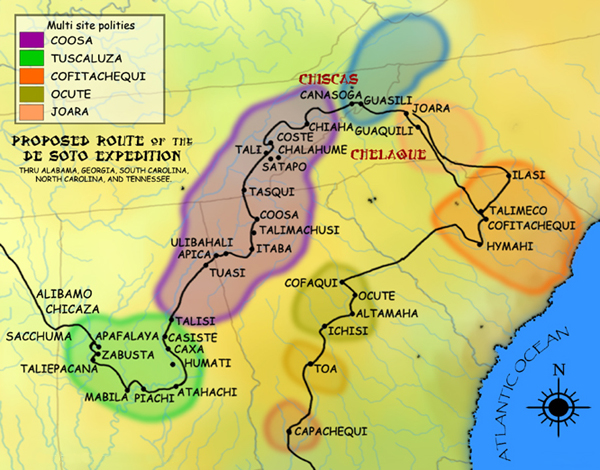
I'll point out the South Appalachian Mississippian town of Etowah in Georgia (another reconstruction for you), mainly for its name alone. It's derived from the Mvskoke word etvlwv (anglicized as "italwa"), which can be roughly translated as something akin to "city-state" in this context, though its definition can also be expanded to "nation". It refers to a dominant town and its subsidiary lands and lesser settlements in a political sense (the term for a town or city in sense of "a physical collection of houses and other buildings" is tvlofv). That Etowah was given this name is a testament to the political prestige it once maintained, but it had gone into decline by the time of European contact. Many other etvlwv flourished at this time instead. The largest of these was Coosa, which dominated the southern Appalachians, despite the fact that the tvlofv of Coosa was only modest, being home to about 5000 people when de Soto came through. For comparison, this was about twice the size or the same size of the army Tuskaluza mustered to fight de Soto at the Battle of Mabila (there's some ambiguity in the Spanish accounts of the battle over whether the 2500 figure given is for the army as a whole or the roughly half that was killed). After de Soto, a political reformation swept through the South Appalachian Mississippians. Coosa would unite with three other etvlwv - Abihka, Tuckabutche, and Coweta - to form the Four Mother Towns of the Creek Confederacy, on of the major powers in the Southeast during the 1700s and early 1800s.
The Apalachee formed another major etvlwv at the time of European contact. Its twin capitals of Anhaica and Ivitachuco were located in modern-day Tallahassee and a bit south of Monticello, FL, respectively. The entire etvlwv was packed tightly into the Tallahassee area. Despite its small geographic size, it still had a large population. When a Spanish priest visited Ivitachuco in the early 1600s to help negotiate a peace treaty between the Apalachee and the Spanish-allied Timucua, some 36,000 Apalachee were in the town (how many were visiting versus how many actually lived there is unknown, unfortunately). While the Apalachee retained many aspects of Mississippian life, they seem to have stopped building the the giant mounds when they moved they split their capital between Anhaica and Ivitachuco. But to give you an idea of what their architecture was like, here's a video of a reconstructed Apalachee council house.
I've been mainly focused on the southeast in this post, but there were also large towns in the northeast (the Wendat capital of Ossossane and the Haudenosaunee capital of Onondaga among them), with populations in the low thousands. The southwest also had large towns and small cities too, such the Great Houses built in Chaco Canyon in New Mexico (the most famous of which is Pueblo Bonito, and Paquime - the gateway between the Southwest and Mesoamerica, located just south of the modern US-Mexico border. Hopefully one of our Southwest specialists can talk about those; as for the ones in the northeast, I can say a bit more later if you (or anyone else) is interested, but for now I think this post is getting long enough.
You can find a lot of past threads discussing this on the Wiki
The first link is particularly interesting (at least to me), comparing technological advancement and covering technology in the pre-Colombus Americas in comparison to Eurasian.
Anatomically modern humans have existed for 200,000 years. Yet, within a few thousand years of each other, American Indians and Eurasians separately invented agriculture, cities, state governments, pottery, writing, bows and arrows, plaster, aqueducts, and a slew of other inventions. In my opinion, the similarities are more remarkable than the differences.