Had an interesting discussion in Askreddit about this subject: http://www.reddit.com/r/AskReddit/comments/2jbiw7/what_country_has_been_fucked_over_the_most_in/claq4f6
I contend his is German ethnically. What does Askhistorians think?
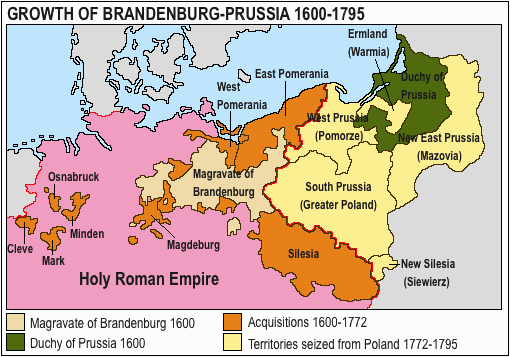
Otto von Bismark was, without a shadow of doubt, descended both genetically and culturally from ethnic German-speakers who had settled in the Altmark (see map).
The post you linked to is more than a little confused in both it's history and nomenclature.
Here's the corrected by simplified version of the term "Prussian":
There was a Balto-Slavic ethnic/linguistic group that inhabited the southeastern shores of the Baltic Sea in the Early Middle Ages. This map show the approximate extent of the "Old Prussian" tribes, as reconstructed based on a mix of historical records and tomomyns (place-names). The Old Prussians spoke a now-exctinct Baltic language that is related to modern Lithuanian and Lativan.
By the 14th century, the area in questions had somefirmly under the political control of German-speaking noblemen as part of the Baltic Crusades against the remaining pagan tribes in the region. Over the next few centuries, the Old Prussian languages would largely be displaced culturally by both German and Polish, although to what degree an actual genocides took place remains a uncertain and contentious topic.
In the late 17th century, the Margraves (de: Markgraf) of Brandenburg (aka the Electorate of Brandenburg) would accquire the territories later known as "East Prussia" and "West Prussia", which corresponds basically with a strip 20-100 miles deep that runs along the southeastern coast of the Baltic sea, and today includes bits of Poland, Russia, and Lithuania. This map makes it a bit clearer.
In the earliest year of the 18th century, because of the political circumstances surrounding the acquisition of his new easternmost territories, the ruler of Brandenburg, William III of Brandenburg, undertook to "rebrand" himself by crowning himself as "King of Prussia", and rebranding his scattered domains as the "Kingdom of Prussia".
The events of mid-18th to early 19th centuries saw the "Kingdom of Prussia" gobble up big bits of Poland, and lots of other small German states to the east and west of it, eventually growing into the Central European behemoth that would unify much of the remainder of German-speaking Europe under it's hegemony by 1871.
My main source for all of this is Cristopher Clark's masterful Iron Kingdom: The Rise and Downfall of Prussia, 1600-1947.