Everything I read about the Native American peoples of the Great Plains is centered around their way of life after Europeans brought horses-- following buffalo herds, living in tipis, and so on. However, this is obviously a very small segment of history. How did they live before horses arrived? What types of shelters did they live in, what did they do for sustenance?
Many well-known Plains tribes migrated from the Great Lakes region onto the Plains after the introduction of the horse, such as the Cheyenne, Lakota, Dakota, and Nakota. Others migrated from the midwest, such as the Osage, Quapaw, Kansas, Iowa, Ponca, and Omaha (these were all traditionally "moundbuilders" from Mississippian societies).
The tribes that were living on the Great Plains prior to European and African contact include the Mandan, Hidatsa, and Arikara of the Northern Plains. They lived in earth lodges, farmed, and traded. For navigation, they used bull boats.
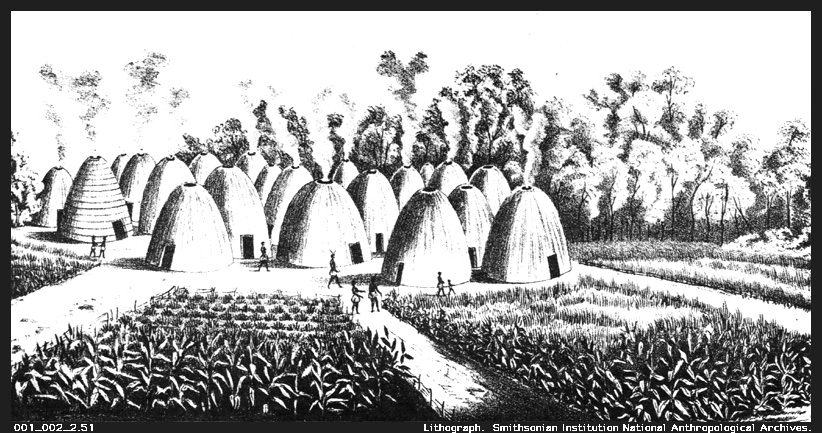
On the Southern Plains, Pawnee, Wichita, Tonkawa, and Caddo were some of the original tribes. As mentioned elsewhere, several of these tribes lived in permanent villages of grass houses.
I know it's Wikipedia, but here's a great overview of precontact agriculture on the Great Plains.
In the Oklahoma-Texas panhandle and in Kansas, some precontact cultures lived in semi-subterranean stone-lined pit-houses, and there is a good deal of cultural overlap with Southwestern tribes. The ancient Ancestral Pueblo "Basketmaker" culture also lived in Texas.
The plains aboriginals did have a very effective working animal: dogs. In terms of teepees and shelters, these animals would be the bulk of the pulling power during transits. That said, it's important to note that despite the fact that they were nomads, they weren't necessarily on the move that often. Tribes weren't going to be ranging thousands of kilometres each year. Indeed, most nomadic tribes throughout history have a relatively set territory that they transition around as seasons change. In the case of the Plains peoples, this was generally dictated by Bison movement, which also followed a relatively straightforward migratory pattern as the seasons changed.
In addition, if you are wondering "how the hell did they hunt Bison without horses?" the answer is: the same way people without horses hunt a host of things. A herd of bison is not designed to protect every individual against predators, but rather, like all herds, designed to protect the majority. One needn't chase down the entire herd, just a few stragglers. Even more impressive though was the techniques they designed for more large scale hunts. These include fencing and traps of the type that can be found around the world in hunter/gatherer type societies. One notable one is Head Smashed In Buffalo Jump (gotta love that literal naming scheme they had) where, through the use of fencing the aboriginals literally drove herds off a cliff.
So working dogs were more than sufficient for the types of movements these tribes were making. Horses added one big advantage, and that was mobility. It allowed the tribes to increase their range, and also contributed in some ways to further internecine conflicts between tribes (and eventually, more amalgamation) as ranges increased.