I've often seen Sumerian cuneiform tablets said to be humanity's first written language. I have also seen it said that the reason we know so much about it is because they inscribed their words onto clay tablets, preserving the writing into modernity. Why is this ancient Sumerian language said to be the first written language and not the oldest known written language (or what we believe to be the first)?
What is the actual historical evidence that shows that this was truly our first written language? How does this evidence preclude another, older, written language that may have been lost because the evidence was not well preserved?
I'd like to approach this from a linguistic perspective more than a historical one, since the ancient near-east is outside the purview of my historical expertise, such that it is.
Firstly, a somewhat pedantic point; the term 'cuneiform' is generally applied to the much later system of writing using wedges pressed into wet clay. This is an example of Sumerian Cuneiform, and it is actually a direct descendant of a much older syllabic or logo-graphic system, which in itself is a descendant of pictographs believed to be used in trade.
One of the reasons Sumerian is so interesting is that we actually have a fairly detailed knowledge of how the writing system developed from a non-linguistic set of symbols into a system for representing language. The earliest use of pictographs appear as lists of objects, and it is theorised these were used to record the contents of pots or bags. This image shows just such a list; the pictographs are quite easily identified. The indentations are believed to be a counting system, with the number of marks indicating the amount of a particular good.
Over time these symbols became more regular, and increasingly abstracted. By far the most important development however was the shift to using the symbols not only to represent the objects they depicted, but also the words to describe those objects. This was a very significant step, as it allowed the symbols to make the leap from pure representations of objects, to the more abstract idea of representing words, and eventually sounds. In later periods, these symbols would be used by analogy to represent words that sounded similar.
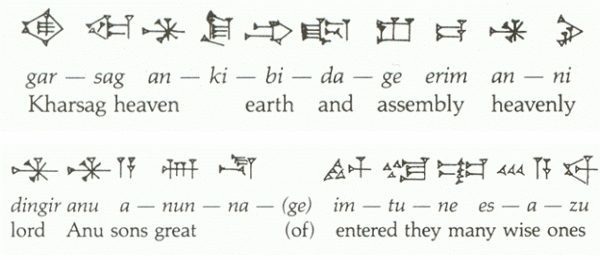
Some words would continue to be represented by their pictographs (or rather, abstracted descendants of pictographs), whilst others words would be 'spelled out' using the syllabic graphs. This gloss shows both usages, albeit using the later cuneiform graphs. The shift to cuneiform is a fairly simple change; at some point (I believe around 1500-2000 BC, but I do not have a reliable source on hand to confirm) the use of triangular styluses for writing was adopted. The distinctive 'arrow' shapes of cuneiform are simply the result of writing the abstracted graphs with these styluses.
To answer your question however, how do we know Sumerian is the first written language? Globally, we cannot be entirely certain that there were no older writing systems that have yet to be discovered, however, the fact that we have such a clear record of the derivation of Cuneiform from early symbolic roots means that we can be quite certain that no other writing system existed to influence the development of Sumerian. Whilst this doesn't preclude the possibility of earlier writing systems in use by people the Sumerians had no contact with, it does leave Sumerian as quite a strong contender for the earliest writing system.