I depends on how you define "impressive." I am an archaeologist who specializes in pre-Columbian North America, so here are a few to chew on (please note, some of these only reference Wikipedia because OP asked for superficial information rather than detailed analysis):
Clovis points - [I've chosen this because beauty is impressive.] (https://en.wikipedia.org/wiki/Clovis_point)
Hopewellian/Mississippian Copper - Once again, chosen for its beauty, and because working copper without smelting is really hardcore
Pueblo Cliff Dwellings - Like these at Mesa Verde. I don't know too much about Pueblo culture, but every time I see pictures of these, I am in awe.
Earth Ovens - (Large pits in the ground that work like giant slow cookers, using heated rocks as a thermal element. I've done a lot of research on these, so I'm a little biased.)
Earth ovens aren't glamorous, but I find them fascinating for a number or reasons. First of all, they preserve very well archaeologically. They can be very large features, and in the Edwards Plateau region of Texas, middens of fire-cracked rock can form thick lenses that represent hundred of years of site reuse. They are also very common in the Pacific Northwest. In both the Northwest and Southwest, they were likely used primarily in processing plants that were high in the complex carbohydrate inulin into the more-easily digestible fructose. Agave in the Southwest and camas in the Northwest are both these sorts of plants. They are inulin-rich and largely inedible in their raw form, but nutritious and useful foodstuffs after roasting in an earth oven for a day or two. "The Fire That Stones Carry", Thoms 2008
An earth oven can process an entire harvest at once. "Green Corn Festivals" are ethnographically documented throughout North America. Young ears of corn would be roasted in the husk in huge ovens, with enough of immediate consumption by the entire community with plenty more to put away for storage. (The Western Apache: Living With the Land Before 1950, Buskirk 1986)
Even more interesting (to me, anyway) are the agave ovens of the Southwestern US/Northern Mexican deserts. The mature century plant is a beautiful plant, and their process of cooking them in an earth oven is a fascinating process. Huge amounts of fuel and stone are used to generate a large earth oven. The leaves of the century plant are used to provide protection for the food and moisture for the bake. Then, the agave hearts are cooked for up to 48 hours. In the resource-starved desert, this processing turns vast amount of inedible plant material into an edible food. "High Dietary Intake of Prebiotic Inulin-Type Fructans from Prehistoric Chihuahuan Desert", Sobolik 2010
EDIT: Sorry about the formatting trouble, I was trying to do this on the down-low at work. Also, I tried only referencing things that weren't behind a paywall. I've got a pretty extensive ethnographic and bibliographic bibliography on earth ovens. Message me if you want more information.
EDIT 2: More formatting adjustments, added Pueblo cliff dwellings to my superficial list because they are really, really impressive.
EDIT 3: I realized I'd trailed off mid-sentence in my first paragraph about earth ovens. I finished the thought and fleshed it out.
The one that most impressed me is a chainsaw / wire saw. I'm a linguist doing language documentation, and during one session, two elders started talking about something the one's grandfather had shown him as a kid. It was a inch wide strip of seal skin about 15 feet long that had had stone teeth (not obsidian, but of the stone used for making axe heads from Nusatsum mountain) in it. When the skin was wet, slits had been cut about every two inches, and these teeth had been inserted, and the skin had then shrunk around them. According to these guys they were told it could be used to cut down trees over the course of several days. It remains for me the most impressing technology I've heard of.
that said, there are still a lot of questions and I'd love to find a hundred little stone teeth in a dig somewhere. I'd also like to know what technique was used for cutting with it - it wouldn't be that straight forward as they'd have to deal with a saw that had a wider curf than teeth unless they offset them (which is possible).
We're starting to get a real appreciation for the large-scale water works Native Americans engineered - I've personally become extremely impressed at what I've seen and read about. Some of them are truly massive and have lasted for centuries. Many of these would have been the envy of contemporary Europeans.
http://www.pbs.org/wgbh/nova/ancient/wright-inca-engineering.html
https://en.wikipedia.org/wiki/Chichen_Itza
https://www.youtube.com/watch?v=Rif4QycmfpQ#t=1718
http://www.theoldexplorer.com/index.php/maya-technology/water-management
http://www.theinnovationdiaries.com/2289/the-ancient-mayans-a-lesson-on-sustainability/
I can't find the source for it right now, but it appears also that social status was linked to proximity to the central reservoir. The further away you were from that central reservoir (and the purer water it contained), the more runoff and dirtier the water in your local reservoirs was until it was used pretty much just for agriculture.
It appears they even developed water pressure systems like fountains
http://www.sciencedaily.com/releases/2010/05/100504155421.htm
The Maya also appeared to have independently invented concrete and engineered roads that are considered superior to Roman roads.
http://gamblershouse.wordpress.com/2010/10/24/mesa-verde-water-control/
http://westernamericana2.blogspot.com/2011/07/ancestral-puebloan-people-of-mesaverde.html
This may be a little further north than you were thinking of, but a really interesting piece of technology available to the Inuit that was strictly better than European technology was cold-resistant clothing!
According to a study of Inuit clothing, Oakes et al. (1995) found that Inuit clothing at least matched the capabilities of modern industry. Compared to what was being used by military expeditions at around the time of the study Inuit clothing (i.e. the caribou and sealskin parka) was warmer when being used in a "sedentary" setting.
At the time of European arctic exploration, Inuit clothing would have certainly been much better than what the explorers would have been outfitted with. Issenman (1997) writes that:
when some explorers experienced the Arctic winter, they donned more and more layers of woolens because they did not understand the necessity to get rid of the humidity on the inside of their garb. They became colder as the cloth absorbed the moisture from the body. When their clothing froze and there was no way to dry it out, it sometimes became their shroud” (Issenman 1997:39).
Inuit clothing, on the other hand dealt with both the moisture from the body as well as from the environment. The caribou and sealskin parka uses the advantages of both animal skins. The caribou skin with its densely packed hairs that trap hair helps insulate the wearer (Meeks and Cartwright 2005:42-43). The caribou skin also deals with the problem of sweating (which will happen regardless of the environment). The explorers mentioned above were at great risk because their clothing did not adequately deal with the problem of sweating. On caribou hairs sweat freezes on the fur instead of being absorbed (Issenman 1985:104).
Sealskin would have been used either on its own for summertime clothing (Hatt and Taylor 1969:10) or in conjunction with caribou skin for water-proof winter clothing. This combination of animal skins resulted in a garment that was far superior for the arctic environment than what Europeans were producing.
If you (or anyone else) are interested, I can upload the chapter of an essay I wrote a while back about Inuit clothing production, which is where I took most of this information.
edit: spelling
Sources:
Hatt, Gudmund, and Kirsten Taylor 1969 Arctic Skin Clothing in Eurasia and America an Ethnographic Study. Arctic Anthropology 5(2):3-132.
Issenman, Betty 1985 Inuit Skin Clothing: Construction and Motifs. Etudes Inuit 9(2):101-119.
Issenman, Betty 1997 Sinews of Survival: The Living Legacy of Inuit Clothing. UBC Press
Meeks, Nigel D., and Caroline R. Cartwright 2005 Caribou and Seal Hair: Examination by Scanning Electron Microscopy. In Arctic Clothing. J.C.H. King, Birgit Pauksztat, and Robert Storrie, eds. Pp. 42-44.
Oakes, J., H. Wilkins, R. Riewe, D. Kelker, T. Forest 1995 Comparison of Traditional and Manufactured Cold Weather Ensembles. Climate Research 5(1):83-90.
I hope you don't mind my expanding "technology" to include sciences and mathematics in general (all encoded in some engineering to make the STEM-folk among us extra happy).
Let's say you want to make astronomical observations that will require a minimum of 18.6 years to complete. Let's also say you that, after you've spent nearly twenty years (at least) making careful observations of celestial motion, you want to make something to confirm your predictions. What do you do?
If you're one of the Scioto Hopewell living ~250CE, you build a monument the size of a small modern city - and juggle pi while you're at it.
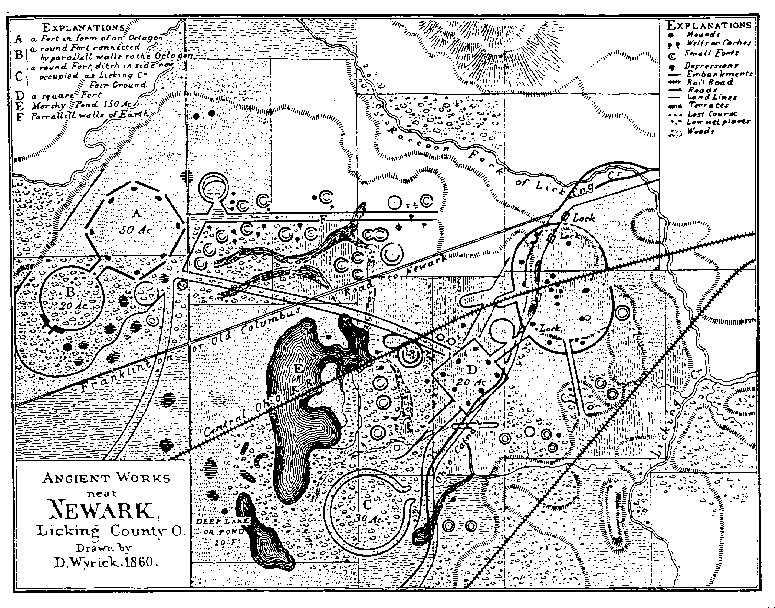
Here are two of the three surviving pieces of the Newark Earthworks - the Observatory Circle and the Octagon. Zoom in and you can see how tiny cars and homes are in comparison. The major axis of these two features points toward the northernmost rising Lunar Standstill, one of the eight standstills in a 18.6 year cycle. The other standstills appear to align with other aspects of these two features.
To add another layer to the site, the geometric relationships between the Observatory Circle, the Octagon, and other Hopewell sites in teh region reveals a standard unit of measure. To archaealogists this is known as the Observatory Circle Diameter (OCD = ~1054 ft or ~321m), though to the Hopewell the really standard unit was probably some fraction of this. Many other Scioto Hopewell sites have large circle features known as Great Circles that are 1 OCD in diameter. However, Observatory Circle isn't known as a Great Circle because at Newark, there's an even larger circular feature that gets the name Great Circle.
Now why is Newark's Great Circle bigger than all the other Great Circles? The now lost Square feature sheds some light on this. The Observatory Circle and the Square shared the same area, but the Square and Newark's Great Circle shared the same perimeter. This shows that the Hopewell understood pi.
All together, the Newark Earthworks were once the largest set of earthen enclosures in the world, covering some 3000 acres. They involved a considerable amount of astronomical and mathematical knowledge to construct, and all without the aid of writing or urban population densities to provide the labor (as far as we can tell archaeologically, the Hopewell lived in scattered homesteads of one or two families). It's an impressive work of art and science for any culture.
A similar thread was started 3 days ago about technology the Europeans adopted.
Beginning in the La Tolita culture of Ecuador (which existed between 600 BC and 200 AD) metal workers figured out how to make a gold-platinum alloy that was not duplicated by Europeans for 1500 years. Platinum has a melting point of 3000 degrees Fahrenheit (versus 1950 degrees for gold) and is very hard to work worth. By combining platinum dust with gold and then melting the gold over charcoal fires, the liquefied gold would bond with the platinum. They new molten mass could be cooled and worked into small artifacts with repeated hammering and heating. The eyes of this mask are made of this alloy, as are the central figure and outlying balls around the edge of this piece
Although the purpose of the construct was mostly ceremonial timekeeping, the Sun Dagger site, erected around the tenth century AD, of the Anasazi/Chaco civilization on Fajada Butte in northwestern New Mexico is remarkable in archeoastronomical circles for being one of the most elaborate detectors of solar (and some have argued lunar) alignments of the equinoxes and solstices outside of the more famous European and Mesoamerican assemblages such as the stone and wood henges of the UK or the temples of Chichen Itza and Teotihuacan.
Bentwood boxes from the Pacific Northwest Coast indians are an interesting piece of invention. Not only are they singularly beautiful, but the 4 walls of the box are made from single piece of wood, which is slotted, steamed then bent into a box shape. Why bend rather than cut and join? The indians didn't have metal and its possible that the bentwood joints are more more durable than the pegs that make the last joint in the box. The indians were here for thousands of years and objects like boxes were handed down. They were built to last.
Well, it all depends on your definition of impressive.
Birchbark canoes are very versatile and well suited to their primary environment, the rivers of eastern North America. The frame and skin construction of a birchbark canoe is superior to the dugout canoes found in other cultures, and there really wasn't a non-native equivalent elsewhere in the world.
Their construction might be described as simple but a skilled canoe maker could make a versatile and long lasting craft with natural materials. The craft could even be repaired in the field with commonly available natural materials (pine pitch and/or additional birch).
Sources: John McPhee wote an excellent work on canoe making by interviewing practitioners, The Survival of the Birch Bark Canoe. http://www.amazon.com/Survival-Bark-Canoe-John-McPhee/dp/0374516936
The first comprehensive western summary of the Native art of canoe making is Edwin Tappan Abbey, Bank Canoes and Skin Boats of North America. http://books.google.com/books?id=1adokGCe08oC&printsec=frontcover#v=onepage&q&f=false
Though I suppose monumental architecture is not a technological achievement, per se, I do think it worth noting in the context of this question. In my opinion, some of the most impressive material creations by Native (North) Americans were earthen mounds.
Mound-building has a long and complex history in North America, especially in the Eastern Woodlands (the region with which I am most familiar). Mound construction reached its zenith during the Mississippian period with mounds acting as the platforms for important religious and/or political structures (including residences). Before that, Native peoples that archaeologists term 'Hopewell' constructed various geometric earthworks along the Ohio River valley during the Woodland period (this is when burial mounds are most prevalent). And even before that, Native peoples were constructing monumental earthworks in SE North America over 5000 years ago (e.g., Watson Brake!).
What makes piles of dirt so special, you may ask? Well, there's many things. The scale of some earthworks (just in terms of volume) is staggering. Monk's Mound(the biggest mound in NA) at the site of Cahokia has over 622,000 cubic meters of earth. That's enough to cover all of Manhattan in 7 cm of dirt! And it was all done by hand with baskets. The scale of these constructions is impressive, but so was the engineering required to make them stand up to the elements and time. Tim Schilling has a recent article that deals with the construction Monks Mound for those interested. Even more, some earthworks, even very large ones, appear to have been constructed relatively rapidly. Sarah Sherwood and T.R. Kidder wrote a fairly recent article about the engineering required in these endeavors (see source below).
Sherwood, Sarah C. and Tristram R. Kidder 2011 The DaVincis of Dirt: Geoarchaeological Perspectives on Native American Mound Building in the Mississippi River Basin. Journal of Anthropological Archaeology 30:69-87.
One amazing piece of "technology" if I can call it that, is the incredible depth of knowledge about the local environment that intelligent people with a continuous, unbroken oral tradition going back thousands of years can acquire. One example: the Chinook indians had no trouble preserving enough calories to get themselves through the winter months but never found a way to preserve a source of vitamin C, so scurvy during winter was a problem. Amazingly, the indians knew to treat scurvy with the skunk cabbage flower (a local plant) which is the first source of vitamin C to emerge in spring. It's incredible that they were able to make connections like that.
The Chinook indians along the Columbia river developed a way to preserve salmon for multiple years. Fish was steamed, dried, pounded, mixed with fat, molded into loaves, wrapped in leaves then buried to keep cool. The loaves lasted longer than pickled fish, the longest lasting european process. (Source: Naked Against the Rain: The People of the Lower Columbia River 1770-1830, by Rick Rubin)
I had an internship Bella Bella this summer, home of the Heiltsuk people. I saw some pretty impressive technology.
http://imgur.com/gallery/sqw9j/new
My dad took pictures during the tribal journeys / qatuwas event where many coastal nations came to Bella Bella. This is an album of some of the technologies we saw that are pretty awesome
Cedar hats are completely waterproof and amazing, expensive though. The traditional method of BBQing fish is still the best. While it's not strictly technology, the music dancing and culture was extremely rich. If you like the art style a local artist made a website at travishall.ca The canoes are great by today's standards and last forever, and fish weir traps are more effective than boating, but largerly banned.
A couple there is start an ecotourism company teaching traditional knowledge of hunting and foraging. They took us out medicine gathering. Plants like the yew tree have been used forever, and it was only recently that scientists discovered that it's actually an effective treatment for some cancers.
Here's a video of medicine gathering
I don't know if this is technology, geology or field craft but the Native people around the Crowsnest Pass in Southern Alberta mined a chert deposit for flint on top of Belleview Ridge around 2000+ m ASL. The flint bearing rock is actually underground sandwiched between some layers of limestone. How they found it was always a mystery to me. They regularly climbed up there and using stone age technology extracted the flint. Somebody must have tracked flint fragments uphill to the source and then dug into the rock to find it. It does not appear on the surface. Archeologists and anthropologists have been studying the site for some time. When these guys were hunting or otherwise wandering around they were working.