Prominent figures? Numbers? Text? Animals?
Or perhaps: when coinage was introduced or implemented in your region of expertise, what were the first images to appear on those coins?
The British Museum website has this page on the origins of coinage. The earliest examples they cite are made from naturally occurring electrum, an alloy of gold and silver, located in the ancient Kingdom of Lydia in Asia Minor (Turkey) and minted in the 7th c. BC.
The Greeks adopted coinage soon after it first appeared in Lydia.
The coins were uniform in weight, but not in shape and size. The images were on one side only and included inscriptions of the names of individuals and images of animals, most likely used symbolically. For example a seal ''phoce' in Greek, may have represented the city of Phocea.
The earliest Gold coins, which are very similar to the electrum coins in their general design, have been attributed to the reign of the legendary Lydian King Croesus in the 6th c. BC, but that is not an established fact and the story may simply be due to his legendary status as a very, very rich man. Archaeological evidence associates them more closely with the later Persian rulers who ruled over Lydia.
Lydia is hailed as having been the first to mint coins in 650s-ish BC. The first Lydian coins were beanlike, stamped with a lion head and made out of electrum.
This is the evolution to the head on coins that we have now.
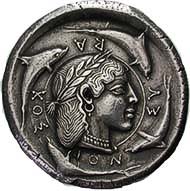
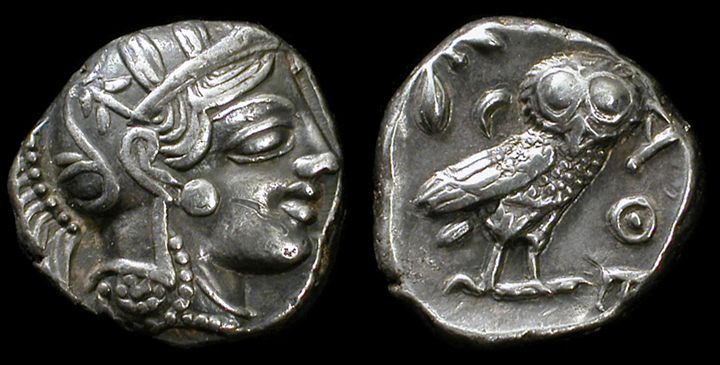
In Ancient Greece, 479 b.c. King Gelon of Syracuse issued a coin called a Demareteion with a portrait of the Demarete, it is the most notable coin to first feature a head. However other places such as Lydia had been making coins for about 200 years before but they did not depicted people, famously a lion. Another Greek coin from 440 b.c., the most renowned ancient coin, is the Athena's Owl. A silver tetradrachm with Athena's head on the obverse(front) and her sacred owl on the reverse. Many Greek coins were issued with the heads of their gods and goddess, actual people were rarely used. Even Alexander the Great did not have his image on his own coins(after his death, some coins were made with his image). In the Roman Empire, probably 99% of emperors had their head on some denomination. Augustus was on at least 20 different coins: Nero had reached at least 14. A few women would get their own coins, Cleopatra and Agrippina. Emperors female relatives such as Titus' daughter, Julia; Trajans sister Marciana and his niece Matidia. Constantine even gave his mother her own coin. Almost every Roman coin from 180 b.c. to the fall and into Byzantine had at least one side with someone's head.
TL;DR Lydia first used coins but did not have people on them, Greek coins would often have a gods head and then in the Roman Empire almost every coin had someones head.
This is kind of a combination of two of my earlier posts.
It is very well known fact that earliest coins were minted in Lydia, in 7th century BC. You may have heard some of their kings by name, like Midas or Croesus.
Coins are probably one the most important (and underrated) inventions of the mankind.
If I remember correctly, the first intance of a human face being printed on a coin happened during Ptolemy reign on the budding Ptolemaic empire. At the time, the successors were seeking ways to "legitimize" their holdings in whatever way possible. Ptolemy was the first to seize Alexander's mummified body longterm for this very goal. From my observation, it would seem this is connected to why he minted Alexander's face on his coins.