Today:
You know the drill: this is the thread for all your history-related outpourings that are not necessarily questions. Minor questions that you feel don't need or merit their own threads are welcome too. Discovered a great new book, documentary, article or blog? Has your Ph.D. application been successful? Have you made an archaeological discovery in your back yard? Did you find an anecdote about the Doge of Venice telling a joke to Michel Foucault? Tell us all about it.
As usual, moderation in this thread will be relatively non-existent -- jokes, anecdotes and light-hearted banter are welcome.
Last weekend we were in St. Louis for a wedding, so my husband suggested the morning after we go to the Cahokia Mounds, which he hadn’t seen since he was a kid, and I’d never been. So we pilfered some bananas and peanut butter from the continental breakfast on the way out of the hotel and went for a little sight-seeing. Herein follows my field trip report.
It’s kinda a strange place, because the town it’s in is pretty economically depressed, even compared to the other surrounding St. Louis towns. There was a pitiful non-neutered pit bull with pretty bad mange wandering around the biggest mound trying to find people to feed him, and it took quite a while to get anyone from the police department to come and pick him up. He didn’t look like he’d been fought but he’d definitely been dumped. We wanted to be good tourists and find some place to spend our lunch money in town but there really wasn’t much. There wasn’t much foot traffic either, like only 7 other families on the site with us. There’s also no admission fee, and that means most people do not give the suggested amount, so if you can, over-donate a bit when you go to a free museum.
The museum Sunday staff was as far as I could tell entirely retirees, who in the typical Midwestern fashion cheerfully insist that you do certain things, please sign the guest book, you really must watch the documentary, it’s only 17 minutes you know, and it exits you right in the museum. As we have both been well-trained to automatically obey the polite orders of matronly Midwestern women, before exploring the mounds we dutifully signed the guestbook, watched the documentary, and were dumped into the museum.
The museum is really worth the trip if only because it is like a perfectly preserved example of museology from 1989. Take along some poorly-behaved grade-school kids and enjoy a fully authentic 90s field trip. Like every display has those annoying little lift-up doors to read the placards, and there’s lots of push buttons that do interactive things like light-up sections on mini dioramas. I love pushing those old arcade-style buttons, I think I pushed every single one they had in the museum. The heart of the museum is a lavish life-size diorama of the ancient city. These are a little unfashionable these days but they have that nostalgia kick for me big-time, so I was kinda thrilled to see such a big one. They also creep me out with their glittery glass eyes and the feeling they’re going to turn their head at any moment and say “boo.” I don’t know, isn’t terrifying children at museums still a goal these days? Kids love fear, they seek cheap thrills all day every day. The life-size dioramas had one of a grave mound with a fake dead guy in it, as well as a more simple one just of guy in the process of gutting a headless taxidermied deer, so I thought that it was all really nightmare-inducing for the kids. Look at this child, he’s clearly shocked and appalled at what he is seeing in this diorama. He will remember this day forever. I asked my husband if he remembered he diorama from his visit as a kid, and he said yes, it was all the same, and he especially remembered “all the boobies.” There’s clearly something here for all tastes. The final scene in the museum is a life-size diorama of a 70s-era archeological dig of one of the mounds. It had two white archeologists surveying and sifting for artifacts, while a black archeologist was doing the hard work of digging on his hands and knees. A more subtly upsetting historical diorama than the headless dear.
And on to the actual mounds. The site is divided by a 4 lane road where people drive 55 miles an hour, with no over-land walkway or a crosswalk or anything. The whole site would be totally walkable except for that damn road. Most of the “good stuff” is on the other side of the road from the museum and welcome center, so you have to hop in your car and drive over. We took a look first at the recreated Woodhenge because that sounded fun. Unfortunately that is right on the edge of the historic site boundaries so it’s right next door to a really ugly construction equipment storage lot.
The heart of the site, the giant “Monk’s Mound” is of course the star of the show and rightly so, it’s really neat how far you can see, you can see the arch from up there. There’s also a little recreated sample of the stockade to the east of the mound that’s good to go look at. On the top of the Monk’s Mound we found a small circle of carefully arranged ears of seed corn, like sized for a person to sit in the middle of the circle. I don’t suppose anyone knows what that might be? I thought it might be religious so we didn’t touch it.
Anyway. If you’re in the St. Louis area and you waste your time seeing that dumb ole arch you’re an idiot, the real thing to see is the Cahokia Mounds. And I think they could use the money/foot traffic. :(
In the world of porno history, I've posted Part II in a two-part series on the cultural/technological "origins" of porno. This entry details the the economic and technological origins of the genre and the role of the printing press.
Part I detailed the 14th century cultural and philosophical origins of the genre, and can be found here.
I'm also free to answer any questions or flattery that you might want to direct my way ;)
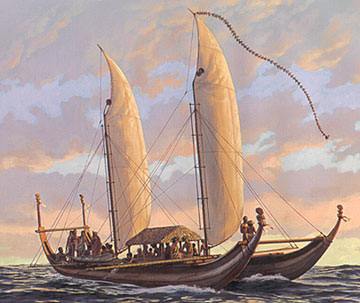
An interesting bit of terminology I have noticed is that when I look at Oceanic studies, all of the ocean going vessels are referred to as a "canoe". Even the Polynesian Voyaging Society refers to the Hokulea as a "canoe" and I am not exactly in a position to correct them. But when I hear the phrase "war canoe" I generally picture something like this (from Papua New Guinea) and not like this. Now I know why "canoe" is used, but it seems to me that the term has a lot of baggage, evoking small, primitive craft rather than the extremely sophisticated and elaborate Polynesian vessels. It is probably part of the reason why you get such ridiculous myths about the Polynesians--would people be so shocked that Polynesians made such voyages in canoes if they knew the canoes look like this?
Not much of a point, but I am wondering if anyone is familiar with any debate around this, or similar ones (I suppose "raft" in Native American studies).
I had a little piece about one of the First World War's more interesting propaganda collaborations up at Slate earlier this week, and I've been pleased by the reception it's received, for the most part. It's certainly an interesting contrast to Reddit.
If any one is interested in contemporary U.S. public opinion, I explained how to use the web interface of the General Social Survey, a nationally representative survey of Americans administered annually or biannually since 1972, in this thread.
One of the striking things, as you play around with this, is how stable many opinions have been in the past forty years. Some, however, especially around race and gender, have changed dramatically. A good one to look at is the answer to the question:
Do you agree or disagree with each statement: b. White people have a right to keep (negroes/blacks/African-Americans) out of their neighborhoods if they want to, and (negroes/blacks/African-Americans) should respect that right.
This is variable RACSEG. So enter RACSEG in the row, and YEAR in the column, and look how in 70's almost 40% of people strongly or slightly agreed with that statement on a four point scale. Only about 30-35% strongly disagreed with it. By the 90's, when they stopped asking this and a lot of other similar race questions (presumably because a national consensus had clearly developed), only 10-15% strongly or slightly agreed with that statement, and now 60-70% strongly disagreed with it. [I chose this question as an example specifically because it was last asked in '96; please don't break the twenty year rule].
I linked to it in the post above, but for a brief history of the General Social Survey, see this short article (the survey is done out of NORC at the University of Chicago, so the history is from the Chicago alumni magazine), which highlights some changes in opinion over the years, like increased acceptance of homosexuality even as views on other forms of sex remain stable and no increase about civil liberties for racist even as their is increased support for other controversial groups' civil liberties. The surveyors, now that this has gone on for forty years especially, take a longer view of their work, and hope to measure what look like small year to year change as they turn into larger decade to decade changes:
“If 200 years from now it was continuing, think what you could go back and trace. What if we’d had one like this during the time of the Civil War, or the Depression?"
I'm looking for primary sources on the life of Mochizuki Chiyome (sometimes called Chiyojo), a famous female ninja/kunoichi. Google has availed me nothing in this regard. Does anyone have any ideas? If I can just find an originating document, like the Heike Monogatari or Tale of Genji, I can track down a translation -- but I have no idea where her story originates, or if it's a purely oral tradition.
So I'm teaching a Greek & Roman Civ survey course this term. The first half was great, since I'm a Hellenist, but now we're starting on Rome and I haven't even thought about the Roman Republic in about 10 years. This is terrifying.
Hi all. I have a question that isn't worth a thread. It's for Chinese or general Asian experts, especially on weapons.
To keep context short, my friend and I are working on costumes from a game that has some historical basis - Ragnarok Online; the costumes are from the jiangshi type monsters, Bongun and Munak. My friend has narrowed down the most likely historical basis to the late Song and early Qing dynasty, although this does not mean knowledge of other dynasties or countries couldn't be useful. I'm wondering if there is any historical basis for Munak's sword, The Punisher . Please let me know if that link doesn't work, the site doesn't like mobile it seems but I know I've used it for years. Here is another.
To me the sword looks ridiculous and like no other Chinese or Korean sword I've been able to find. I say Chinese and Korean because those are the two most likely cultures developers have drawn from for the area these monsters are found in; in no way did the team ever put historical accuracy first though, things have been used from all over Asia.
Basically I'd like to know if this weapon, supposedly used to beat kids with, has any historical basis or if the development team just had their fun. We are trying to keep our costumes somewhat accurate and would enjoy knowing any techniques or purposes this thing had. For what it's worth the other monster's weapon is a simple sword.
Please let me know if I can clarify in any way. I'm writing this on mobile and I know it's all a bit ridiculous.
Edit: Just wanted to add that it might not even be a sword at all. My out of left field guess is it's something like a futon beater repurposed? This is based on the "hoop" in the ingame sprite being flat. Still, any knowledge or guesses on this is welcome.
i was posting in a thread in debate religion and i'd like to see what you guys think about this guy's post about islam. http://www.reddit.com/r/DebateReligion/comments/2k0baa/islam_vs_christianity_the_closest_apples_to/?sort=new i asked him what the reason for the initial expansion and this is his response http://www.reddit.com/r/DebateReligion/comments/2k0baa/islam_vs_christianity_the_closest_apples_to/clhsd0i?context=3 My history class is getting into islam and the rise of the the muslim empires so i'm really wondering if my history book is bs or if this guy is bs. i know there is always a bias and obviously the dude is muslim so he is obviously biased but that doesnt necessarily mean he is wrong.
Hello, I don't want to start my own thread for this minor question re: a post from another subreddit. I originally posted a submission to AskHistory but they sent me here. Please be warned that the item may or may not be SFW. It is a a round table with phallus' , breasts, and small mouldings of women holding their knees to their chest... you mostly see her legs and pelvis. Picture if you CAN look
This was posted to /r/WTF. Link and probably NSFW too
Rather than believe rumour as fact, I have a hunch this table probably came from a brothel rather than belong to Catherine the Great. What do you guys say?
I don't believe that this is anything more than furniture from a whorehouse. I have heard (and seen from a few documentaries) this stuff was rather common even in Rome so that's my guess but I have no way of really find out fact without getting either redirected by porn links or irrelevant information. Does anyone have a better idea of where this came from or who it actually belonged to?
EDIT: I realise this table is probably not actually Roman, but I was merely comparing it to the items that did come from Roman brothels.
I apologise for the NSFW nature of my question, I was just genuinely curious about this item.
To Ph.d or not to Ph.d...
Does anyone know where I can find plain text transcriptions of any first/rough/non-final drafts of the United States Constitution? I've been searching on and off for months, but have come up empty. Best I can find are low resolution images of said documents, and I admit I can't read them with any sort of fidelity (flowery 18th century writing, blah).
I have access to a university library, and I'm willing to hand-type out transcriptions if they can be found in dead tree books.
So this was (rightfully) removed, but I thought it would be interesting to get answers here nonetheless. Note I don't want anyone to construe this as somehow hostile, considering most here are academics, it's just a question of interest.
What have been the most egregious examples of dishonesty or retrospectively incorrect positions entering the scholarly consensus in the history of academia?
There's a common perception among many laymen that academics of particular fields are often reliably off the mark. Stock traders like William O'Neil make it a point to bash academic analysis of the market in favor of his own methods (and his success lends people to agree with him). I'm not talking about the rational conclusions people draw when they have a lack of information, I'm talking about either when bias or faulty thinking seeps its way into the professional literature.
What have been the somewhat embarrassing missteps in the history of academic thought?
Hi everyone!
I've been thoroughly enjoying this subreddit for awhile. It's great to find a place on reddit with serious, researched responses, and I've been learning a lot.
I've particularly had my interest piqued in Chinese history. Unfortunately, I didn't learn much Eastern history in my high school and college studies (I was a Latin American Studies major). I was wondering if any of you could recommend a book or two that would give me a decent background on the history of China. I know it's long and China is huge, but I literally know almost nothing about it and really want to at least have some basic understanding.
I'm also pretty new to reading nonfiction for fun, so something on the lighter side might be nice, but not necessary.
Thanks!
What was the culture of slavery like during the Byzantine empire? Was a large segment of the population slaves, like they were under the Roman Empire? Did christianity affect the perception and practice of slavery in Byzantium?
Hardly a big deal, but I found an amazing, really cheap bookstore near where I live. Not only do they have cheap books, they have a huge selection. So today, for half of what it'd cost elsewhere, I got Israel and the Bomb, one book I had been unable to find for cheap anywhere else, and which is really fascinating.
So happy!
I recently discovered the book Blue Latitudes that follows Captain Cook's voyage throughout the Pacific! very interesting, telling you both about precolonial life in the pacific, the cultures of the people, naval life during the time and much, much more!
As well as that, during my countless researches into West African civilizations (I am currently studying the Mali empire) I discovered Shell currency and how shells would be imported into Western Africa, sold inland and would be collected by the higher ups and used as a form of trade and currency (among other things). another interesting tidbit!
Just wanted to share some of my discoveries!
In RPGs, it is common for the townsfolk to ask you to go on fetch quest, delivery quest, and rescuing people as soon as you, a stranger enter town. Even if you are a hero it seems weird. Did people really do this? Did this ever happen or are games trying to make the world feel alive?
I have not looked into one of these threads before. May I post a meta-comment?
Do other people see some of the questions here and wonder "Why not JFGI!!!"? (J: Just; G: Google; I: It)