For a major Hollywood production, it does a fairly good job. Major kudos to Martin Scorsese (a native New Yorker), his team and the movie's writers. They did a lot of research and included some great, mostly accurate portrayals (e.g. Hell-Cat Maggie, who did actually have a jar with pickled ears in it) and historic references (some of the scenes were deliberately reminiscent of Jacob Riis, whose monumental "How the Other Half Lives" would document the nearby area in the 1880s). When mentioning gangs, they included the names of real gangs that fought in and around the Five Points, and they were sure to underscore that the area held many brothels (although many of them were being shuttered by religious organizations such as the Five Points Mission, who had shuttered and demolished the Old Brewery to build their mission house). One of the things they tried to do is give an idea of how filthy the area (and most of the city) was, but I think this was something they actually held back on. After all, residents of poor areas were used to knee-high mud, rotten garbage and the corpses of dead animals in various states of composition; area tenements often had open outhouses in the back, which overflowed when it rained, creating a thick sludge of refuse and excrement that coated the streets (ick).
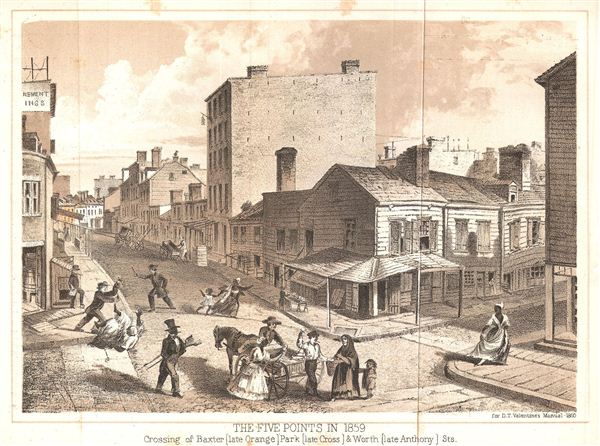
I happen to like their portrayal of Paradise Square (or, as it was known later, Paradise Park); the wooden fence replicates one seen in the drawing of the Old Brewery (linked above). In the background of some scenes, you can make out well-known characters such as the Hot Corn girl (also known as a G'hal, compared to the Bowery B'hoys), which is a great touch. The set design was done well, and references actual sketches and views; compare this set (Paradise Square in the middle) to this 1859 view. Another thing that they did well was the portrayal of voter fraud and how certain groups (such as the Irish) voted in large blocs, with many people voting multiple times. In some shots, you can clearly see large outcroppings of rock; as the area was built on top of the poorly filled-in Collect Pond, there weren't rock outcroppings so I think this is a nod to the infamous tenements of Hell's Kitchen (as seen here).
That said, they left quite a bit about the city's history out and condensed certain events or changed the dates of them. For example, the Old Brewery was demolished in 1852, William "Butcher Bill" Poole was murdered in 1855 and P.T. Barnum's museum burned down in 1865. They didn't directly deal with the city's copperhead (pro-Confederate) sympathies (the city was a major hotbed for Confederate spies), but they worked in the tumultuous relationship between different races and classes. They didn't get too much into local politics beyond Tweed (who had recently become Grand Satchem of Tammany Hall and provided a rallying point for Irish rioters) but obviously there's only so much they can include.
The fighting between the gangs was definitely bloody, but the movie seems to focus on it too much. While the elites of the city did go on slum tours and decried the area's violence, the Five Points was not as openly violent as they make it seem; a lot of the violence was behind drafty tenement doors and in windowless basements, not in the streets. That said, both the Dead Rabbits Riot (1857 in real life, where over a thousand people joined in the melee; this seems to be the inspiration for the 1846 fight, when young Amsterdam's father is killed) and the Draft Riots were brutal. The Draft Riots saw mobs of thousands coursing through the streets, lynching blacks (eleven in total), looting, destroying property and setting fires to targeted buildings (including an Orphan's Asylum). The police (many of whom were part of a policeman's riot in 1857) were outnumbered and unable to disperse the mob (if they weren't rioting themselves) and the firemen (most of whom were part of a gang, or formed a gang themselves) fought each other over fires; this was all portrayed nicely in the movie.
Overall, I thought the movie did a good job of putting the story in context. It isn't perfect, but it definitely has generated interest in New York City history, which is always great.
Thanks for the gold!
Are you asking about the movie or Herbert Asbury's 1928 book of the same name? Assuming you are asking about the movie, you should know that while it is loosely based on Asbury's work, it takes a lot of liberties. Probably the biggest difference between the two --leaving aside the many aspects that were completely invented for the screenplay-- is the fact that the movie is a single narrative story that's constructed with a coherent plot while the book is a work of journalism that Asbury put together through interviews and archival research. As such, the original work doesn't really follow a storyline or plot at all.
Some people have accused Asbury of stretching the truth a bit in order to sell his writing, but if that is so, I haven't seen any convincing evidence of it and it is worth noting that he worked with and wrote for no less a luminary than H.L. Mencken himself.
As for your question, I am not qualified to answer it, I just thought it would be worthwhile to make it clear whether you are asking about the book or the movie since they are so very different.
A wonderful read on the same time period and location (five points ) is Kevin Baker's Paradise Alley. He concentrates on the Irish and Blacks, with flashbacks to the famine and a truly horrifying description of the draft riots.