It is debateable to what extent swords were ever used as the primary weapon of battle. For many centuries swords were the primary sidearm of the aristocracy, but that is a very different thing than being the primary weapon of warfare.
For instance, under the Greeks, the hoplite spear was the primary weapon, while the hoplite sword was a secondary weapon used only if the phalanx broke down. The Romans adopted similar methods in the early Republic, but had to increase the proportion of swordsmen when fighting the Celts. By the time the Roman defeated the Macedonians, swordsmen had become the dominant unit of the Roman army. Polybius described the legion of 150 BC as being a little over half swordsmen, and one seventh spearmen.
The dominance of swords in Roman military doctrine continued through to the Empire. This era is the only significant period in Western history where swords were arguably the primary weapon of battle for one side, and the Romans vs Celts (c. 340 BC) one of the few cases were it may have been true for both sides (barring Roman civil wars, of course.) By the late Empire, mercenary soldiers with their own weapons were taking over Roman armies and the sword thereafter went into decline as a legionary weapon. That would suggest one of the Roman civil wars of the Middle or Late Empire as the last (western) battle dominated by swords.
The Germanic tribes that pressed on the borders of the late empire favoured axes and spears, and this style of soldier dominated Europe after the fall of Rome, and throughout the early middle ages. By the late middle ages, the tight spear formation was returning in the form of the pike, which dominated Renaissance battlefields, eventually being replaced by the bayonet. So the sword never regained the battlefield significance it had under the Romans.
Swords remained significant as a personal sidearm for much longer, of course. But they were comparatively expensive, especially as they grew longer, and so their significance was more as a weapon of status than a weapon for the common soldier. By the time steel smelting and industry allowed for the production of cheap swords that could outfit an army, guns had already taken over, and the swords were manufactured instead as bayonet blades.
Source: Swords and Hilt Weapons, Greece and Rome, Peter Connolly
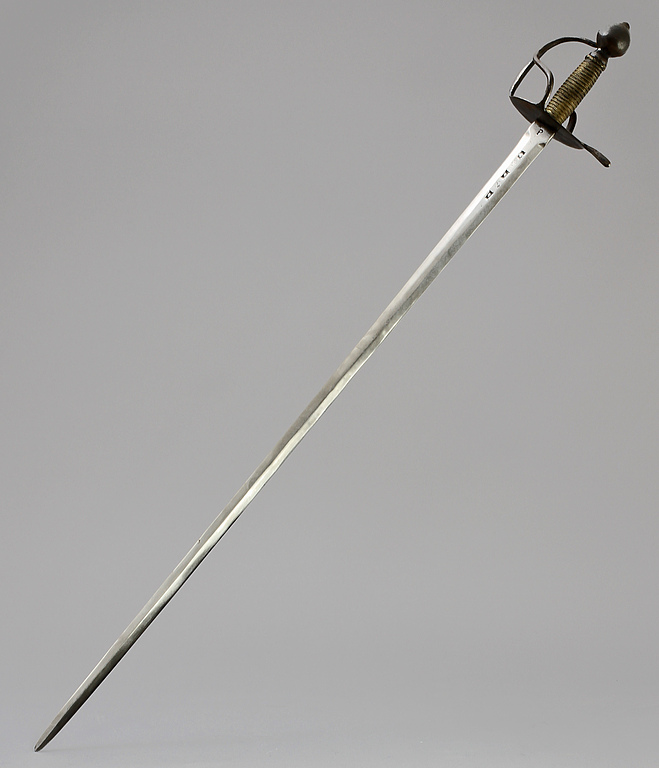
I don't know wether it would count as a primary weapon, but Swedish soldiers in the Great Nordic War were all equipped with a Värja m/1685 (Rapier m/1685). The pikemen were instructed to drop their pikes and use their rapiers after the initial charge.
At the Battle of Helsingborg 1710, the Danish infantry are described as being "tumbled over" by the Swedish pikemen.