Is there a margin of error for using the surrounding findings to date all forms stone tools?
You've got the right idea. The way archaeologists date stone tools and the like is through their context. So, for example, if a stone tool is found in situ with something organic like charcoal or bone, it can be carbon dated. The margin of error can be as tight as 30-50 years, though 100+ is not unheard of.
We also use stylistic differences to help us get approximate dates. This is called seriation. When you get enough of a particular artifact from a particular context, you can get a good median age for that style.
Judgement is necessary. Dating organic materials from the layer/vicinity a stone artifact is found is the best way to get a good idea, however, it is far from exact. This can only tell us when the object was buried, not necessarily when it was first constructed. This is often why stone artifacts have much larger date ranges than other artifacts. On the other hand, you can generally safely assume that it is no younger than the date of surrounding organic materials, which is something at least.
I studied archaeology, and was specialised in prehistory, so that's largely my domain.
Anyway, many people answered correctly. Most of the time, stone tools can be dated within their context. If you can date other things like charcoal within the same strata, you got the approximate date of the tool.
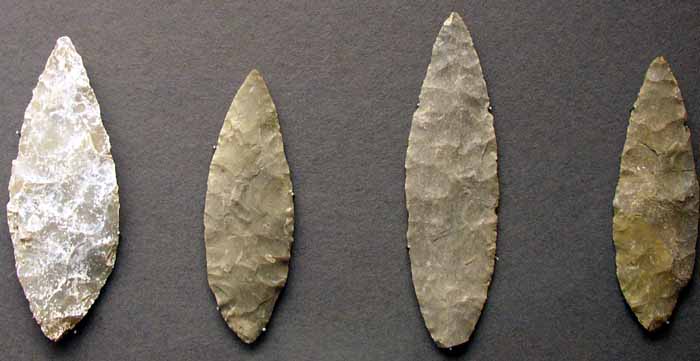
Another good dating system is to recognise the caracteristic tools corresponding to a culture. For example, we know the Solutrean culture existed around 20,000 BP, because we could date some strata on other countless sites. So if we find a characteristic tool somewhere, like a "feuille de Laurier" (sorry, don't know what it's called in English), which is absolutely typical of the Solutrean culture, we know we're dealing with a Solutrean site and that it's around 20,000 BP.
We know pretty much all the characteristic tools for every prehistoric culture in Europe, and when and approximately where they existed. So it's really not difficult, in the same way that a specialist may be able to date a ancient Greek ceramic pot just by looking at the art style and shape of it.
In many places in France one can find stone tools on the ground. Usually after a farmer has ploughed his field. So there the stone tools were taken out of context, and it's more difficult to date each individual stone. If one finds a big biface ("hand axe"), he can consider that particular tool is probably Mousterian, and thus grossly between 300,000 to 40,000 years old. However, if you only find flakes with no particular detail, you can't really conclude anything. Now if you find tons of flakes and some tools, and you recognise the tools belonging to a particular culture, you could conclude that the flakes are from the same culture as the other tools, but you still can't say it for sure. Most of these ploughed fields were inhabited for millennia by different groups throughout time, so in reality you'll likely find tools from many different cultures, and you can only date the characteristic tools.
Obsidian can be dated via Obsidian hydration dating. Obsidian tools and flakes develop a 'rind' at a known rate over time, and measuring that rind can give you a date. This only works with obsidian, and there is no similar technique for other rock types.
Side note, but I have met at least one archaeologist who thinks this technique is not the most reliable dating method. C14 dating, context, and seriation are more commonly used.
There are a lot of good points made in the postings so far. I'll just add that C14 would certainly not be the only option to put an age on such an object, and that establishing an age would probably come indirectly, through dating the sediments found over the object.
Other potentially usefull methods could be:
Palynology (relative)
Note that pretty much all of the above depend on the object beeing found in situ and properly contextualised.
As an aside, C14 would be a terrible way of dating most rock types. More appropriate methods would be U-Pb on zircon or K-Ar. C14 is best for organic remains less than about 1/2 My old (shells, wood, and like that)...
As a second aside, there is a whole wide field of historical material caracterisation where dating the actual rock a specific artifact was made of would still be relevant. For instance, in trying to identify the source of rhyolite arrowheads to trace out ancient trade routes and migration patterns.